
Integral vs Peripheral Membrane Proteins — Classification by Ease of Extraction
📚 Practice ConceptDepending on the ease of extraction, membrane proteins can be classified as integral and peripheral. Peripheral proteins lie on the surface of membrane while the integral proteins are partially or totally buried in the membrane.
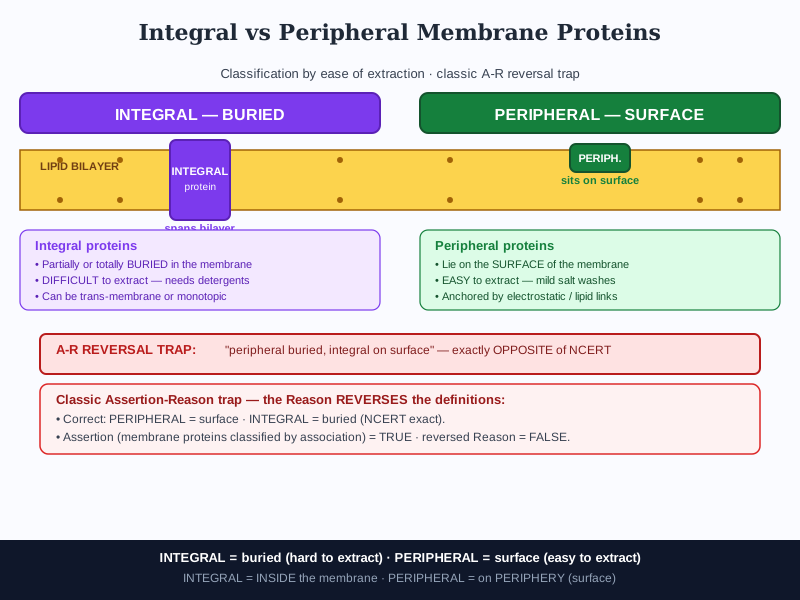
Peripheral proteins are partially or totally buried in the membrane while integral proteins lie on the surface.
Integral proteins are partially or totally BURIED in the membrane. Peripheral proteins lie on the SURFACE of the membrane.
INTEGRAL = INSIDE the membrane (buried, hard to extract). PERIPHERAL = on PERIPHERY (surface, easy to extract).
- Classification basis: ease of EXTRACTION from the membrane (NCERT exact).
- Integral proteins: partially or totally BURIED in the bilayer — difficult to extract.
- Peripheral proteins: lie on the SURFACE of the membrane — easily extracted.
- Common A-R trap: NTA reverses the definitions — students who don't memorise exact wording fall for it.
Consider the following statements about membrane proteins: S1: Membrane proteins are classified as integral and peripheral based on the ease of extraction. S2: Peripheral proteins are partially or totally buried within the membrane. S3: Integral proteins lie on the surface of the membrane. S4: Integral proteins are partially or totally buried in the membrane. S5: Peripheral proteins lie on the surface of the membrane and can be extracted with mild treatments.
View bonus solution & explanation
Correct answer: B — S1, S4 and S5
S1 CORRECT: NCERT classifies based on ease of extraction. S2 WRONG: Peripheral proteins lie on the SURFACE (not buried) — common A-R reversal trap. S3 WRONG: Integral proteins are BURIED (not on surface). S4 CORRECT: Integral proteins are partially or totally buried. S5 CORRECT: Peripheral proteins lie on the surface and are easily extracted. The whole concept is a definition-swap trap: don't read the words 'buried' and 'surface' the wrong way around.
What is Integral vs Peripheral Membrane Proteins?
What did NEET previous years ask on Integral vs Peripheral Membrane Proteins?
What is the most common NEET trap on Integral vs Peripheral Membrane Proteins?
How do you remember Integral vs Peripheral Membrane Proteins for NEET?
What are the key components of Integral vs Peripheral Membrane Proteins?
Through deep analysis of NEET and NTA, 176 of the 180 ReNEET 2026 (June 21) questions were already in the MedicNEET question bank before the exam.
176/180MedicNEET's Biology question bank is built from the same NCERT lines NTA picks repeatedly. Not random MCQs — questions crafted exactly like NTA crafts them.
You just learned this concept. The free app turns it into a daily goal built from your weak topics and brings it back just before you forget it — using active recall and spaced repetition — so it stays till exam day.