
Golgi Apparatus — Cis Face (Convex) vs Trans Face (Concave)
✅ Asked in NEET 2024Given below are two statements: Statement I: The Golgi cisternae are concentrically arranged near the nucleus with distinct convex cis or the forming face and concave trans or the maturing face. Statement II: The cis and trans faces of the organelle are identical and interconnected. Choose the correct answer: NEET 2024
Given below are two statements: Statement I: The Golgi cisternae are concentrically arranged near the nucleus with distinct convex cis or the forming face and concave trans or the maturing face. Statement II: The cis and trans faces of the organelle are identical and interconnected. Choose the correct answer: NEET 2024
Answer & NCERT explanation
Correct answer: C — Statement I is True but Statement II is False
Statement I is true - Golgi cisternae are arranged concentrically near nucleus with convex cis face (forming face) and concave trans face (maturing face) as per NCERT. Statement II is false because cis and trans faces are NOT identical - they have different functions and protein compositions. Cis face receives materials while trans face ships them out.
Read more NCERT concept on the PYQ
The cis and the trans faces of the organelle are entirely different, but interconnected.
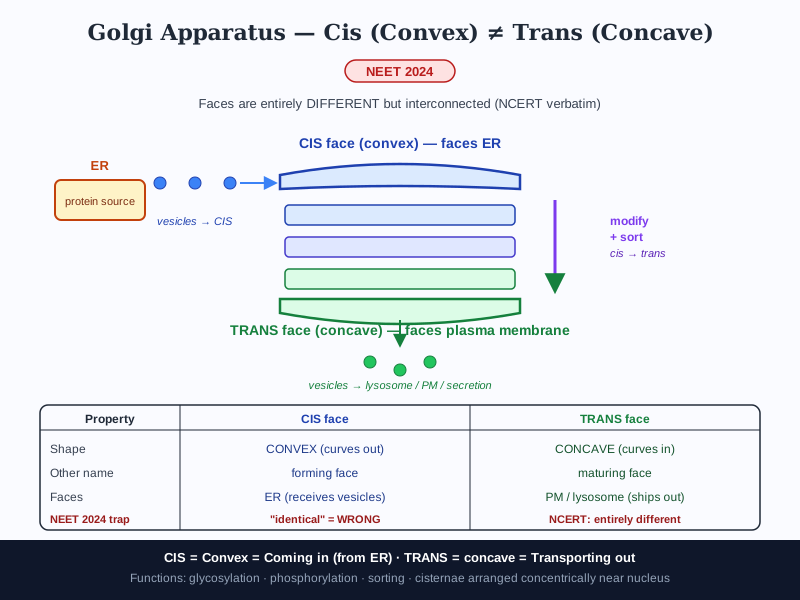
The Golgi apparatus consists of flattened membrane-bound cisternae arranged concentrically near the nucleus. It has two distinct faces: the cis face (also called the forming face) is convex and faces the endoplasmic reticulum — it receives vesicles from the ER. The trans face (also called the maturing face) is concave and faces the plasma membrane — it ships modified vesicles to lysosomes, plasma membrane, or secretion. The cis and trans faces are entirely different in function and protein composition but interconnected through the cisternae. NEET 2024 tested this as a statement-statement question: Statement I (cisternae arrangement, cis=convex, trans=concave) is TRUE; Statement II (cis and trans are identical) is FALSE.
NCERT's exact words: 'The cis and the trans faces of the organelle are entirely different, but interconnected.' Statement II in NEET 2024 said they are 'identical' — this is precisely what NCERT says they are NOT. The Golgi functions as a processing and sorting centre: proteins from the ER enter at the cis face, are modified by enzymes in each cisterna as they pass through, and exit at the trans face packaged into vesicles for their destinations. This directional flow is fundamental to cell secretion.
The cis and trans faces of the Golgi are identical in structure and function (Statement II NEET 2024).
Cis and trans faces are ENTIRELY DIFFERENT (not identical) but interconnected. NCERT exact: 'entirely different, but interconnected'.
CIS = Convex = Coming in (from ER). TRANS = concave = Transporting out. Different direction = different face.
- Golgi cisternae arranged concentrically near the nucleus — NCERT explicit (Statement I NEET 2024).
- Cis face = convex = forming face (receives from ER). Trans face = concave = maturing face (ships out).
- NCERT exact: 'The cis and the trans faces of the organelle are entirely different, but interconnected.'
- Golgi functions: glycosylation, phosphorylation, and sorting of proteins from ER to final destinations.
What is Golgi Apparatus?
What did NEET 2024 ask on Golgi Apparatus?
What is the most common NEET trap on Golgi Apparatus?
How do you remember Golgi Apparatus for NEET?
What are the key components of Golgi Apparatus?
Through deep analysis of NEET and NTA, 176 of the 180 ReNEET 2026 (June 21) questions were already in the MedicNEET question bank before the exam.
176/180MedicNEET's Biology question bank is built from the same NCERT lines NTA picks repeatedly. Not random MCQs — questions crafted exactly like NTA crafts them.
You just learned this concept. The free app turns it into a daily goal built from your weak topics and brings it back just before you forget it — using active recall and spaced repetition — so it stays till exam day.