
Nuclear Envelope — Double Membrane, Perinuclear Space, Nuclear Pores for RNA/Protein Transit
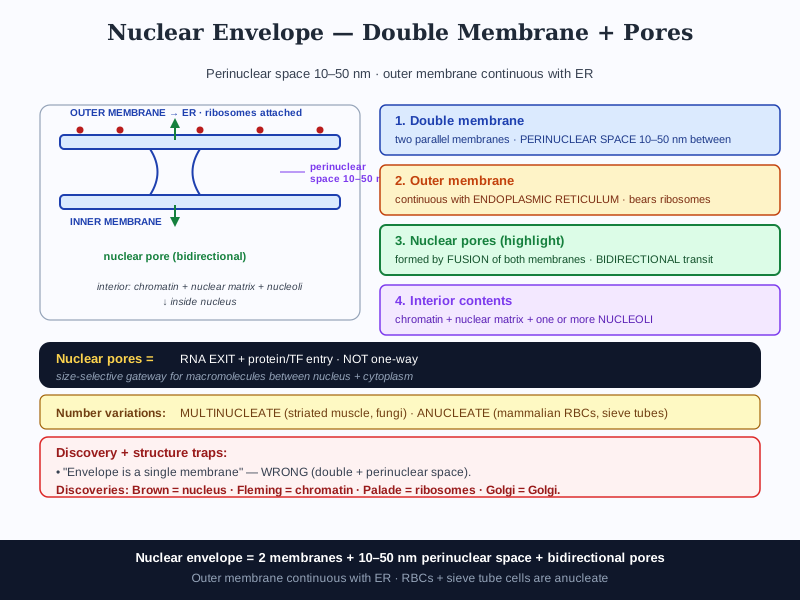
🔥 Predicted for NEET 2027The interphase nucleus (nucleus of a cell when it is not dividing) has highly extended and elaborate nucleoprotein fibres called chromatin, nuclear matrix and one or more spherical bodies called nucleoli (sing.: nucleolus). Electron microscopy has revealed that the nuclear envelope, which consists of two parallel membranes with a space between (10 to 50 nm) called the perinuclear space, forms a barrier between the materials present inside the nucleus and that of the cytoplasm. The outer membrane usually remains continuous with the endoplasmic reticulum and also bears ribosomes on it. At a number of places the nuclear envelope is interrupted by minute pores, which are formed by the fusion of its two membranes. These nuclear pores are the passages through which movement of RNA and protein molecules takes place in both directions between the nucleus and the cytoplasm. Normally, there is only one nucleus per cell, variations in the number of nuclei are also frequently observed. Can you recollect names of organisms that have more than one nucleus per cell? Some mature cells even lack nucleus, e.g., erythrocytes of many mammals and sieve tube cells of vascular plants. Would you consider these cells as 'living'?
Adjacent to a frequently-asked paragraph in the same chapter.
Three NEET-yield facts: (1) Perinuclear space = 10-50 nm. (2) Outer nuclear membrane is continuous with ER and bears ribosomes. (3) Nuclear pores = bidirectional (RNA exits; proteins enter). Discovery credits: Robert BROWN discovered the NUCLEUS (1831); FLEMING first described CHROMATIN; George PALADE discovered RIBOSOMES (1953); Camillo GOLGI described the GOLGI APPARATUS. Anucleate cells: mammalian RBCs + sieve tube cells of vascular plants. Multinucleate: striated muscle fibres, fungi (coenocytic), Paramecium.
The nuclear envelope is a single membrane interrupted by pores; nuclear pores allow only RNA to leave the nucleus.
Nuclear envelope = DOUBLE membrane with 10-50 nm perinuclear space. Pores allow BIDIRECTIONAL transit of RNA AND protein molecules.
Nuclear envelope = 2 membranes + 10-50 nm perinuclear space. Pores = bidirectional RNA + protein transit. Outer membrane = continuous with ER, bears ribosomes.
- Nuclear envelope = TWO parallel membranes; perinuclear space = 10-50 nm between them.
- Outer membrane continuous with ER; bears ribosomes on its cytoplasmic surface.
- Nuclear pores formed by FUSION of the two membranes; allow BIDIRECTIONAL transit of RNA + protein molecules.
- Multinucleate (striated muscle, fungi) vs ANUCLEATE cells (mammalian RBCs, sieve tube cells). Robert Brown discovered the nucleus.
Match List I with List II. List-I: A. Fleming B. Robert Brown C. George Palade D. Camillo Golgi List-II: I. Disc-shaped sacs near nucleus II. Chromatin III. Ribosomes IV. Nucleus [NEET 2024]
View solution & NCERT explanation
Correct answer: D — A–II, B–IV, C–III, D–I
Fleming → Chromatin (II): First described chromatin material. Robert Brown → Nucleus (IV): Discovered the nucleus. George Palade → Ribosomes (III): Identified ribosomes as sites of protein synthesis. Camillo Golgi → Golgi apparatus (I): Disc-shaped organelle near nucleus.
What is Nuclear Envelope?
What did NEET previous years ask on Nuclear Envelope?
What is the most common NEET trap on Nuclear Envelope?
How do you remember Nuclear Envelope for NEET?
What are the key components of Nuclear Envelope?
Through deep analysis of NEET and NTA, 176 of the 180 ReNEET 2026 (June 21) questions were already in the MedicNEET question bank before the exam.
176/180MedicNEET's Biology question bank is built from the same NCERT lines NTA picks repeatedly. Not random MCQs — questions crafted exactly like NTA crafts them.
You just learned this concept. The free app turns it into a daily goal built from your weak topics and brings it back just before you forget it — using active recall and spaced repetition — so it stays till exam day.