
M.S. Swaminathan and the Green Revolution — Biology's Role in Food Security
📚 Practice ConceptBorn in August 1925 in Kumbakonam in Tamil Nadu, Monkombu Sambasivan Swaminathan did his graduation and post-graduation in Botany from Madras University. He worked in different capacities in large number of institutions in India and abroad and developed his expertise in genetics and plant breeding.
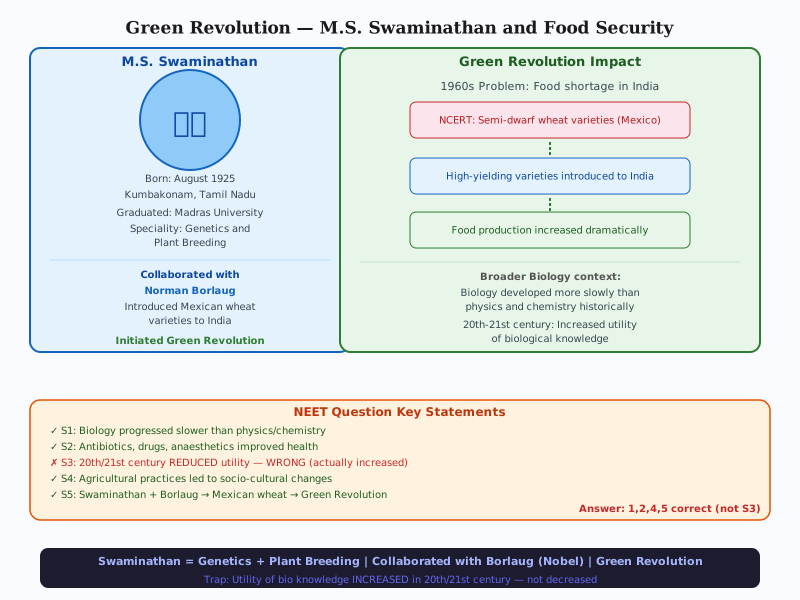
The 20th and 21st centuries showed reduced utility of biological knowledge compared to earlier times.
The 20th and 21st centuries dramatically INCREASED the utility of biological knowledge — agriculture, medicine, biotechnology all advanced.
20th century = antibiotics + Green Revolution + DNA technology = INCREASED biology utility. Never 'reduced'.
- M.S. Swaminathan: Born 1925, Kumbakonam, Tamil Nadu. Botany graduate from Madras University. Expertise: genetics and plant breeding.
- Collaborated with Norman Borlaug to introduce semi-dwarf Mexican wheat — Borlaug won Nobel Peace Prize 1970 for this work.
- Green Revolution: increased food production through HYV seeds, irrigation, fertilisers — socio-cultural transformation.
- More than 25% of drugs currently sold worldwide are derived from plants — NCERT statistic for utilitarian biodiversity argument.
Consider the following statements about M.S. Swaminathan and the broader context of biology in human welfare: 1. M.S. Swaminathan was born in Kumbakonam and specialised in genetics and plant breeding at Madras University. 2. He collaborated with Norman Borlaug to introduce high-yielding semi-dwarf wheat varieties to India. 3. The 20th century saw a reduced application of biological knowledge compared to the 19th century. 4. More than 25% of currently sold drugs worldwide are derived from plants according to NCERT. 5. The Green Revolution transformed food security but biology has contributed nothing to medicine or diagnostics. Which of the following options correctly identifies all TRUE statements?
View bonus solution & explanation
Correct answer: B — 1, 2 and 4 only
S1 CORRECT: Swaminathan was born in Kumbakonam, studied at Madras University, expertise in genetics and plant breeding. S2 CORRECT: He collaborated with Norman Borlaug (Mexican wheat varieties → India → Green Revolution). S3 WRONG: The 20th and 21st centuries INCREASED, not reduced, the utility of biological knowledge. S4 CORRECT: NCERT explicitly states >25% of drugs are plant-derived. S5 WRONG: Biology has contributed enormously to medicine, diagnostics, and biotechnology.
What is M.S. Swaminathan and the Green Revolution?
What did NEET previous years ask on M.S. Swaminathan and the Green Revolution?
What is the most common NEET trap on M.S. Swaminathan and the Green Revolution?
How do you remember M.S. Swaminathan and the Green Revolution for NEET?
What are the key components of M.S. Swaminathan and the Green Revolution?
Through deep analysis of NEET and NTA, 176 of the 180 ReNEET 2026 (June 21) questions were already in the MedicNEET question bank before the exam.
176/180MedicNEET's Biology question bank is built from the same NCERT lines NTA picks repeatedly. Not random MCQs — questions crafted exactly like NTA crafts them.
You just learned this concept. The free app turns it into a daily goal built from your weak topics and brings it back just before you forget it — using active recall and spaced repetition — so it stays till exam day.