
ELISA for Early Disease Detection — Antibody-Antigen Diagnostic Technique
✅ Asked in NEET 2021For effective treatment of the disease, early diagnosis and understanding its pathophysiology is very important. Which of the following molecular diagnostic techniques is very useful for early detection? (NEET 2021)
For effective treatment of the disease, early diagnosis and understanding its pathophysiology is very important. Which of the following molecular diagnostic techniques is very useful for early detection? (NEET 2021)
Answer & NCERT explanation
Correct answer: D — ELISA Technique
ELISA (Enzyme-Linked Immunosorbent Assay) is most useful for early disease detection because it can detect specific antigens or antibodies in very small quantities with high sensitivity and specificity. It's widely used for diagnosing infections, autoimmune diseases, and detecting biomarkers. Other techniques like hybridization, Western blot, and Southern blot are more specialized and typically used for research or confirmatory testing rather than routine early diagnosis.
Read more NCERT concept on the PYQ
Antibodies against cancer-specific antigens are also used for detection of certain cancers. Techniques of molecular biology can be
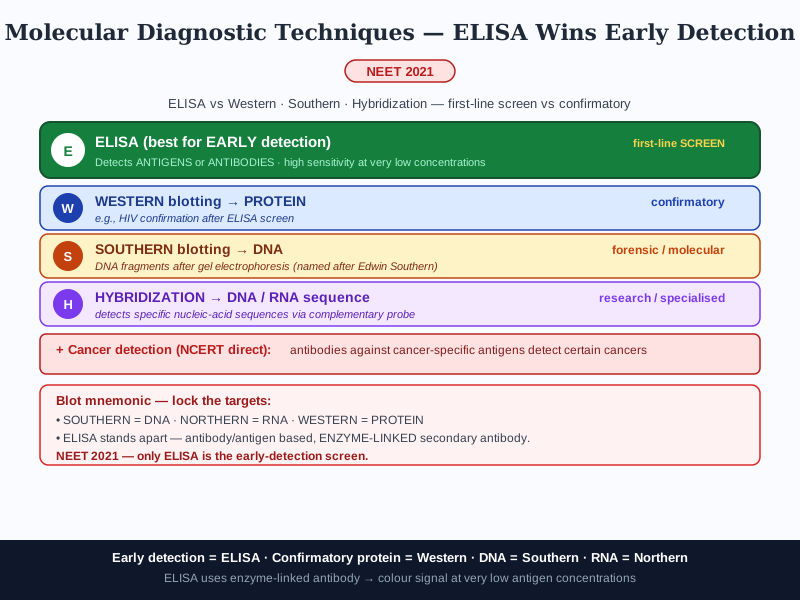
Early diagnosis is critical for effective disease treatment. NCERT names ELISA — ENZYME-LINKED IMMUNOSORBENT ASSAY — as the molecular diagnostic technique most useful for EARLY DETECTION. ELISA works by detecting SPECIFIC ANTIGENS (pathogen molecules) or ANTIBODIES (host immune response) at extremely low concentrations, with high sensitivity and specificity. The technique uses an enzyme-linked secondary antibody whose enzymatic activity produces a measurable colour or signal proportional to the amount of target. Antibodies against CANCER-SPECIFIC ANTIGENS are also used for detection of certain cancers. ELISA is widely used for HIV diagnosis, autoimmune disease screening, hormone assays and biomarker quantification.
Why ELISA wins for EARLY detection: it can pick up antigens or antibodies in the picogram to nanogram range — long before clinical symptoms appear. Other techniques in the NCERT options serve different purposes: HYBRIDIZATION = detect specific DNA/RNA sequences (research-scale). SOUTHERN BLOTTING = DNA detection after gel electrophoresis (forensic / molecular characterisation). WESTERN BLOTTING = PROTEIN detection (confirmatory for HIV after ELISA screen). ELISA is the FIRST-LINE early-detection screen; Western is the confirmatory follow-up.
Southern blotting is the most useful molecular diagnostic technique for early disease detection.
ELISA is the most useful for EARLY detection — it detects antigens or antibodies with high sensitivity at very low concentrations. Southern blot detects DNA, not used for early screening.
ELISA = antibody/antigen, EARLY detection. Western = protein (confirmatory). Southern = DNA. Northern = RNA.
- ELISA = Enzyme-Linked ImmunoSorbent Assay — detects antigens or antibodies via enzyme-linked secondary antibody.
- Used for early diagnosis of HIV, autoimmune diseases, hormone levels, cancer biomarkers.
- Antibodies against cancer-specific antigens are also used for cancer detection (NCERT direct).
- Blot mnemonic: SDS Southern-DNA | NorthernRNA | Western-protein | ELISA-antibody/antigen (early).
Consider the following statements about ELISA and molecular diagnostic techniques: S1: ELISA is the most useful molecular diagnostic technique for early detection of disease. S2: ELISA detects specific antigens or antibodies at very low concentrations with high sensitivity. S3: Southern blotting is used for detection of proteins after gel electrophoresis. S4: Antibodies against cancer-specific antigens are also used for detection of certain cancers. S5: Western blotting is used for detection of DNA sequences in forensic samples.
View bonus solution & explanation
Correct answer: A — S1, S2 and S4
S1 CORRECT: NEET 2021 answer — ELISA is the best for early detection. S2 CORRECT: High sensitivity, very low detection limits (picogram range). S3 WRONG: Southern blotting detects DNA, NOT proteins. (Western detects proteins.) S4 CORRECT: NCERT exact — antibodies against cancer-specific antigens detect certain cancers. S5 WRONG: Western blotting detects PROTEINS, not DNA. (Southern detects DNA.) Common blot mix-up: S→DNA, N→RNA, W→protein.
What is ELISA for Early Disease Detection?
What did NEET 2021 ask on ELISA for Early Disease Detection?
What is the most common NEET trap on ELISA for Early Disease Detection?
How do you remember ELISA for Early Disease Detection for NEET?
What are the key components of ELISA for Early Disease Detection?
Through deep analysis of NEET and NTA, 176 of the 180 ReNEET 2026 (June 21) questions were already in the MedicNEET question bank before the exam.
176/180MedicNEET's Biology question bank is built from the same NCERT lines NTA picks repeatedly. Not random MCQs — questions crafted exactly like NTA crafts them.
You just learned this concept. The free app turns it into a daily goal built from your weak topics and brings it back just before you forget it — using active recall and spaced repetition — so it stays till exam day.