
Root Regions — Root Cap to Maturation Zone and Root Hairs
✅ Asked in NEET 2026In angiosperms, root hairs arise from which one of the following regions of the root?
In angiosperms, root hairs arise from which one of the following regions of the root?
Answer & NCERT explanation
Correct answer: D — The region of maturation
Root hairs are fine, thread-like outgrowths formed from epidermal cells in the region of maturation, which lies just above the elongation zone and is responsible for water and mineral absorption.
Read more NCERT concept on the PYQ
The root is covered at the apex by a thimble-like structure called the root cap. It protects the tender apex of the root as it makes its way through the soil. A few millimetres above the root cap is the region of meristematic activity. The cells of this region are very small, thin-walled and with dense protoplasm. They divide repeatedly. The cells proximal to this region undergo rapid elongation and enlargement and are responsible for the growth of the root in length. This region is called the region of elongation. The cells of the elongation zone gradually differentiate and mature. Hence, this zone, proximal to region of elongation, is called the region of maturation. From this region some of the epidermal cells form very fine and delicate, thread-like structures called root hairs. These root hairs absorb water and minerals from the soil.
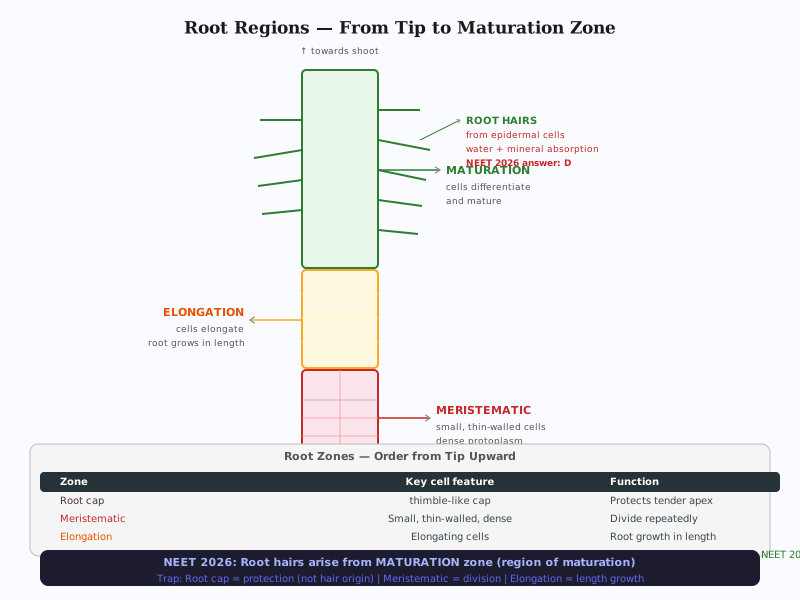
The root has four distinct zones from tip to base. The root cap is a thimble-like protective structure at the very tip that shields the tender meristematic cells as the root pushes through soil. Just above is the region of meristematic activity — small, thin-walled cells with dense protoplasm that divide repeatedly. Above that is the region of elongation — cells that have stopped dividing elongate rapidly, driving root growth in length. Most proximal is the region of maturation — cells differentiate and mature into permanent tissues. Crucially, root hairs arise from epidermal cells in this maturation zone, absorbing water and minerals from the soil.
NEET 2026 specifically asked from which region root hairs arise — answer is the region of maturation (not elongation, not meristematic, not root cap). The functional significance: root hairs massively increase the surface area for absorption without requiring new cellular material. Each root hair is an extension of a single epidermal cell. Root hairs are absent from woody roots — they occur mainly in the active absorption zone near the growing tip. The meristematic region is described as being 'a few millimetres above the root cap' in NCERT.
Root hairs arise from the region of elongation because this is the actively growing part of the root.
Root hairs arise from the REGION OF MATURATION — cells must first differentiate and mature before forming epidermal extensions.
MATURE cells form HAIR. You grow hair when you MATURE. Elongation just stretches — it doesn't differentiate.
- Root cap = thimble-like structure protecting meristematic tip as root pushes through soil.
- Meristematic region = small thin-walled cells with dense protoplasm — divide repeatedly.
- Region of elongation = cells elongate and enlarge — responsible for root growth in length.
- Region of maturation = cells differentiate; root hairs form from epidermal cells here — absorption zone (NEET 2026).
A student observes a root tip under a microscope and identifies four regions. Arrange these regions in correct order from the tip of the root upwards, and identify which region is responsible for water absorption: Regions: (P) Region of maturation, (Q) Root cap, (R) Region of elongation, (S) Region of meristematic activity Which option correctly arranges them tip → upward AND identifies the water absorption region?
View bonus solution & explanation
Correct answer: B — Q → S → R → P | Water absorption: P
Correct order tip → upward: Q (Root cap) → S (Meristematic) → R (Elongation) → P (Maturation). Root cap is at the very tip. Meristematic region is just above it (few mm above root cap per NCERT). Elongation zone is above meristematic. Maturation zone is most proximal (toward shoot). Water and mineral absorption occurs in the REGION OF MATURATION (P) — root hairs arise from epidermal cells here (NEET 2026 tested this exact fact).
What is Root Regions?
What did NEET 2026 ask on Root Regions?
What is the most common NEET trap on Root Regions?
How do you remember Root Regions for NEET?
What are the key components of Root Regions?
Through deep analysis of NEET and NTA, 176 of the 180 ReNEET 2026 (June 21) questions were already in the MedicNEET question bank before the exam.
176/180MedicNEET's Biology question bank is built from the same NCERT lines NTA picks repeatedly. Not random MCQs — questions crafted exactly like NTA crafts them.
You just learned this concept. The free app turns it into a daily goal built from your weak topics and brings it back just before you forget it — using active recall and spaced repetition — so it stays till exam day.