
Intrinsic Rate of Natural Increase (r) — Norway Rat, Flour Beetle, Human
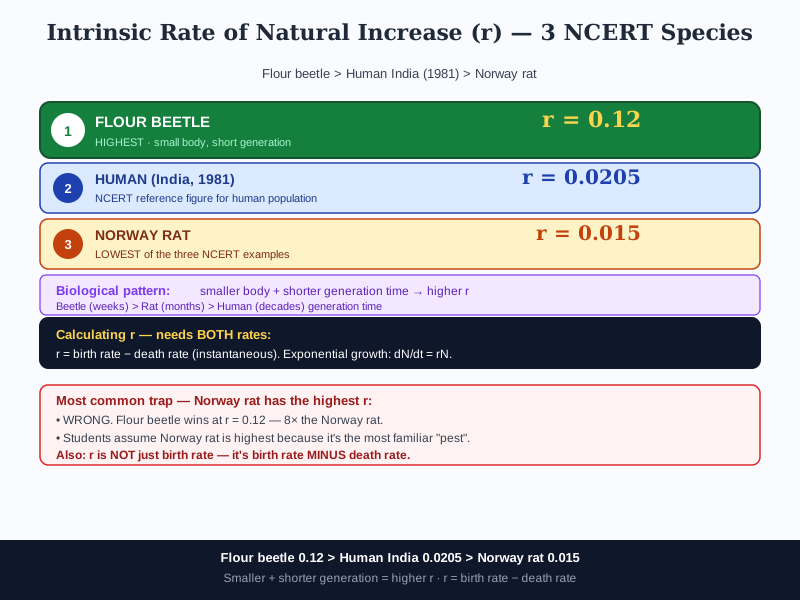
📚 Practice ConceptTo give you some idea about the magnitude of r values, for the Norway rat the r is 0.015, and for the flour beetle it is 0.12. In 1981, the r value for human population in India was 0.0205. Find out what the current r value is. For calculating it, you need to know the birth rates and death rates.
Norway rat has the highest intrinsic rate of natural increase (r = 0.015) among NCERT examples.
FLOUR BEETLE has the highest r at 0.12 — much higher than Norway rat (0.015) and human (0.0205 in India, 1981).
Order: Flour beetle 0.12 > Human 0.0205 > Norway rat 0.015. Smaller + shorter generation = higher r.
- Norway rat: r = 0.015 (NCERT exact).
- Flour beetle: r = 0.12 (highest of the three NCERT examples).
- Human population in India (1981): r = 0.0205.
- Higher r generally correlates with smaller body size and shorter generation time.
Consider the following statements about the intrinsic rate of natural increase (r): S1: The r value for Norway rat is 0.015 according to NCERT. S2: The r value for flour beetle is 0.12, the highest among the NCERT-cited examples. S3: The r value for the human population in India in 1981 was 0.0205. S4: Norway rat has the highest r among Norway rat, flour beetle and human. S5: Calculation of r requires knowledge of birth rates and death rates.
View bonus solution & explanation
Correct answer: A — S1, S2, S3 and S5
S1 CORRECT: Norway rat r = 0.015 (NCERT). S2 CORRECT: Flour beetle r = 0.12 — highest of the three. S3 CORRECT: Human (India 1981) r = 0.0205. S4 WRONG: FLOUR BEETLE (0.12) has the highest r, NOT Norway rat (0.015). This is the classic ordering trap. S5 CORRECT: NCERT explicitly says you need birth rates and death rates to calculate r (r = b − d in the simplest expression).
What is Intrinsic Rate of Natural Increase (r)?
What did NEET previous years ask on Intrinsic Rate of Natural Increase (r)?
What is the most common NEET trap on Intrinsic Rate of Natural Increase (r)?
How do you remember Intrinsic Rate of Natural Increase (r) for NEET?
What are the key components of Intrinsic Rate of Natural Increase (r)?
Through deep analysis of NEET and NTA, 176 of the 180 ReNEET 2026 (June 21) questions were already in the MedicNEET question bank before the exam.
176/180MedicNEET's Biology question bank is built from the same NCERT lines NTA picks repeatedly. Not random MCQs — questions crafted exactly like NTA crafts them.
You just learned this concept. The free app turns it into a daily goal built from your weak topics and brings it back just before you forget it — using active recall and spaced repetition — so it stays till exam day.