
Dominance is Not Autonomous — Depends on Gene Product and Phenotype Examined
📚 Practice ConceptTherefore, dominance is not an autonomous feature of a gene or the product that it has information for. It depends as much on the gene product and the production of a particular phenotype from this product as it does on the particular phenotype that we choose to examine, in case more than one phenotype is influenced by the same gene.
Dominance is an autonomous property of a gene that does not depend on which phenotype is examined.
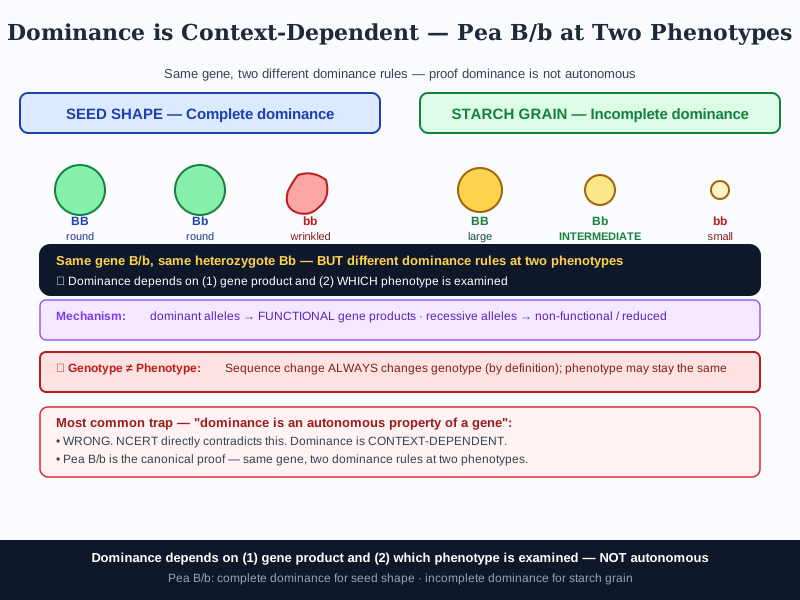
Dominance is NOT autonomous. It depends on the gene product AND on which phenotype is examined. The same gene can show complete dominance for one phenotype and incomplete dominance for another (pea starch B/b).
Dominance = context-dependent. Pea B/b: round vs wrinkled = complete dominance. Starch grain size = incomplete dominance. SAME gene, two rules.
- Dominance depends on (1) gene product and how phenotype is produced, AND (2) which phenotype is examined.
- Recessive phenotype often results when the allele produces a NON-FUNCTIONAL or reduced-function enzyme.
- Pea starch B/b: complete dominance at seed-shape level, incomplete dominance at starch-grain-size level — same gene.
- Sequence change → genotype change (by definition). It's the phenotype that may stay the same despite different sequences.
Evaluate the following statements about dominance: 1. Dominance depends on the gene product and on which phenotype is examined. 2. Recessive phenotype often results when a non-functional enzyme is produced. 3. Equivalent alleles can produce the same genotype despite sequence changes. 4. In starch synthesis, heterozygotes (Bb) show intermediate grain size when measured at the starch-grain level. 5. Therefore, dominance is an autonomous property of a gene. Which statements are correct?
View bonus solution & explanation
Correct answer: D — 1, 2 and 4
1 CORRECT: NCERT explicit — dominance depends on gene product AND on the phenotype examined. 2 CORRECT: A non-functional enzyme produced by a recessive allele typically yields the recessive phenotype. 3 WRONG: By definition, a sequence change creates a DIFFERENT genotype — even if the phenotype remains the same. Don't conflate genotype with phenotype. 4 CORRECT: Bb pea heterozygotes show intermediate starch grain size (incomplete dominance at this phenotype). 5 WRONG: Direct contradiction of S1 and NCERT — dominance is NOT autonomous.
What is Dominance is Not Autonomous?
What did NEET previous years ask on Dominance is Not Autonomous?
What is the most common NEET trap on Dominance is Not Autonomous?
How do you remember Dominance is Not Autonomous for NEET?
What are the key components of Dominance is Not Autonomous?
Through deep analysis of NEET and NTA, 176 of the 180 ReNEET 2026 (June 21) questions were already in the MedicNEET question bank before the exam.
176/180MedicNEET's Biology question bank is built from the same NCERT lines NTA picks repeatedly. Not random MCQs — questions crafted exactly like NTA crafts them.
You just learned this concept. The free app turns it into a daily goal built from your weak topics and brings it back just before you forget it — using active recall and spaced repetition — so it stays till exam day.