
Pollen Viability — Rosaceae, Leguminosae, Solanaceae Viable for Months
✅ Asked in NEET 2023In which of the following sets of families, the pollen grains are viable for months? (NEET 2023)
In which of the following sets of families, the pollen grains are viable for months? (NEET 2023)
In some members of which of the following pairs of families, pollen grains retain their viability for months after release? (NEET 2021)
Answer & NCERT explanation
Correct answer: A — Solanaceae, Poaceae and Liliaceae
According to NCERT, pollen grains in Solanaceae (potato, tomato), Poaceae (grasses), and Liliaceae (lilies) families can remain viable for months due to their reduced moisture content and protective exine structure. These families have evolved mechanisms to preserve pollen viability for extended periods unlike other plant families.
Read more NCERT concept on the PYQ
When once they are shed, pollen grains have to land on the stigma before they lose viability if they have to bring about fertilisation. How long do you think the pollen grains retain viability? The period for which pollen grains remain viable is highly variable and to some extent depends on the prevailing temperature and humidity. In some cereals such as rice and wheat, pollen grains lose viability within 30 minutes of their release, and in some members of Rosaceae, Leguminosae and Solanaceae, they maintain viability for months. You may have heard of storing semen/sperms of many animals including humans for artificial insemination. It is possible to store pollen grains of a large number of species for years in liquid nitrogen (-196°C). Such stored pollen can be used as pollen banks, similar to seed banks, in crop breeding programmes.
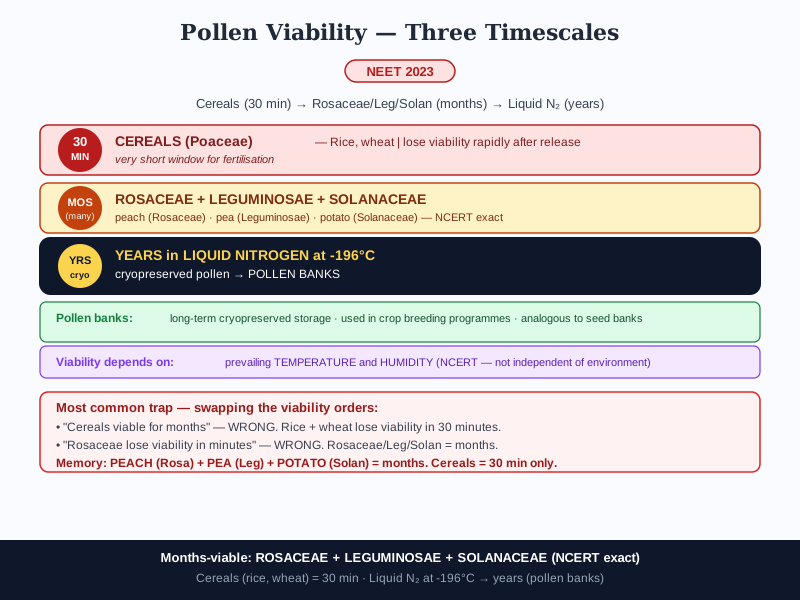
Once shed, pollen grains must land on the stigma before they LOSE VIABILITY to bring about fertilisation. The viability period is HIGHLY VARIABLE — depends on TEMPERATURE and HUMIDITY. NCERT extremes: CEREALS like RICE and WHEAT lose viability within 30 MINUTES. Members of ROSACEAE, LEGUMINOSAE and SOLANACEAE maintain viability for MONTHS. Long-term storage is possible by keeping pollen in LIQUID NITROGEN (-196°C), enabling POLLEN BANKS analogous to seed banks, used in crop breeding programmes. So: minutes (cereals) → months (Rosaceae/Leguminosae/Solanaceae) → years (cryopreservation at -196°C).
NEET 2023 and 2021 both tested this — NCERT-correct families are ROSACEAE, LEGUMINOSAE, SOLANACEAE. Some answer keys cite Poaceae or Liliaceae but the NCERT exact text lists Rosaceae/Leguminosae/Solanaceae. Memory: 'PEACH (Rosaceae), PEA (Leguminosae), POTATO (Solanaceae) — pollen viable for months'. Cereals (rice, wheat = POACEAE/grass family) are the OPPOSITE — viability lost in 30 minutes. Liquid nitrogen at -196°C extends viability to YEARS for pollen banks.
Pollen grains of cereals like rice and wheat remain viable for several months after release.
Rice and wheat (POACEAE/cereals) LOSE VIABILITY within 30 MINUTES. ROSACEAE, LEGUMINOSAE and SOLANACEAE remain viable for MONTHS.
Months-viable families: ROSACEAE (peach), LEGUMINOSAE (pea), SOLANACEAE (potato). Cereals = 30 min only. Liquid N₂ at -196°C = years.
- Pollen viability is HIGHLY VARIABLE — depends on temperature and humidity.
- Cereals (rice, wheat) lose viability within 30 MINUTES of release.
- Rosaceae, Leguminosae and Solanaceae pollens remain viable for MONTHS (NCERT exact).
- Liquid nitrogen storage at -196°C extends viability for YEARS → POLLEN BANKS for crop breeding.
Consider the following statements about pollen viability and storage: S1: In rice and wheat, pollen grains lose viability within 30 minutes of release. S2: Pollen grains of Rosaceae, Leguminosae and Solanaceae remain viable for months. S3: Pollen grains are stored in liquid nitrogen at -196°C for use in pollen banks. S4: Pollen viability is independent of prevailing temperature and humidity conditions. S5: Pollen banks are used in crop breeding programmes, similar to seed banks.
View bonus solution & explanation
Correct answer: A — S1, S2, S3 and S5
S1 CORRECT: Rice and wheat lose viability in 30 minutes (NCERT exact). S2 CORRECT: Rosaceae, Leguminosae, Solanaceae viable for MONTHS (NCERT exact wording — NEET 2023, 2021). S3 CORRECT: Liquid nitrogen at -196°C for storage. S4 WRONG: NCERT explicitly says viability DEPENDS on temperature and humidity — NOT independent. S5 CORRECT: Pollen banks operate like seed banks in crop breeding programmes.
What is Pollen Viability?
What did NEET 2023 ask on Pollen Viability?
What is the most common NEET trap on Pollen Viability?
How do you remember Pollen Viability for NEET?
What are the key components of Pollen Viability?
Through deep analysis of NEET and NTA, 176 of the 180 ReNEET 2026 (June 21) questions were already in the MedicNEET question bank before the exam.
176/180MedicNEET's Biology question bank is built from the same NCERT lines NTA picks repeatedly. Not random MCQs — questions crafted exactly like NTA crafts them.
You just learned this concept. The free app turns it into a daily goal built from your weak topics and brings it back just before you forget it — using active recall and spaced repetition — so it stays till exam day.