
Pollen Wall — Exine (Sporopollenin) and Intine (Cellulose + Pectin)
✅ Asked in NEET 2024Pollen grains remain preserved as fossils due to the presence of:
Pollen grains remain preserved as fossils due to the presence of:
Which of the following has proved helpful in preserving pollen as fossils? (NEET 2018)
Answer & NCERT explanation
Correct answer: C — Exine layer
According to NCERT, the exine layer of pollen grains is made of sporopollenin, which is highly resistant to physical and chemical degradation. This extreme durability allows pollen grains to remain preserved as fossils for millions of years. Intine is cellulosic and easily degraded, while tapetum and epidermis are not pollen components.
Read more NCERT concept on the PYQ
Pollen grains are generally spherical measuring about 25-50 micrometers in diameter. It has a prominent two-layered wall. The hard outer layer called the exine is made up of sporopollenin which is one of the most resistant organic material known. It can withstand high temperatures and strong acids and alkali. No enzyme that degrades sporopollenin is so far known. Pollen grain exine has prominent apertures called germ pores where sporopollenin is absent. Pollen grains are well-preserved as fossils because of the presence of sporopollenin. The exine exhibits a fascinating array of patterns and designs. Why do you think the exine should be hard? What is the function of germ pore? The inner wall of the pollen grain is called the intine. It is a thin and continuous layer made up of cellulose and pectin. The cytoplasm of pollen grain is surrounded by a plasma membrane. When the pollen grain is mature it contains two cells, the vegetative cell and generative cell. The vegetative cell is bigger, has abundant food reserve and a large irregularly shaped nucleus. The generative cell is small and floats in the cytoplasm of the vegetative cell. It is spindle shaped with dense cytoplasm and a nucleus. In over 60 per cent of angiosperms, pollen grains are shed at this 2-celled stage. In the remaining species, the generative cell divides mitotically to give rise to the two male gametes before pollen grains are shed (3-celled stage).
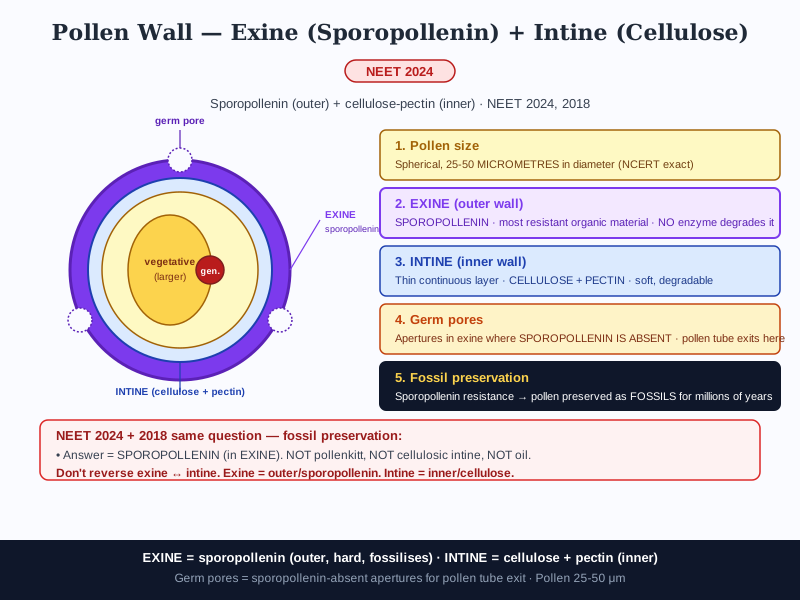
Pollen grains are generally SPHERICAL, measuring 25-50 MICROMETRES in diameter. The wall is TWO-LAYERED. The HARD OUTER LAYER (EXINE) is made of SPOROPOLLENIN — ONE OF THE MOST RESISTANT ORGANIC MATERIALS known. Sporopollenin withstands HIGH TEMPERATURES, STRONG ACIDS AND ALKALIS; NO ENZYME that degrades sporopollenin is yet known. The exine has prominent apertures called GERM PORES where sporopollenin is ABSENT — these are exit points for the pollen tube. Pollen grains are PRESERVED AS FOSSILS because of sporopollenin's resistance — a key application in palaeobotany. The INNER WALL (INTINE) is a thin, continuous layer of CELLULOSE AND PECTIN. The cytoplasm of the pollen grain is surrounded by a plasma membrane and contains a vegetative cell and a generative cell.
NEET 2024 + 2018 both asked the SAME question: 'which substance preserves pollen as fossils?' → ANSWER: SPOROPOLLENIN (in the EXINE). Common distractors: pollenkitt (sticky coating), cellulosic intine (degradable), oil content, tapetum (anther tissue, not pollen), epidermis. Pollen size = 25-50 μm. Germ pores = sporopollenin-absent apertures for pollen tube exit. Intine = cellulose + pectin (inner). Exine = sporopollenin (outer, hard). Don't reverse the two layers — common A-R trap.
Pollen grains are preserved as fossils due to the cellulosic intine layer or due to pollenkitt coating.
Pollen grains are preserved as fossils due to SPOROPOLLENIN in the EXINE — the most resistant organic material known.
EXINE = sporopollenin = hard, fossilises (NEET 2024, 2018). INTINE = cellulose + pectin = inner, soft. Germ pores = sporopollenin-absent gaps in exine.
- Pollen grains are SPHERICAL, 25-50 μm in diameter.
- EXINE = outer wall, made of SPOROPOLLENIN — most resistant organic material known; withstands high temperature, strong acids, alkalis.
- INTINE = inner wall, made of CELLULOSE AND PECTIN; thin and continuous.
- Germ pores = apertures in exine where sporopollenin is absent; pollen tube emerges through them.
Consider the following statements about the pollen grain wall: S1: Pollen grains are generally spherical, measuring 25-50 micrometres in diameter. S2: The exine is made of sporopollenin, one of the most resistant organic materials known. S3: Sporopollenin is degraded by several known enzymes within months of pollen release. S4: Germ pores are apertures in the exine where sporopollenin is absent. S5: The intine is the inner wall made of cellulose and pectin.
View bonus solution & explanation
Correct answer: B — S1, S2, S4 and S5
S1 CORRECT: 25-50 μm, spherical (NCERT exact). S2 CORRECT: Sporopollenin is the most resistant organic material known (NEET 2018 answer). S3 WRONG: NCERT explicitly says NO enzyme that degrades sporopollenin is so far known. This is what makes pollen fossilise. S4 CORRECT: Germ pores are sporopollenin-absent apertures in exine. S5 CORRECT: Intine = cellulose + pectin (NCERT exact).
What is Pollen Wall?
What did NEET 2024 ask on Pollen Wall?
What is the most common NEET trap on Pollen Wall?
How do you remember Pollen Wall for NEET?
What are the key components of Pollen Wall?
Through deep analysis of NEET and NTA, 176 of the 180 ReNEET 2026 (June 21) questions were already in the MedicNEET question bank before the exam.
176/180MedicNEET's Biology question bank is built from the same NCERT lines NTA picks repeatedly. Not random MCQs — questions crafted exactly like NTA crafts them.
You just learned this concept. The free app turns it into a daily goal built from your weak topics and brings it back just before you forget it — using active recall and spaced repetition — so it stays till exam day.