
Microsporogenesis — Sporogenous Tissue to Pollen Grain Sequence
✅ Asked in NEET 2026Arrange the following in correct developmental sequence related to microsporogenesis: A. Microspore tetrads, B. Sporogenous tissue, C. Pollen grains, D. Pollen mother cells.
Arrange the following in correct developmental sequence related to microsporogenesis: A. Microspore tetrads, B. Sporogenous tissue, C. Pollen grains, D. Pollen mother cells.
Answer & NCERT explanation
Correct answer: B — B, D, A, C
Microsporogenesis goes from sporogenous tissue (B) -> pollen mother cells (D) -> microspore tetrads via meiosis (A) -> mature pollen grains (C).
Read more NCERT concept on the PYQ
Microsporogenesis: As the anther develops, the cells of the sporogenous tissue undergo meiotic divisions to form microspore tetrads. What would be the ploidy of the cells of the tetrad?
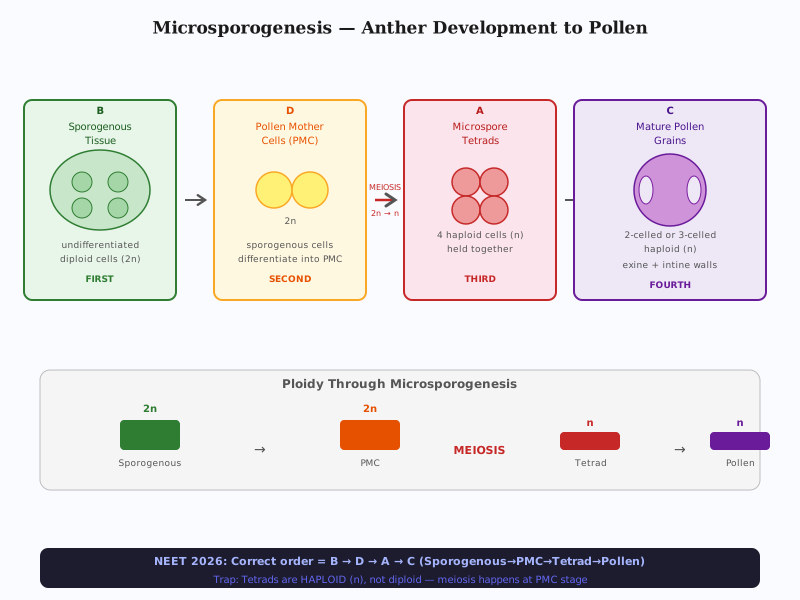
Microsporogenesis is the process by which pollen grains are formed from the anther. The sequence begins with the sporogenous tissue — a mass of undifferentiated diploid (2n) cells in the anther wall. These cells differentiate into pollen mother cells (PMC), also diploid. Each PMC undergoes meiosis to produce a microspore tetrad — four haploid (n) cells held together. Finally, individual microspores mature into pollen grains, which may be shed as a tetrad (e.g., Calotropis) or as individual grains. The ploidy changes precisely at meiosis — from 2n (PMC) to n (tetrad and pollen grains).
NCERT asks 'What would be the ploidy of the cells of the tetrad?' — the answer is haploid (n). This is the most tested aspect. NEET 2026 tested the sequence order: B (sporogenous tissue) → D (PMC) → A (tetrad) → C (pollen grain). The wrong options mix up this order. A key distinction: sporogenous tissue and PMC are both 2n (diploid), while tetrads and pollen grains are n (haploid). The meiotic division happens at the PMC stage — not at sporogenous tissue stage.
The microspore tetrad is diploid (2n) because it forms inside the diploid anther.
Microspore tetrads are HAPLOID (n) — meiosis occurs at PMC stage. Tetrads are the post-meiotic product.
PMC → MEIOSIS → TETRAD. Cross the meiosis line = cross from 2n to n. Tetrad is ALWAYS haploid.
- Sporogenous tissue and PMC are both diploid (2n); Microspore tetrad and pollen grain are haploid (n).
- NEET 2026 correct sequence: Sporogenous tissue (B) → PMC (D) → Microspore tetrad (A) → Pollen grain (C).
- Calotropis sheds pollen as tetrads; most plants shed as individual grains.
- The mature pollen grain is a 2-celled (vegetative cell + generative cell) or 3-celled (vegetative + 2 male gametes) structure.
Which of the following statements about microsporogenesis are CORRECT? 1. Sporogenous tissue cells are haploid (n). 2. Pollen mother cells undergo meiosis to form microspore tetrads. 3. Each microspore tetrad contains four haploid cells. 4. The correct developmental sequence is: Sporogenous tissue → PMC → Tetrad → Pollen grain. 5. The generative cell in mature pollen undergoes mitosis to produce 2 male gametes.
View bonus solution & explanation
Correct answer: B — 2, 3, 4 and 5
Statement 1 is WRONG — Sporogenous tissue cells are DIPLOID (2n), not haploid. Statements 2, 3, 4, and 5 are all correct: PMC undergoes meiosis (2), producing 4 haploid tetrads (3), in the sequence B→D→A→C (4), and the generative cell undergoes mitosis within the pollen tube to produce 2 male gametes (5).
What is Microsporogenesis?
What did NEET 2026 ask on Microsporogenesis?
What is the most common NEET trap on Microsporogenesis?
How do you remember Microsporogenesis for NEET?
What are the key components of Microsporogenesis?
Through deep analysis of NEET and NTA, 176 of the 180 ReNEET 2026 (June 21) questions were already in the MedicNEET question bank before the exam.
176/180MedicNEET's Biology question bank is built from the same NCERT lines NTA picks repeatedly. Not random MCQs — questions crafted exactly like NTA crafts them.
You just learned this concept. The free app turns it into a daily goal built from your weak topics and brings it back just before you forget it — using active recall and spaced repetition — so it stays till exam day.