
Ovule Structure — Hilum, Funicle, Micropyle, Nucellus, Integuments
✅ Asked in NEET 2024The junction between ovule and funicle is represented by:
The junction between ovule and funicle is represented by:
The body of the ovule is fused within the funicle at (NEET 2020)
The ovule of an angiosperm is technically equivalent to (NEET 2016 Phase 2)
Answer & NCERT explanation
Correct answer: D — Hilum
According to NCERT, hilum is the junction point where the ovule attaches to the funicle (ovular stalk). It serves as the connection between the ovule body and its stalk. Nucellus is the tissue inside ovule, integuments are protective layers, and chalaza is where integuments and nucellus meet at the opposite end.
Read more NCERT concept on the PYQ
The Megasporangium (Ovule): Let us familiarise ourselves with the structure of a typical angiosperm ovule. The ovule is a small structure attached to the placenta by means of a stalk called funicle. The body of the ovule fuses with funicle in the region called hilum. Thus, hilum represents the junction between ovule and funicle. Each ovule has one or two protective envelopes called integuments. Integuments encircle the nucellus except at the tip where a small opening called the micropyle is organised. Opposite the micropylar end, is the chalaza, representing the basal part of the ovule.
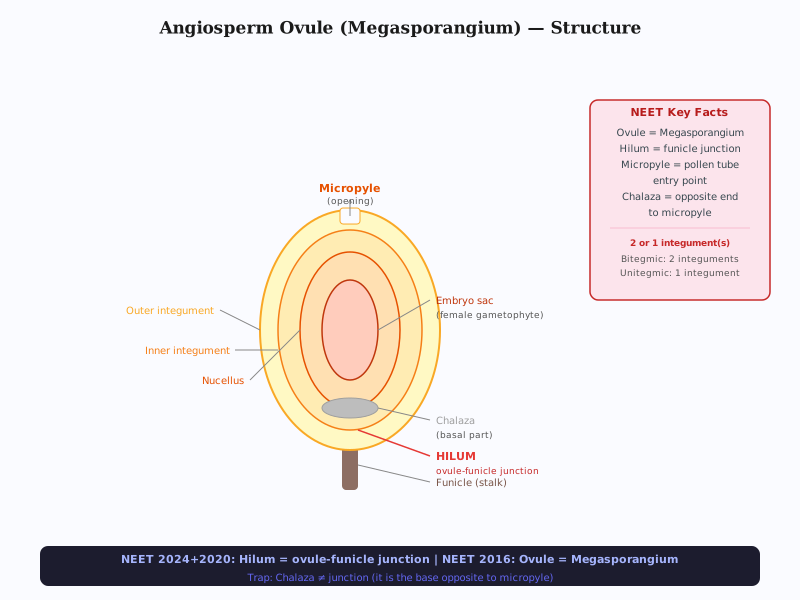
The angiosperm ovule (technically equivalent to a megasporangium) is attached to the placenta by a stalk called the funicle. Where the ovule body fuses with the funicle is the hilum — a precise junction point that NTA has tested in three separate NEET years (2016, 2020, 2024). The ovule is enclosed by one or two protective layers called integuments, which do not cover the entire nucellus — they leave a small opening at the tip called the micropyle. The micropyle guides the pollen tube toward the embryo sac for fertilisation. Opposite the micropylar end is the chalaza, which represents the basal part of the ovule where integuments and nucellus fuse.
NCERT states that the ovule is 'technically equivalent to the megasporangium' — this is NEET 2016 material. Students must distinguish: megasporangium = ovule (whole structure), megasporophyll = carpel (bears the sporangium), megaspore mother cell = cell inside nucellus that undergoes meiosis, megaspore = product of meiosis. The ovule is not the megaspore or the megaspore mother cell. Bitegmic ovules have two integuments (most angiosperms), unitegmic ovules have one (some families like Asteraceae).
Chalaza is the junction between ovule and funicle (because it is at the base/bottom of the ovule).
HILUM is the junction between ovule and funicle. Chalaza is the basal part of the nucellus (opposite to micropyle) where integuments terminate.
HILUM = ovule's belly button (attachment point to stalk). Chalaza = opposite end to micropyle.
- Ovule = megasporangium (tested NEET 2016 Phase 2) — not megaspore, not megasporophyll.
- Hilum tested in NEET 2024, NEET 2020, and NEET 2016 — highest repetition for any single ovule structure.
- Micropyle functions in pollen tube entry AND in water absorption during seed germination.
- Anatropous ovule: body of ovule is inverted (most common type in angiosperms) — funicle runs alongside the ovule.
Consider the following statements about the structure of the angiosperm ovule: S1: The hilum represents the junction between the ovule body and the funicle. S2: The chalaza is located at the micropylar end of the ovule. S3: Integuments encircle the nucellus completely, leaving no opening. S4: The ovule is technically equivalent to a megasporangium. S5: The micropyle guides the pollen tube to the embryo sac. Which statements are CORRECT?
View bonus solution & explanation
Correct answer: B — S1, S4 and S5
S1 CORRECT: Hilum = junction between ovule body and funicle (NCERT exact definition, tested NEET 2024, 2020). S2 WRONG: Chalaza is at the OPPOSITE end to the micropyle (not at the micropylar end). S3 WRONG: Integuments leave the micropyle opening — they do NOT encircle completely. S4 CORRECT: Ovule = megasporangium (NCERT explicit statement, tested NEET 2016). S5 CORRECT: Micropyle guides pollen tube entry toward the embryo sac.
What is Ovule Structure?
What did NEET 2024 ask on Ovule Structure?
What is the most common NEET trap on Ovule Structure?
How do you remember Ovule Structure for NEET?
What are the key components of Ovule Structure?
Through deep analysis of NEET and NTA, 176 of the 180 ReNEET 2026 (June 21) questions were already in the MedicNEET question bank before the exam.
176/180MedicNEET's Biology question bank is built from the same NCERT lines NTA picks repeatedly. Not random MCQs — questions crafted exactly like NTA crafts them.
You just learned this concept. The free app turns it into a daily goal built from your weak topics and brings it back just before you forget it — using active recall and spaced repetition — so it stays till exam day.