
Megaspore Mother Cell — Large, Dense Cytoplasm, Meiosis Gives Four Megaspores
✅ Asked in NEET 2016In majority of angiosperms (NEET 2016 Phase 2)
In majority of angiosperms (NEET 2016 Phase 2)
Answer & NCERT explanation
Correct answer: C — Reduction division occurs in the megaspore mother cells.
According to NCERT, in majority of angiosperms, reduction division (meiosis) occurs in megaspore mother cells to produce four haploid megaspores. The egg has no filiform apparatus (synergids have it), there are typically 3 antipodal cells, and the central cell is large, not small.
Read more NCERT concept on the PYQ
It is a large cell containing dense cytoplasm and a prominent nucleus. The MMC undergoes meiotic division. What is the importance of the MMC undergoing meiosis? Meiosis results in the production of four megaspores.
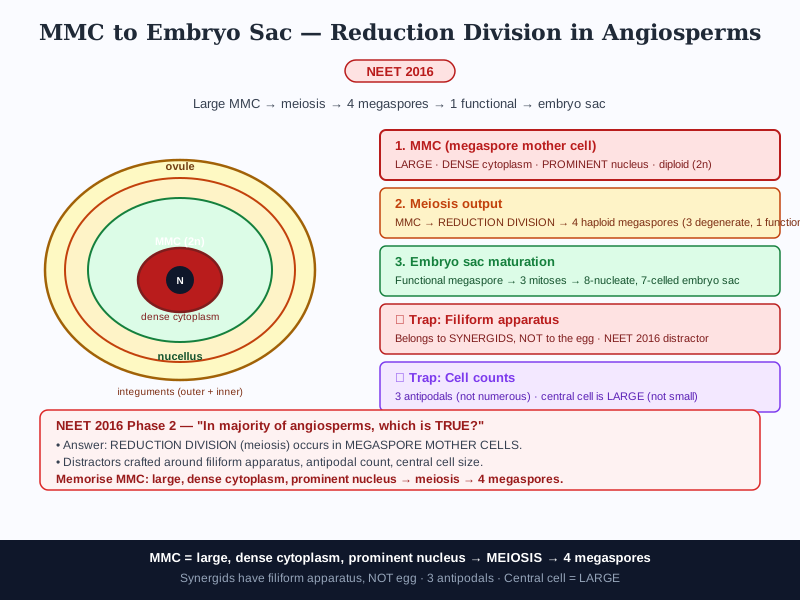
The MEGASPORE MOTHER CELL (MMC) is a LARGE CELL with DENSE CYTOPLASM and a PROMINENT NUCLEUS, located inside the nucellus of the ovule. It is diploid (2n). The MMC undergoes MEIOTIC DIVISION (REDUCTION DIVISION) to produce FOUR HAPLOID MEGASPORES — only ONE of which survives to become the functional megaspore that develops into the embryo sac. Why meiosis at this step? It establishes the HAPLOID gametophytic generation that produces female gametes; haploid egg + haploid sperm restore diploidy at fertilisation. The functional megaspore then undergoes THREE successive MITOTIC divisions to give the 8-nucleate, 7-celled embryo sac. In the MAJORITY of angiosperms, this Polygonum-type pattern is the rule.
NEET 2016 Phase 2 directly asked which is TRUE 'in the majority of angiosperms' — answer: REDUCTION DIVISION (meiosis) occurs in MEGASPORE MOTHER CELLS. Common distractors: egg has NO filiform apparatus (synergids have it); antipodal cells number 3 (NOT 'numerous'); central cell is LARGE (not small). MMC is the SINGLE most important diploid cell on the female side — analogous to the microspore mother cell on the male side.
In majority of angiosperms, the egg cell has a filiform apparatus and there are numerous antipodal cells.
The MMC undergoes meiosis (reduction division) to produce 4 megaspores in majority of angiosperms. SYNERGIDS (not egg) have the filiform apparatus; antipodal cells are typically THREE (not numerous).
MMC = large, dense cytoplasm, prominent nucleus → MEIOSIS → 4 megaspores → 1 survives → 8-nucleate embryo sac.
- MMC is a LARGE diploid cell with DENSE CYTOPLASM and a PROMINENT NUCLEUS.
- MMC undergoes MEIOSIS (reduction division) to produce 4 haploid megaspores; only 1 survives as functional megaspore.
- Filiform apparatus is in SYNERGIDS, not in the egg (common NEET 2016 trap).
- Antipodal cells number THREE (not 'numerous'); central cell is LARGE (not small).
In the majority of angiosperms, which of the following statements are correct about the megaspore mother cell (MMC) and embryo sac? S1: The MMC is a large cell containing dense cytoplasm and a prominent nucleus. S2: The MMC undergoes meiotic (reduction) division to produce four megaspores. S3: The egg cell of the embryo sac bears the filiform apparatus. S4: There are typically three (not numerous) antipodal cells in the typical embryo sac. S5: The central cell of the embryo sac is small and inconspicuous.
View bonus solution & explanation
Correct answer: A — S1, S2 and S4
S1 CORRECT: MMC is large, dense cytoplasm, prominent nucleus (NCERT exact). S2 CORRECT: MMC undergoes MEIOSIS → 4 megaspores (NEET 2016 answer). S3 WRONG: The FILIFORM APPARATUS is in the SYNERGIDS, NOT in the egg. Common NEET trap. S4 CORRECT: Typical embryo sac has THREE antipodal cells (not numerous). S5 WRONG: The central cell is LARGE (it contains the 2 polar nuclei and most of the embryo sac volume), not small.
What is Megaspore Mother Cell?
What did NEET 2016 ask on Megaspore Mother Cell?
What is the most common NEET trap on Megaspore Mother Cell?
How do you remember Megaspore Mother Cell for NEET?
What are the key components of Megaspore Mother Cell?
Through deep analysis of NEET and NTA, 176 of the 180 ReNEET 2026 (June 21) questions were already in the MedicNEET question bank before the exam.
176/180MedicNEET's Biology question bank is built from the same NCERT lines NTA picks repeatedly. Not random MCQs — questions crafted exactly like NTA crafts them.
You just learned this concept. The free app turns it into a daily goal built from your weak topics and brings it back just before you forget it — using active recall and spaced repetition — so it stays till exam day.