
Cleistogamous Flowers — Invariably Autogamous with Assured Seed Set
✅ Asked in NEET 2022Given below are two statements: (NEET 2022) Statement I: Cleistogamous flowers are invariably autogamous. Statement II: Cleistogamy is disadvantageous as there is no chance for cross pollination. In the light of the above statements, choose the correct answer from the options given below:
Given below are two statements: (NEET 2022) Statement I: Cleistogamous flowers are invariably autogamous. Statement II: Cleistogamy is disadvantageous as there is no chance for cross pollination. In the light of the above statements, choose the correct answer from the options given below:
Answer & NCERT explanation
Correct answer: C — Both Statement I and Statement II are correct.
Statement I is correct: Cleistogamous flowers never open, so self-pollination is inevitable (autogamy). Statement II is also correct: Since flowers don't open, cross-pollination cannot occur, which reduces genetic variation and is disadvantageous evolutionarily. Both statements accurately describe cleistogamy as per NCERT.
Read more NCERT concept on the PYQ
Some plants such as Viola (common pansy), Oxalis, and Commelina produce two types of flowers – chasmogamous flowers which are similar to flowers of other species with exposed anthers and stigma, and cleistogamous flowers which do not open at all. In such flowers, the anthers and stigma lie close to each other. When anthers dehisce in the flower buds, pollen grains come in contact with the stigma to effect pollination. Thus, cleistogamous flowers are invariably autogamous as there is no chance of cross-pollen landing on the stigma. Cleistogamous flowers produce assured seed-set even in the absence of pollinators. Do you think that cleistogamy is advantageous or disadvantageous to the plant? Why?
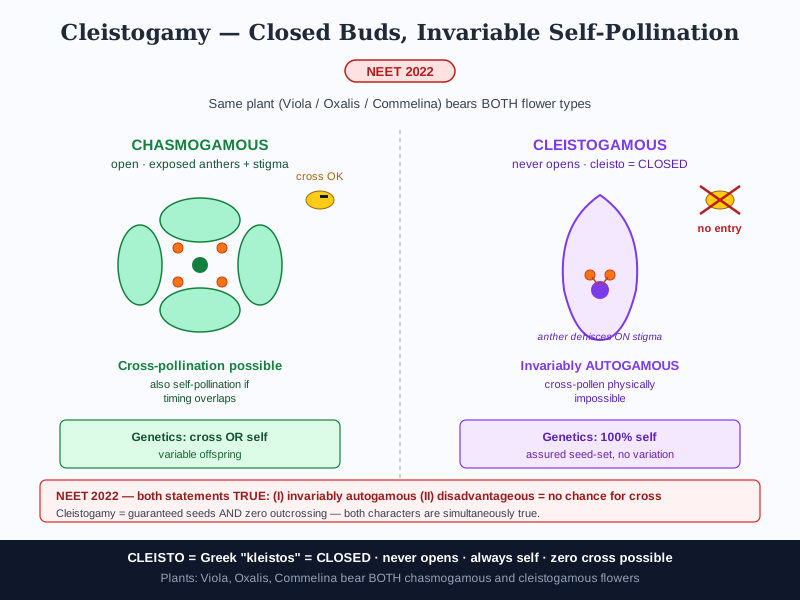
Some plants produce two types of flowers: chasmogamous (exposed anthers and stigma, similar to most plants — allow cross-pollination) and cleistogamous (never open). In cleistogamous flowers, the anthers and stigma lie close to each other inside the unopened bud. When anthers dehisce within the bud, pollen directly contacts the stigma — achieving pollination without ever opening. Therefore, cleistogamous flowers are invariably autogamous (self-pollinating). They guarantee seed-set even without pollinators. The disadvantage is that cross-pollination cannot occur, limiting genetic variation. Plants with both types: Viola (pansy), Oxalis, and Commelina.
NEET 2022 used a Two Statement format: Statement I (cleistogamous = invariably autogamous) = TRUE. Statement II (cleistogamy = disadvantageous because no cross-pollination) = TRUE. Both are correct — answer is C. Many students mark only Statement I as true and think Statement II must be false because cleistogamy has 'advantages' (assured seed set). However, Statement II is specifically about the DISADVANTAGE aspect — and it is correct that there is NO CHANCE of cross-pollination, which is genuinely disadvantageous from a genetic variation perspective.
Cleistogamous flowers are sometimes cross-pollinated when insects enter the buds. Statement II (disadvantage of no cross-pollination) is incorrect because assured seed-set is an advantage.
Cleistogamous flowers NEVER open — cross-pollination is IMPOSSIBLE. Statement II is correct as stated: 'disadvantageous as there is no chance for cross-pollination' — this is the evolutionary disadvantage even while having the advantage of assured seed-set.
CLEISTO = CLOSED (Greek: kleistos). Never opens → always self-pollinates → no cross possible. Both statements NEET 2022 are TRUE.
- Cleistogamous flowers never open — anthers dehisce inside the bud, pollen contacts stigma directly.
- Invariably autogamous: there is no chance of cross-pollen landing on stigma of cleistogamous flowers.
- Assured seed-set: even without pollinators, cleistogamous flowers always produce seeds.
- Plants with both flower types: Viola (common pansy), Oxalis, Commelina — same plant has both.
What is Cleistogamous Flowers?
What did NEET 2022 ask on Cleistogamous Flowers?
What is the most common NEET trap on Cleistogamous Flowers?
How do you remember Cleistogamous Flowers for NEET?
What are the key components of Cleistogamous Flowers?
Through deep analysis of NEET and NTA, 176 of the 180 ReNEET 2026 (June 21) questions were already in the MedicNEET question bank before the exam.
176/180MedicNEET's Biology question bank is built from the same NCERT lines NTA picks repeatedly. Not random MCQs — questions crafted exactly like NTA crafts them.
You just learned this concept. The free app turns it into a daily goal built from your weak topics and brings it back just before you forget it — using active recall and spaced repetition — so it stays till exam day.