
Double Fertilisation — Syngamy (Zygote) + Triple Fusion (PEN), Unique to Angiosperms
✅ Asked in NEET 2023In angiosperm, the haploid, diploid and triploid structures of a fertilized embryo sac sequentially are:
In angiosperm, the haploid, diploid and triploid structures of a fertilized embryo sac sequentially are:
Double fertilisation is exhibited by (NEET 2017)
Answer & NCERT explanation
Correct answer: C — Synergids, Zygote and Primary endosperm nucleus
In a fertilized angiosperm embryo sac, the structures are: Synergids (haploid) - help in fertilization process, Zygote (diploid) - formed by fusion of male and female gametes, and Primary endosperm nucleus (triploid) - formed by fusion of one male gamete with two polar nuclei during triple fusion. This sequence represents the correct ploidy levels after double fertilization has occurred.
Read more NCERT concept on the PYQ
After entering one of the synergids, the pollen tube releases the two male gametes into the cytoplasm of the synergid. One of the male gametes moves towards the egg cell and fuses with its nucleus thus completing the syngamy. This results in the formation of a diploid cell, the zygote. The other male gamete moves towards the two polar nuclei located in the central cell and fuses with them to produce a triploid primary endosperm nucleus (PEN). As this involves the fusion of three haploid nuclei it is termed triple fusion. Since two types of fusions, syngamy and triple fusion take place in an embryo sac the phenomenon is termed double fertilisation, an event unique to flowering plants. The central cell after triple fusion becomes the primary endosperm cell (PEC) and develops into the endosperm while the zygote develops into an embryo.
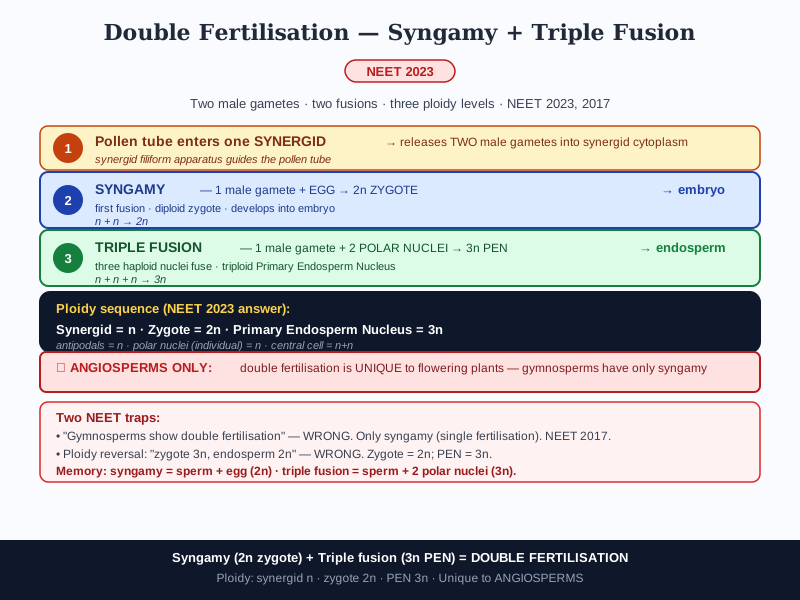
After entering one of the SYNERGIDS, the pollen tube releases TWO MALE GAMETES into the synergid cytoplasm. ONE male gamete moves to the EGG CELL and fuses with its nucleus — this is SYNGAMY, producing a DIPLOID (2n) ZYGOTE. The OTHER male gamete moves to the CENTRAL CELL and fuses with the TWO POLAR NUCLEI — this is TRIPLE FUSION (three haploid nuclei fusing), producing the TRIPLOID (3n) PRIMARY ENDOSPERM NUCLEUS (PEN). Together, syngamy + triple fusion = DOUBLE FERTILISATION — an event UNIQUE TO FLOWERING PLANTS (angiosperms). The central cell after triple fusion becomes the primary endosperm cell (PEC), which develops into the ENDOSPERM. The zygote develops into the EMBRYO.
PLOIDY TABLE to lock for NEET: SYNERGIDS = n (haploid); ZYGOTE = 2n (diploid); PRIMARY ENDOSPERM NUCLEUS = 3n (triploid). NEET 2023 asked this exact ploidy sequence. NEET 2017 asked: 'Double fertilisation is exhibited by' → ANGIOSPERMS (NOT algae, NOT fungi, NOT gymnosperms). Gymnosperms have single fertilisation (just syngamy). Other ploidies to know: antipodals = n, polar nuclei (individual) = n, central cell (before fertilisation) = n+n, PEC after triple fusion = 3n.
Double fertilisation is exhibited by gymnosperms and angiosperms; the zygote formed is triploid while the endosperm is diploid.
Double fertilisation is UNIQUE to ANGIOSPERMS (not gymnosperms). ZYGOTE = 2n (diploid). PRIMARY ENDOSPERM NUCLEUS = 3n (triploid).
SYNGAMY = sperm + egg = 2n ZYGOTE. TRIPLE FUSION = sperm + 2 polar nuclei = 3n PEN. Both together = DOUBLE FERTILISATION = ANGIOSPERMS ONLY.
- Syngamy = fusion of male gamete with EGG → 2n ZYGOTE → develops into EMBRYO.
- Triple fusion = fusion of male gamete with TWO POLAR NUCLEI → 3n PRIMARY ENDOSPERM NUCLEUS (PEN) → develops into ENDOSPERM.
- Double fertilisation = syngamy + triple fusion together — UNIQUE to ANGIOSPERMS.
- Ploidy sequence after fertilisation: Synergid = n | Zygote = 2n | PEN = 3n (NEET 2023).
Consider the following statements about double fertilisation in angiosperms: S1: The pollen tube releases two male gametes into the cytoplasm of one synergid. S2: Syngamy is the fusion of one male gamete with the egg, producing a diploid (2n) zygote. S3: Triple fusion is the fusion of one male gamete with the two polar nuclei, producing a triploid (3n) primary endosperm nucleus. S4: Double fertilisation is exhibited by both gymnosperms and angiosperms. S5: The central cell after triple fusion becomes the primary endosperm cell, which develops into the endosperm.
View bonus solution & explanation
Correct answer: B — S1, S2, S3 and S5
S1 CORRECT: Pollen tube releases 2 male gametes into one synergid (NCERT). S2 CORRECT: Syngamy → 2n zygote → embryo. S3 CORRECT: Triple fusion → 3n PEN → endosperm. S4 WRONG: Double fertilisation is UNIQUE to ANGIOSPERMS (NEET 2017) — gymnosperms show single fertilisation (only syngamy). S5 CORRECT: Central cell after triple fusion = primary endosperm cell (PEC) → endosperm. Memory hook for NEET 2023 ploidy: synergid (n) → zygote (2n) → PEN (3n).
What is Double Fertilisation?
What did NEET 2023 ask on Double Fertilisation?
What is the most common NEET trap on Double Fertilisation?
How do you remember Double Fertilisation for NEET?
What are the key components of Double Fertilisation?
Through deep analysis of NEET and NTA, 176 of the 180 ReNEET 2026 (June 21) questions were already in the MedicNEET question bank before the exam.
176/180MedicNEET's Biology question bank is built from the same NCERT lines NTA picks repeatedly. Not random MCQs — questions crafted exactly like NTA crafts them.
You just learned this concept. The free app turns it into a daily goal built from your weak topics and brings it back just before you forget it — using active recall and spaced repetition — so it stays till exam day.