
Dicot Embryo — Embryonal Axis, Cotyledons, Plumule, Radicle, Epicotyl, Hypocotyl
📚 Practice ConceptA typical dicotyledonous embryo, consists of an embryonal axis and two cotyledons. The portion of embryonal axis above the level of cotyledons is the epicotyl, which terminates with the plumule or stem tip. The cylindrical portion below the level of cotyledons is hypocotyl that terminates at its lower end in the radicle or root tip. The root tip is covered with a root cap.
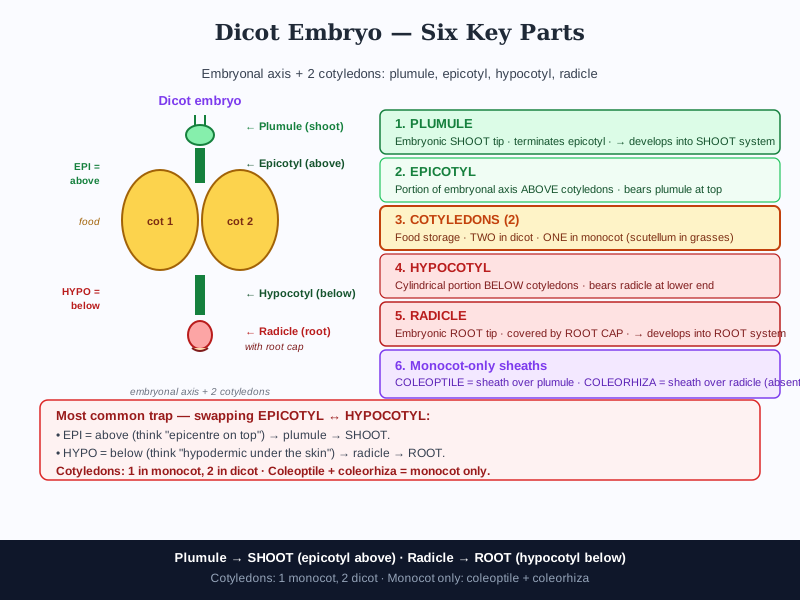
The epicotyl is the cylindrical portion below the level of cotyledons that terminates in the radicle.
The EPICOTYL is ABOVE the cotyledons (terminates in plumule → shoot). The HYPOCOTYL is BELOW the cotyledons (terminates in radicle → root). Don't swap.
EPI = above (plumule → shoot). HYPO = below (radicle → root). Cotyledons = food (2 in dicot, 1 in monocot). Coleorhiza/coleoptile = monocot only.
- Plumule = embryonic shoot tip → develops into SHOOT system; terminates the epicotyl.
- Radicle = embryonic root tip → develops into ROOT system; terminates the hypocotyl. Covered by root cap.
- Epicotyl = axis ABOVE cotyledons; Hypocotyl = axis BELOW cotyledons.
- Cotyledons: 1 in monocot (scutellum in grasses), 2 in dicot. Monocots also have coleoptile (plumule sheath) + coleorhiza (radicle sheath).
Match the embryo parts with their derivatives and key features: Column I (Part): A. Plumule | B. Radicle | C. Epicotyl | D. Hypocotyl | E. Cotyledons Column II (Derivative): I. Shoot system | II. Root system | III. Stem above cotyledons | IV. Stem below cotyledons | V. Food storage Column III (Feature): P. Terminates with the shoot apex | Q. Protected by coleorhiza in monocots | R. Portion of embryonal axis ABOVE cotyledon level | S. Cylindrical portion BELOW cotyledon level | T. Can be one or two in number
View bonus solution & explanation
Correct answer: D — A-I-P, B-II-Q, C-III-R, D-IV-S, E-V-T
A-I-P: Plumule → SHOOT system; terminates with shoot apex. B-II-Q: Radicle → ROOT system; protected by coleorhiza in monocots. C-III-R: Epicotyl = stem above cotyledons; the portion of embryonal axis ABOVE cotyledon level. D-IV-S: Hypocotyl = stem below cotyledons; cylindrical portion BELOW cotyledon level. E-V-T: Cotyledons = food storage; can be ONE (monocot) or TWO (dicot). Correct option D. Trap: option A swaps epicotyl (R: above) with S (below), reversing the position rule.
What is Dicot Embryo?
What did NEET previous years ask on Dicot Embryo?
What is the most common NEET trap on Dicot Embryo?
How do you remember Dicot Embryo for NEET?
What are the key components of Dicot Embryo?
Through deep analysis of NEET and NTA, 176 of the 180 ReNEET 2026 (June 21) questions were already in the MedicNEET question bank before the exam.
176/180MedicNEET's Biology question bank is built from the same NCERT lines NTA picks repeatedly. Not random MCQs — questions crafted exactly like NTA crafts them.
You just learned this concept. The free app turns it into a daily goal built from your weak topics and brings it back just before you forget it — using active recall and spaced repetition — so it stays till exam day.