
Seed Viability After Dispersal — Lupinus Arcticus and Phoenix Dactylifera Records
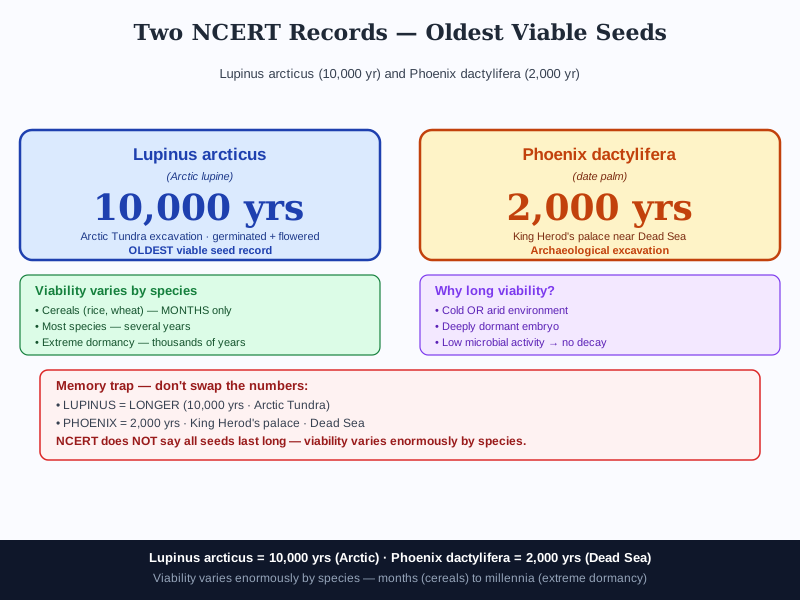
📚 Practice ConceptHow long do the seeds remain alive after they are dispersed? This period again varies greatly. In a few species the seeds lose viability within a few months. Seeds of a large number of species live for several years. Some seeds can remain alive for hundreds of years. There are several records of very old yet viable seeds. The oldest is that of a lupine, Lupinus arcticus excavated from Arctic Tundra. The seed germinated and flowered after an estimated record of 10,000 years of dormancy. A recent record of 2000 years old viable seed is of the date palm, Phoenix dactylifera discovered during the archeological excavation at King Herod's palace near the Dead Sea.
All dispersed seeds remain viable for at least several hundred years regardless of species or environmental conditions.
Seed viability VARIES greatly — from a few months (cereals) to several thousand years (Lupinus arcticus, Phoenix dactylifera). Long viability requires dormancy and favourable storage.
Lupinus arcticus = 10,000 yrs (Arctic Tundra). Phoenix dactylifera = 2,000 yrs (Dead Sea). Cereals = months only.
- Lupinus arcticus: oldest viable seed record at ~10,000 years (Arctic Tundra excavation) — germinated and flowered.
- Phoenix dactylifera (date palm): viable seed of ~2,000 years from King Herod's palace near the Dead Sea.
- Viability period varies enormously by species — months (cereals) to thousands of years (extreme dormancy).
- Both record-holding environments share: low temperature or aridity + low microbial activity + deep dormancy.
Consider the following statements about seed viability after dispersal: S1: The oldest viable seed record is Lupinus arcticus, excavated from the Arctic Tundra with an estimated dormancy of 10,000 years. S2: Phoenix dactylifera (date palm) showed viability for approximately 2,000 years. S3: All dispersed seeds remain viable for at least several hundred years regardless of species. S4: The 2,000-year-old Phoenix dactylifera seed was discovered during archaeological excavation at King Herod's palace near the Dead Sea. S5: Cereal seeds (such as rice and wheat) generally lose viability within a few months of release.
View bonus solution & explanation
Correct answer: B — S1, S2, S4 and S5
S1 CORRECT: Lupinus arcticus = 10,000-year viable seed (oldest record, Arctic Tundra). S2 CORRECT: Phoenix dactylifera = ~2,000 years. S3 WRONG: NCERT explicitly states seed viability VARIES GREATLY — some species lose viability within months (e.g., cereals), others persist for thousands of years. S4 CORRECT: King Herod's palace, Dead Sea — archaeological context (NCERT exact). S5 CORRECT: Cereal seeds are short-lived compared to the extreme dormancy records.
What is Seed Viability After Dispersal?
What did NEET previous years ask on Seed Viability After Dispersal?
What is the most common NEET trap on Seed Viability After Dispersal?
How do you remember Seed Viability After Dispersal for NEET?
What are the key components of Seed Viability After Dispersal?
Through deep analysis of NEET and NTA, 176 of the 180 ReNEET 2026 (June 21) questions were already in the MedicNEET question bank before the exam.
176/180MedicNEET's Biology question bank is built from the same NCERT lines NTA picks repeatedly. Not random MCQs — questions crafted exactly like NTA crafts them.
You just learned this concept. The free app turns it into a daily goal built from your weak topics and brings it back just before you forget it — using active recall and spaced repetition — so it stays till exam day.