
Seed Number and Size — Orchid, Ficus and Dispersal Strategy
📚 Practice ConceptCan you think of some plants in which fruits contain very large number of seeds. Orchid fruits are one such category and each fruit contain thousands of tiny seeds. Similar is the case in fruits of some parasitic species such as Orobanche and Striga. Have you seen a tiny seed of Ficus? How large is the tree of Ficus developed from that tiny seed. How many billions of seeds does each Ficus tree produce? Can you imagine any other example in which such a tiny structure can produce such a large biomass over the years?
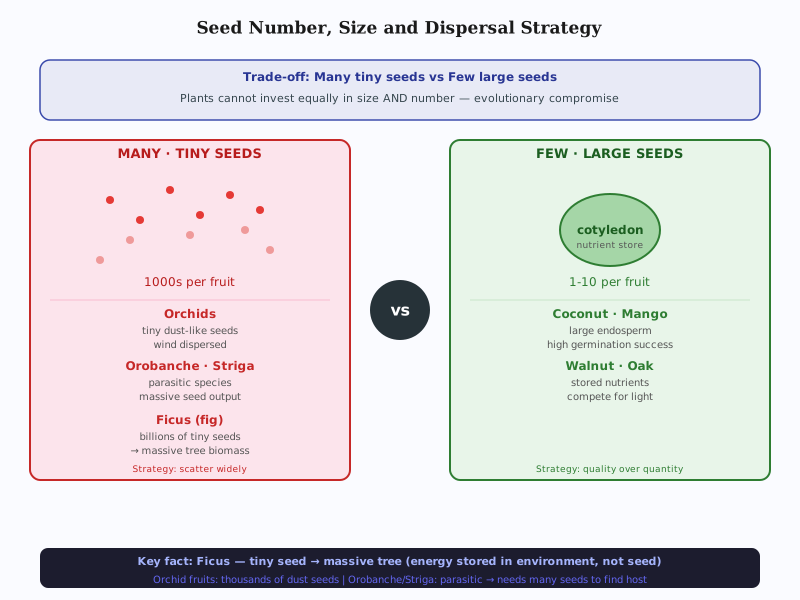
Students assume large seed = large plant. Ficus disproves this — tiny seed produces one of the world's largest trees.
Seed size determines immediate establishment success, not eventual plant size. Ficus accumulates energy from environment over decades.
Ficus: tiny seed → giant tree (energy from sun, not seed). Orchid: dust seeds → dispersal success
- Orchid fruits contain thousands of minute seeds — an adaptation for wide wind dispersal in forest canopy environments.
- Orobanche and Striga are obligate root parasites — they produce massive seed numbers because only 1 in thousands contacts a host root.
- Ficus trees are keystone species — their fruits support hundreds of animal species, hence evolutionary pressure for high seed production.
- True fruit = develops from ovary only; False fruit = involves other floral parts (e.g., apple includes thalamus).
Match the following regarding seed and fruit characteristics: Column I (Plant/structure) A. Orchid B. Ficus C. True fruit D. Parthenocarpic fruit Column II (Characteristic) I. Tiny seed → massive eventual biomass II. Develops solely from ovary III. Thousands of dust-like seeds per fruit IV. Develops without fertilisation
View bonus solution & explanation
Correct answer: A — A-III, B-I, C-II, D-IV
Orchid (A-III): produces thousands of tiny dust-like seeds per fruit. Ficus (B-I): tiny seeds develop into massive trees by accumulating energy from environment. True fruit (C-II): develops solely from the ovary. Parthenocarpic fruit (D-IV): develops without fertilisation (e.g., banana). This tests NCERT content on seed strategies and fruit types.
What is Seed Number and Size?
What did NEET previous years ask on Seed Number and Size?
What is the most common NEET trap on Seed Number and Size?
How do you remember Seed Number and Size for NEET?
What are the key components of Seed Number and Size?
Through deep analysis of NEET and NTA, 176 of the 180 ReNEET 2026 (June 21) questions were already in the MedicNEET question bank before the exam.
176/180MedicNEET's Biology question bank is built from the same NCERT lines NTA picks repeatedly. Not random MCQs — questions crafted exactly like NTA crafts them.
You just learned this concept. The free app turns it into a daily goal built from your weak topics and brings it back just before you forget it — using active recall and spaced repetition — so it stays till exam day.