
NEET 2021 · PhysicsDipole torquePrevious Year Question

A dipole is placed in a non-uniform electric field as shown. In which direction will it move?

Answer: (D) towards the right as its potential energy will decrease. Answer: (d) Solution: In a non-uniform electric field the two charges of the dipole experience unequal forces, so there is a net translational force in addition to any torque.
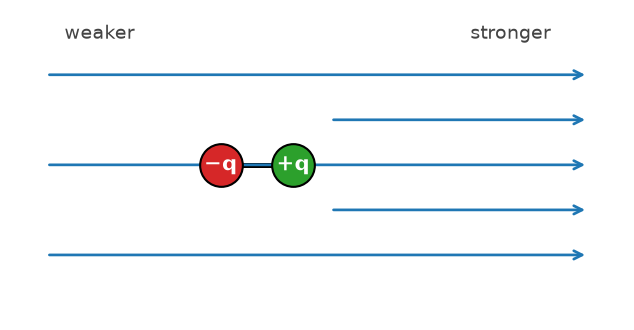
NEET 2021 Physics question — A dipole is placed in a non-uniform electric field as shown. In which direction will it…
  1. A.towards the left as its potential energy will decrease
  2. B.towards the right as its potential energy will increase
  3. C.towards the left as its potential energy will increase
  4. D.towards the right as its potential energy will decrease

Correct Answer

(D) towards the right as its potential energy will decrease

Solution & Explanation

Answer: (d) Solution: In a non-uniform electric field the two charges of the dipole experience unequal forces, so there is a net translational force in addition to any torque. A dipole always tends to move toward the region of stronger field, because doing so lowers its potential energy U = −p·E (the field magnitude is larger there once the dipole is aligned). From the figure, the stronger field (and lower PE) lies to the right, so the dipole moves toward the right as its potential energy decreases. Hence option (d).

🎯
43,000+ questions in हिंदी & English · one-tap toggle
Practice NEET 2021 Physics — free, with instant solutions
43,000+ NEET questions solved step-by-step, chapter-wise, in the MedicNEET app.
📚Practice all NEET Physics PYQs chapter-wise 💡Don't get it? Learn the Electric Charges And Fields concepts

More NEET PYQ solutions

PhysAn electric dipole with dipole moment 5 × 10⁻⁶ C m is aligned with the direction of a uniform electric field of magnitude 4 × 10⁵ N/C. The dipole is then rotated through an angle of 60° with respect to the electric field. The change in the potential energy of the dipole is:PhysAn electric dipole is placed at an angle of 30° with an electric field of intensity 2 × 10⁵ N/C. It experiences a torque equal to 4 N·m. The charge on the dipole, if the dipole length is 2 cm, isPhysAn electric dipole is placed at an angle of 30° with an electric field of intensity 2 × 10⁵ N C⁻¹. It experiences a torque equal to 4 N m. Calculate the magnitude of charge on the dipole, if the dipole length is 2 cm.PhysAn electric dipole with dipole moment 5 × 10⁻⁶ C·m is aligned with the direction of a uniform electric field of magnitude 4 × 10⁵ N/C. The dipole is then rotated through an angle of 60° with respect to the electric field. The change in the potential energy of the dipole is:PhysTwo identical charged conducting spheres A and B have their centres separated by a certain distance. Charge on each sphere is q and the force of repulsion between them is F. A third identical uncharged conducting sphere is brought in contact with sphere A first and then with B and finally removed from both. New force of repulsion between spheres A and B (radii negligible vs separation, treated as point charges) is best given as:PhysThe plates of a parallel plate capacitor are separated by d. Two slabs of different dielectric constant K1 and K2 with thickness 3d/8 and d/2 respectively are inserted in the capacitor. Due to this, the capacitance becomes two times larger than when there is nothing between the plates. If K1/K2 = 1.25, the value of K1 is:PhysA sphere of radius R is carved out of a uniform solid sphere of radius 2R (internally tangent, so its centre is at distance R from the big centre). The ratio of the moment of inertia of the small sphere to that of the remaining part, both about the Y-axis through the big sphere's centre, is:PhysThe Sun rotates once in 27 days. If it expanded to twice its present radius (uniform-density sphere, no external influence), its new period would be about: