
The major product formed in the following conversion is: A cyclopentanone bearing a (2-oxopropyl) side chain treated with (i) , then (ii) , heat.
Answer: (C) (C). \textbf{Answer:} (C) cyclopentene ring (endocyclic ) bearing an internal prop-1-enyl side chain \textbf{Solution:} reduces both carbonyl groups (the ring ketone and the side-chain ketone) to secondary alcohols, giving a diol.
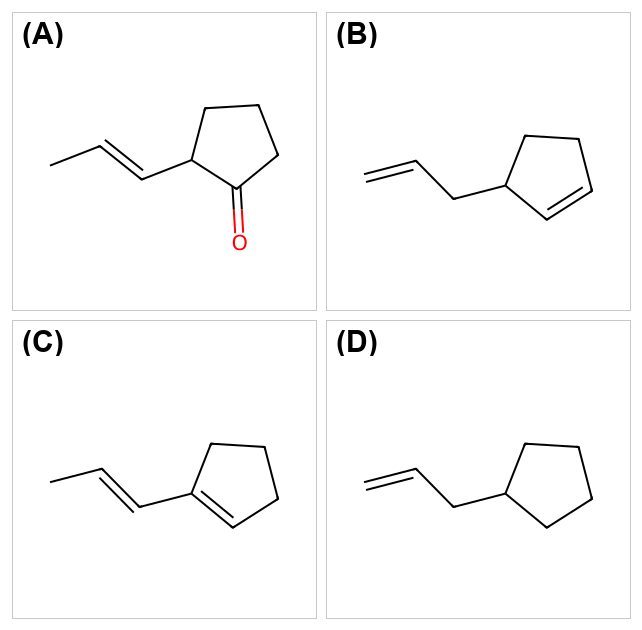
- A.(A)
- B.(B)
- C.(C)✓
- D.(D)
Correct Answer
(C) (C)
Solution & Explanation
\textbf{Answer:} (C) cyclopentene ring (endocyclic ) bearing an internal prop-1-enyl side chain \textbf{Solution:} reduces both carbonyl groups (the ring ketone and the side-chain ketone) to secondary alcohols, giving a diol. On heating with , each alcohol undergoes acid-catalysed E1 dehydration to the more substituted (Saytzeff) alkene: the ring gives an endocyclic cyclopentene double bond and the side-chain gives an internal prop-1-enyl double bond. The major product is this doubly dehydrated diene.