
The carbocation C₆H₅-+CH-CH₃ (1-phenylethyl cation) is stabilized by the interaction of the empty p orbital with:
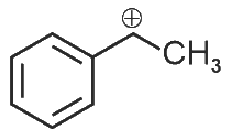
- A.filled σ and filled π orbitals✓
- B.empty σ and empty π* orbitals
- C.empty σ* and filled π orbitals
- D.empty σ* and empty π* orbitals
Correct Answer
(A) filled σ and filled π orbitals
Solution & Explanation
Concept — A carbocation is electron-deficient: the central positive carbon is sp² with an empty p orbital. It is stabilised when nearby electron pairs (filled orbitals) can donate density into that empty p orbital. Donation always comes from FILLED orbitals into the EMPTY one. For C₆H₅–⁺CH–CH₃ (the 1-phenylethyl / benzylic cation) there are two such filled donors: (1) Resonance/conjugation: the benzene ring's filled π orbitals overlap with the empty p orbital, delocalising the positive charge onto the ortho and para ring carbons. This is the dominant stabilisation (benzylic). (2) Hyperconjugation: the filled σ (C–H) bonding orbitals of the adjacent CH₃ group overlap with the empty p orbital, donating σ electron density. Both donors — the ring π and the C–H σ — are FILLED orbitals. Why the others fail: empty orbitals (σ*, π*) have no electrons to donate, so they cannot stabilise an already electron-deficient cation; options (B), (C) and (D) all invoke empty/antibonding orbitals. Hence the empty p orbital is stabilised by filled σ and filled π orbitals — option A.
✅ We had this exact concept in our bank before the exam — Concept match, 80% match.
That's the Predicted Batch — it trains you on the exact high-probability concepts NEET repeats every year. 98% of the 2026 paper (176/180) was in our bank before the exam.
Master these concepts + 50,000+ NEET PYQs in the app — free, built for NEET 2027.
Start the Predicted Batch — Free →