
Meiosis II — Mitosis-Like Division of Haploid Cells with Sister Chromatids
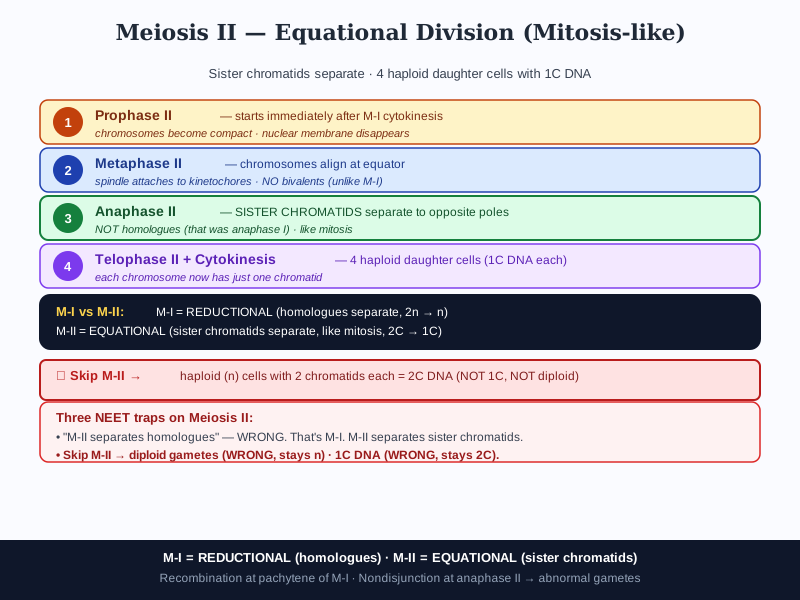
📚 Practice ConceptProphase II: Meiosis II is initiated immediately after cytokinesis, usually before the chromosomes have fully elongated. In contrast to meiosis I, meiosis II resembles a normal mitosis. The nuclear membrane disappears by the end of prophase II. The chromosomes again become compact.
The primary purpose of Meiosis II is to separate homologous chromosomes, leading to reduction of chromosome number.
Meiosis II separates SISTER CHROMATIDS (like mitosis). Homologous chromosomes are separated in MEIOSIS I (the reductional division).
Meiosis I = REDUCTIONAL (homologue separation, 2n→n). Meiosis II = EQUATIONAL (sister chromatid separation, like mitosis). Skip M-II → 2C haploid cells.
- Meiosis II starts immediately after cytokinesis of M-I, often before chromosomes elongate fully.
- Meiosis II RESEMBLES normal mitosis — separates SISTER CHROMATIDS (no bivalents, no crossing over).
- If M-II is skipped: 2 haploid cells retain chromosomes with 2 sister chromatids each (DNA = 2C, not 1C).
- Nondisjunction in anaphase II → gametes with abnormal chromosome numbers. Recombination = pachytene of M-I.
Which of the following statements regarding the role and implications of Meiosis II are NOT correct? S1: If a cell skips Meiosis II, the two cells after Meiosis I will each contain a haploid number of chromosomes, but each chromosome will still consist of two sister chromatids. S2: Skipping Meiosis II would result in formation of two diploid gametes, thereby maintaining the diploid chromosome number across generations. S3: The primary purpose of Meiosis II is to separate homologous chromosomes, leading to reduction of chromosome number. S4: Nondisjunction of sister chromatids during Anaphase II would lead to gametes with abnormal chromosome numbers. S5: Genetic recombination is crucial for increasing genetic variability and occurs primarily during the pachytene stage of Meiosis I. S6: In the absence of Meiosis II, the DNA content of the resulting cells would be 1C, similar to normal haploid gametes.
View bonus solution & explanation
Correct answer: B — S2, S3 and S6
S2 INCORRECT: Skipping M-II would NOT make gametes diploid — they remain haploid (n) but each chromosome still has 2 sister chromatids. The haploid count is set by M-I; M-II doesn't change ploidy. S3 INCORRECT: M-II separates SISTER CHROMATIDS (like mitosis), NOT homologous chromosomes. Homologue separation is M-I (reductional). S6 INCORRECT: Without M-II, DNA content would be 2C (chromosomes still have 2 chromatids), NOT 1C. Wrong statements: S2, S3, S6 → answer B. S1, S4, S5 are correct.
What is Meiosis II?
What did NEET previous years ask on Meiosis II?
What is the most common NEET trap on Meiosis II?
How do you remember Meiosis II for NEET?
What are the key components of Meiosis II?
Through deep analysis of NEET and NTA, 176 of the 180 ReNEET 2026 (June 21) questions were already in the MedicNEET question bank before the exam.
176/180MedicNEET's Biology question bank is built from the same NCERT lines NTA picks repeatedly. Not random MCQs — questions crafted exactly like NTA crafts them.
You just learned this concept. The free app turns it into a daily goal built from your weak topics and brings it back just before you forget it — using active recall and spaced repetition — so it stays till exam day.