
Mitochondria — Sausage-Shaped, Double Membrane, Inner Membrane Permeability
✅ Asked in NEET 2024Given below are two statements: Statement I: Mitochondria and chloroplasts both double membranes bound organelles. Statement II: Inner membrane of mitochondria is relatively less permeable, as compared to chloroplast. Choose the correct answer:
Given below are two statements: Statement I: Mitochondria and chloroplasts both double membranes bound organelles. Statement II: Inner membrane of mitochondria is relatively less permeable, as compared to chloroplast. Choose the correct answer:
Answer & NCERT explanation
Correct answer: C — Statement I is correct but Statement II is incorrect
Statement I is correct - both mitochondria and chloroplasts have double membranes. Statement II is incorrect - inner mitochondrial membrane is actually MORE permeable than chloroplast inner membrane due to presence of numerous transport proteins and porins.
Read more NCERT concept on the PYQ
Mitochondria (sing.: mitochondrion), unless specifically stained, are not easily visible under the microscope. The number of mitochondria per cell is variable depending on the physiological activity of the cells. In terms of shape and size also, considerable degree of variability is observed. Typically it is sausage-shaped or cylindrical having a diameter of 0.2-1.0μm (average 0.5μm) and length 1.0-4.1μm. Each mitochondrion is a double
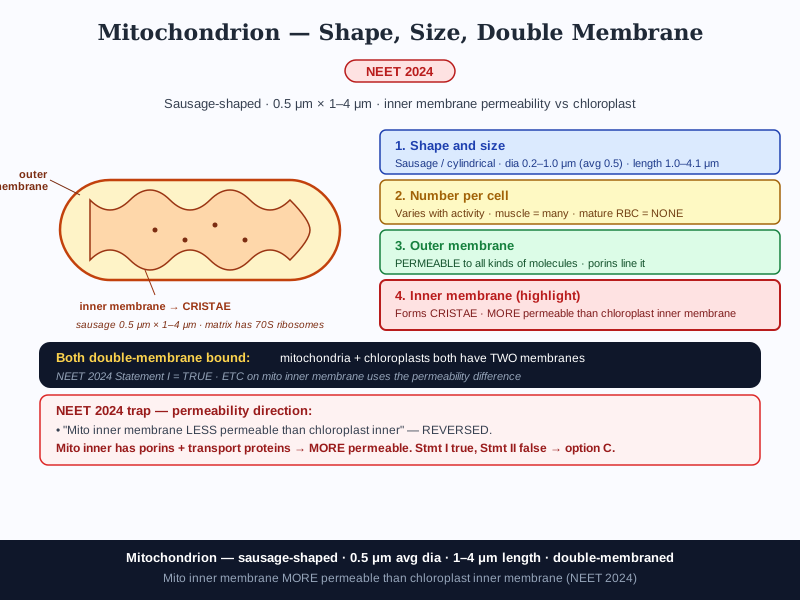
MITOCHONDRIA (sing.: mitochondrion) are not easily visible under the microscope unless specifically stained. The NUMBER per cell varies with the PHYSIOLOGICAL ACTIVITY of the cell. Mitochondria are typically SAUSAGE-SHAPED or CYLINDRICAL, with a diameter of 0.2-1.0 μm (average 0.5 μm) and length 1.0-4.1 μm. Each mitochondrion is a DOUBLE MEMBRANE-BOUND organelle — the OUTER and INNER membranes divide the lumen into TWO COMPARTMENTS. The OUTER membrane is PERMEABLE to all kinds of molecules; the INNER membrane forms CRISTAE and is RELATIVELY PERMEABLE (more permeable than the chloroplast inner membrane) due to numerous transport proteins and porins. CHLOROPLASTS are also double-membrane bound; their inner membrane is LESS permeable than mitochondrial inner membrane.
NEET 2024 trap: 'Inner mitochondrial membrane is LESS permeable than chloroplast' — REVERSED. Inner mitochondrial membrane has many transport proteins/porins, so it is MORE permeable than chloroplast inner membrane. Both organelles are double-membrane bound (Statement I TRUE). So Statement I correct, Statement II incorrect → option C. Memory: mitochondrion = sausage shape, 0.5 μm average diameter, 1-4 μm length, variable number per cell based on activity (e.g., muscle cells have many; RBCs have none).
The inner membrane of mitochondria is relatively LESS permeable than the inner membrane of chloroplasts.
The inner membrane of mitochondria is relatively MORE permeable than the chloroplast inner membrane (due to transport proteins and porins).
Both = double membrane. Mitochondrion inner membrane = MORE permeable than chloroplast inner membrane. Mito = sausage, 0.5 μm × 1-4 μm.
- Mitochondria are sausage-shaped/cylindrical; diameter 0.2-1.0 μm (avg 0.5 μm); length 1.0-4.1 μm.
- Number per cell varies with physiological activity (high in muscle cells, zero in RBCs).
- Both mitochondria and chloroplasts are DOUBLE membrane-bound organelles (NEET 2024 Statement I).
- Inner mitochondrial membrane is MORE permeable than chloroplast inner membrane (porins + transport proteins).
What is Mitochondria?
What did NEET 2024 ask on Mitochondria?
What is the most common NEET trap on Mitochondria?
How do you remember Mitochondria for NEET?
What are the key components of Mitochondria?
Through deep analysis of NEET and NTA, 176 of the 180 ReNEET 2026 (June 21) questions were already in the MedicNEET question bank before the exam.
176/180MedicNEET's Biology question bank is built from the same NCERT lines NTA picks repeatedly. Not random MCQs — questions crafted exactly like NTA crafts them.
You just learned this concept. The free app turns it into a daily goal built from your weak topics and brings it back just before you forget it — using active recall and spaced repetition — so it stays till exam day.