
Mitochondria Structure — Cristae, Matrix, DNA, 70S Ribosomes, Semi-autonomous
✅ Asked in NEET 2021Match List–I with List–II: List–I (a) Cristae (b) Thylakoids (c) Centromere (d) Cisternae List–II (i) Primary constriction in chromosome (ii) Disc-shaped sacs in Golgi apparatus (iii) Infoldings in mitochondria (iv) Flattened membranous sacs in stroma of plastids NEET 2021
Match List–I with List–II: List–I (a) Cristae (b) Thylakoids (c) Centromere (d) Cisternae List–II (i) Primary constriction in chromosome (ii) Disc-shaped sacs in Golgi apparatus (iii) Infoldings in mitochondria (iv) Flattened membranous sacs in stroma of plastids NEET 2021
Which of the following statements regarding mitochondria is incorrect? NEET 2019
Which of the following cell organelles is responsible for extracting energy from carbohydrates to form ATP? (NEET 2017)
Mitochondria and chloroplast are (A) Semi-autonomous organelles (B) Formed by division of pre-existing organelles and they contain DNA but lack protein synthesising machinery. Which one of the following options is correct? (NEET 2016 Phase 1)
Answer & NCERT explanation
Correct answer: A — (a–iii), (b–iv), (c–i), (d–ii)
Cristae are infoldings in mitochondria (a-iii), thylakoids are flattened sacs in chloroplast stroma (b-iv), centromere is primary constriction in chromosome (c-i), and cisternae are disc-shaped sacs in Golgi apparatus (d-ii). These structural features are characteristic of their respective organelles.
Read more NCERT concept on the PYQ
The inner compartment is filled with a dense homogeneous substance called the matrix. The outer membrane forms the continuous limiting boundary of the organelle. The inner membrane forms a number of infoldings called the cristae (sing.: crista) towards the matrix. The cristae increase the surface area. The two membranes have their own specific enzymes associated with the mitochondrial function. Mitochondria are the sites of aerobic respiration. They produce cellular energy in the form of ATP, hence they are called 'power houses' of the cell. The matrix also possesses single circular DNA molecule, a few RNA molecules, ribosomes (70S) and the components required for the synthesis of proteins. The mitochondria divide by fission.
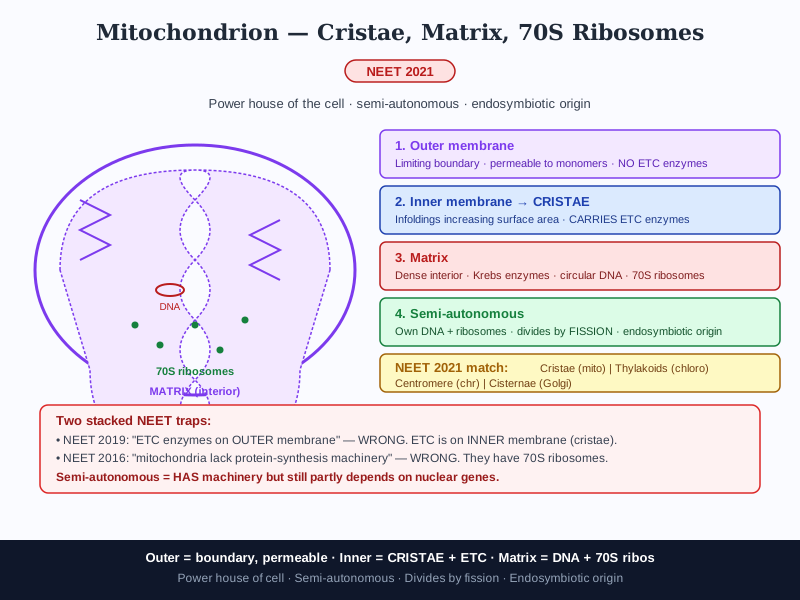
Mitochondria are the 'power houses' of the cell and the sites of AEROBIC RESPIRATION, producing ATP. Structure: a DOUBLE MEMBRANE organelle. The OUTER membrane forms the continuous limiting boundary. The INNER membrane forms infoldings called CRISTAE that project into the matrix and INCREASE SURFACE AREA for ATP synthesis. The MATRIX (inner compartment) is a dense homogeneous substance containing a SINGLE CIRCULAR DNA molecule, a few RNA molecules, 70S RIBOSOMES and the components needed for protein synthesis. Both membranes carry their own specific enzymes. Mitochondria divide by FISSION and are SEMI-AUTONOMOUS — they have DNA and ribosomes (can make some proteins) but depend on nuclear-coded proteins for full function.
NEET 2021 matching: Cristae → infoldings in mitochondria; Thylakoids → flattened membranous sacs in chloroplast stroma; Centromere → primary constriction in chromosome; Cisternae → disc-shaped sacs in Golgi. NEET 2019 trap: electron transport enzymes are on the INNER membrane, NOT the outer — outer membrane is permeable to small molecules. NEET 2016: mitochondria/chloroplasts are SEMI-AUTONOMOUS — the claim that they LACK protein-synthesising machinery is FALSE (they have 70S ribosomes). Mitochondrial DNA is CIRCULAR (prokaryotic-like, supporting the endosymbiotic theory).
Enzymes of the electron transport chain are embedded in the OUTER membrane of mitochondria.
ETC enzymes are on the INNER membrane (along the cristae). The OUTER membrane is permeable to small molecules and lacks ETC enzymes.
INNER = cristae + ETC. OUTER = boundary, permeable. Matrix = 1 circular DNA + 70S ribosomes. Semi-autonomous.
- Outer membrane = limiting boundary; permeable to monomers. Inner membrane = cristae (infoldings) carrying ETC enzymes.
- Matrix contains: SINGLE CIRCULAR DNA, RNA, 70S ribosomes, enzymes of Krebs cycle.
- Mitochondria are SEMI-AUTONOMOUS — they have DNA and ribosomes but still depend on nuclear genes.
- Mitochondria divide by FISSION. 70S ribosomes (prokaryote-like) support endosymbiotic origin.
Consider the following statements about mitochondria: S1: The inner membrane forms infoldings called cristae that project into the matrix and increase surface area. S2: The matrix contains a single circular DNA molecule, RNA molecules and 70S ribosomes. S3: Enzymes of the electron transport chain are embedded in the outer membrane. S4: Mitochondria are semi-autonomous organelles that divide by fission. S5: Cristae correspond to infoldings in mitochondria — paired with thylakoids (chloroplast stroma sacs) in NEET 2021 matching.
View bonus solution & explanation
Correct answer: B — S1, S2, S4 and S5
S1 CORRECT: Cristae are inner-membrane infoldings (NCERT exact). S2 CORRECT: Matrix has single circular DNA + 70S ribosomes (prokaryote-like). S3 WRONG: ETC enzymes are on the INNER membrane (NEET 2019 explicit) — the outer membrane is permeable to small molecules and lacks ETC. S4 CORRECT: Semi-autonomous + divide by fission (NEET 2016 supports). S5 CORRECT: NEET 2021 matched cristae-infoldings-mitochondria and thylakoids-chloroplast-stroma-sacs.
What is Mitochondria Structure?
What did NEET 2021 ask on Mitochondria Structure?
What is the most common NEET trap on Mitochondria Structure?
How do you remember Mitochondria Structure for NEET?
What are the key components of Mitochondria Structure?
Through deep analysis of NEET and NTA, 176 of the 180 ReNEET 2026 (June 21) questions were already in the MedicNEET question bank before the exam.
176/180MedicNEET's Biology question bank is built from the same NCERT lines NTA picks repeatedly. Not random MCQs — questions crafted exactly like NTA crafts them.
You just learned this concept. The free app turns it into a daily goal built from your weak topics and brings it back just before you forget it — using active recall and spaced repetition — so it stays till exam day.