
Intravenous Drug Use — AIDS and Hepatitis B via Infected Needles
📚 Practice ConceptThose who take drugs intravenously (direct injection into the vein using a needle and syringe), are much more likely to acquire serious infections like AIDS and Hepatitis B. The viruses, which are responsible for these diseases, are transferred from one person to another by sharing of infected needles and syringes. Both AIDS and Hepatitis B infections are chronic infections and ultimately fatal. Both can be transmitted through sexual contact or infected blood.
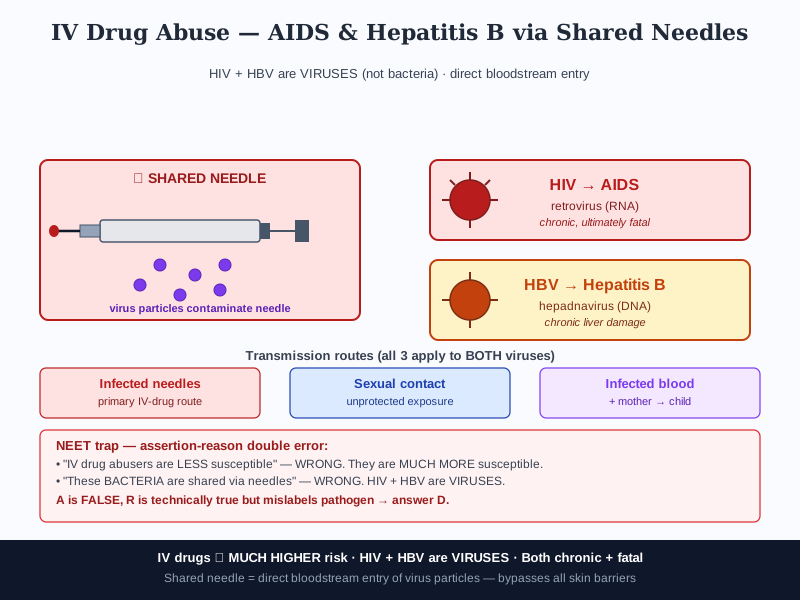
IV drug abusers are less susceptible to AIDS/Hepatitis B. These bacteria are shared via infected needles.
IV drug abusers are MUCH MORE susceptible. HIV and HBV are VIRUSES (not bacteria) shared via infected needles.
IV drugs = MORE risk. HIV + HBV = VIRUSES. Shared needle = direct bloodstream entry of virus.
- HIV (AIDS) and HBV (Hepatitis B): both chronic, both ultimately fatal, both VIRAL infections.
- Transmission routes: infected needles/syringes, sexual contact, infected blood, mother-to-child.
- IV drug abusers share needles → direct bloodstream exposure → very high infection risk.
- HIV = retrovirus (RNA). HBV = hepadnavirus (DNA). Both enveloped viruses.
Consider the following about diseases associated with intravenous drug abuse: S1: Intravenous drug users are at much higher risk of acquiring AIDS and Hepatitis B than the general population. S2: HIV and Hepatitis B virus are transferred between individuals by sharing infected needles and syringes. S3: Both AIDS and Hepatitis B are bacterial infections that can be treated with antibiotics. S4: Both AIDS and Hepatitis B can also be transmitted through sexual contact and infected blood. S5: Both AIDS and Hepatitis B are chronic infections that are ultimately fatal.
View bonus solution & explanation
Correct answer: B — S1, S2, S4 and S5
S1 CORRECT: IV drug users are MUCH MORE LIKELY to acquire AIDS/Hepatitis B (NCERT exact). S2 CORRECT: HIV and HBV transferred by sharing infected needles/syringes. S3 WRONG: Both are VIRAL infections — HIV (retrovirus) and HBV (hepadnavirus). Antibiotics target bacteria, not viruses. S4 CORRECT: Both also transmitted via sexual contact or infected blood. S5 CORRECT: Both are chronic infections and ultimately fatal (NCERT explicit).
What is Intravenous Drug Use?
What did NEET previous years ask on Intravenous Drug Use?
What is the most common NEET trap on Intravenous Drug Use?
How do you remember Intravenous Drug Use for NEET?
What are the key components of Intravenous Drug Use?
Through deep analysis of NEET and NTA, 176 of the 180 ReNEET 2026 (June 21) questions were already in the MedicNEET question bank before the exam.
176/180MedicNEET's Biology question bank is built from the same NCERT lines NTA picks repeatedly. Not random MCQs — questions crafted exactly like NTA crafts them.
You just learned this concept. The free app turns it into a daily goal built from your weak topics and brings it back just before you forget it — using active recall and spaced repetition — so it stays till exam day.