
Testes in Scrotum — 2-2.5°C Below Body Temperature for Spermatogenesis
📚 Practice ConceptThe testes are situated outside the abdominal cavity within a pouch called scrotum. The scrotum helps in maintaining the low temperature of the testes (2–2.5° C lower than the normal internal body temperature) necessary for spermatogenesis. In adults, each testis is oval in shape, with a length of about 4 to 5 cm and a width of about 2 to 3 cm. The testis is covered by a dense covering. Each testis has about 250 compartments called testicular lobules.
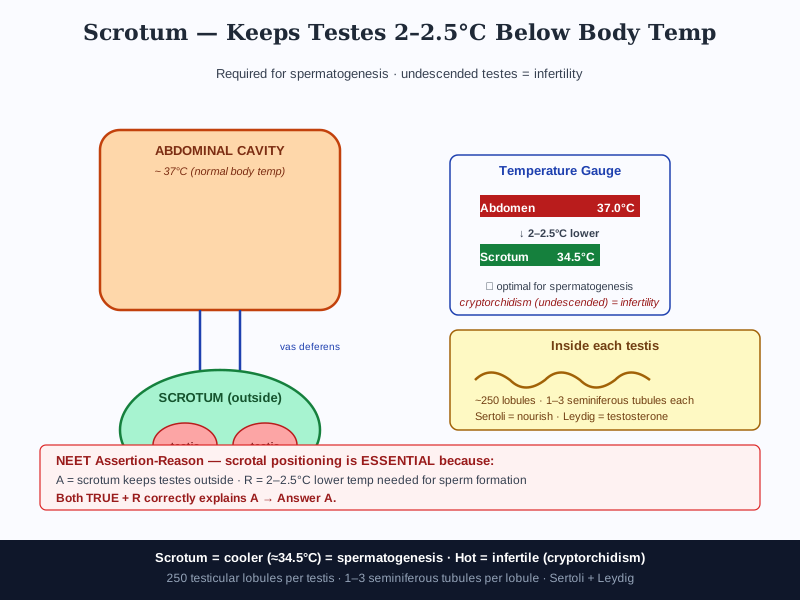
The scrotum is inside the abdominal cavity and maintains normal body temperature for sperm production.
Scrotum is OUTSIDE abdominal cavity. Maintains 2-2.5°C BELOW body temperature. Essential for spermatogenesis.
Scrotum = cooler = 2-2.5°C below = spermatogenesis. Hot = infertile (cryptorchidism).
- Testes: outside abdomen in scrotum | oval shape | 4-5 cm length | 2-3 cm width.
- ~250 testicular lobules per testis, each with 1-3 seminiferous tubules.
- Temperature requirement: 2-2.5°C below body temperature — essential for spermatogenesis.
- Sertoli cells nourish developing sperm. Leydig (interstitial) cells secrete testosterone.
Assertion (A): The positioning of testes within the scrotum outside the abdominal cavity is essential for male fertility. Reason (R): Spermatogenesis requires a temperature of 2-2.5°C lower than the normal internal body temperature. Additionally, which of the following about testicular structure is CORRECT? S1: Each testis contains approximately 250 testicular lobules. S2: Each testicular lobule contains 3-5 seminiferous tubules. S3: The scrotum helps maintain the low temperature necessary for spermatogenesis.
View bonus solution & explanation
Correct answer: A — A and R both true; R explains A. S1 and S3 correct.
Assertion TRUE: Scrotal position is essential for fertility. Reason TRUE: Spermatogenesis requires 2-2.5°C below body temperature (NCERT exact). R correctly explains A — the low temperature requirement explains why the testes must be outside the warm abdominal cavity. S1 CORRECT: ~250 testicular lobules per testis. S2 WRONG: Each lobule has 1-3 (not 3-5) seminiferous tubules. S3 CORRECT: Scrotum maintains reduced temperature.
What is Testes in Scrotum?
What did NEET previous years ask on Testes in Scrotum?
What is the most common NEET trap on Testes in Scrotum?
How do you remember Testes in Scrotum for NEET?
What are the key components of Testes in Scrotum?
Through deep analysis of NEET and NTA, 176 of the 180 ReNEET 2026 (June 21) questions were already in the MedicNEET question bank before the exam.
176/180MedicNEET's Biology question bank is built from the same NCERT lines NTA picks repeatedly. Not random MCQs — questions crafted exactly like NTA crafts them.
You just learned this concept. The free app turns it into a daily goal built from your weak topics and brings it back just before you forget it — using active recall and spaced repetition — so it stays till exam day.