
VNTR — Mini-Satellite DNA for DNA Fingerprinting
📚 Practice ConceptThe VNTR belongs to a class of satellite DNA referred to as mini-satellite. A small DNA sequence is arranged tandemly in many copy numbers. The copy number varies from chromosome to chromosome in an individual. The numbers of repeats show very high degree of polymorphism. As a result the size of VNTR varies in size from 0.1 to 20 kb. Consequently, after hybridisation with VNTR probe, the autoradiogram gives many bands of differing sizes. These bands give a characteristic pattern for an individual DNA. It differs from individual to individual in a population except in the case of monozygotic (identical) twins. The sensitivity of the technique has been increased by use of polymerase chain reaction (PCR- you will study about it in Chapter 9). Consequently, DNA from a single cell is enough to perform DNA fingerprinting analysis. In addition to application in forensic science, it has much wider application, such as
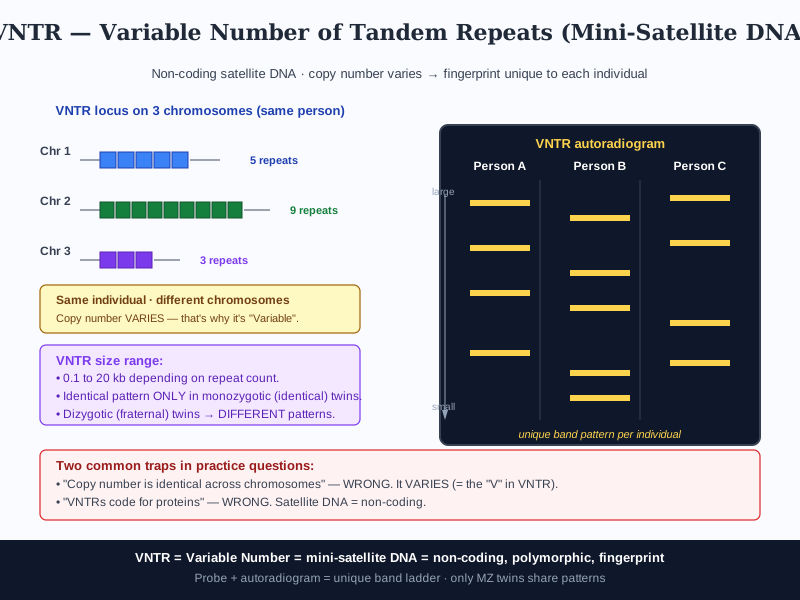
Copy number of VNTRs is identical across all chromosomes in an individual. VNTRs code for essential proteins.
Copy number VARIES from chromosome to chromosome (that's why it's VARIABLE Number). VNTRs are non-coding satellite DNA — they do NOT code for proteins.
VNTR = Variable Number = copy number VARIES. Satellite DNA = non-coding = no protein. Unique to individual except MZ twins.
- VNTR = mini-satellite DNA | small sequence arranged in tandem repeats | copy number varies per chromosome.
- Size range: 0.1 to 20 kb depending on repeat number.
- VNTR probe hybridisation → autoradiogram → unique band pattern per individual.
- Identical pattern only in monozygotic (identical) twins — not in dizygotic twins.
Which of the following statements about VNTRs and DNA fingerprinting are NOT CORRECT? S1: VNTRs are a class of mini-satellite DNA where a small sequence is arranged tandemly in many copy numbers. S2: The copy number of VNTRs is identical across all chromosomes within an individual. S3: VNTR sequences code for essential proteins contributing to an individual's phenotypic traits. S4: High polymorphism in VNTRs refers to variability in repeat numbers between individuals. S5: Monozygotic twins exhibit identical VNTR banding patterns due to their shared genetic origin.
View bonus solution & explanation
Correct answer: B — S2 and S3
S1 CORRECT: VNTRs = mini-satellite DNA with small sequence in tandem repeats. S2 WRONG: Copy number VARIES from chromosome to chromosome — this is the 'variable number' in VNTR (NCERT: 'copy number varies from chromosome to chromosome'). S3 WRONG: VNTRs are non-coding satellite sequences — they do NOT code for proteins. S4 CORRECT: High polymorphism = variability in repeat numbers between individuals — making each fingerprint unique. S5 CORRECT: Monozygotic twins share identical DNA → identical VNTR patterns (NCERT exception).
What is VNTR?
What did NEET previous years ask on VNTR?
What is the most common NEET trap on VNTR?
How do you remember VNTR for NEET?
What are the key components of VNTR?
Through deep analysis of NEET and NTA, 176 of the 180 ReNEET 2026 (June 21) questions were already in the MedicNEET question bank before the exam.
176/180MedicNEET's Biology question bank is built from the same NCERT lines NTA picks repeatedly. Not random MCQs — questions crafted exactly like NTA crafts them.
You just learned this concept. The free app turns it into a daily goal built from your weak topics and brings it back just before you forget it — using active recall and spaced repetition — so it stays till exam day.