
Reproductive Health — WHO Definition: Total Well-Being in All Aspects of Reproduction
✅ Asked in NEET 2023Which of the following statements are correct? (NEET 2023) A. Reproductive health refers to total well-being in all aspects of reproduction B. Amniocentesis is legally banned for sex determination in India C. "Saheli" – an oral contraceptive for females was developed in collaboration with ICMR (New Delhi) D. Amniocentesis is used to determine genetic disorders and survivability of foetus Choose the most appropriate answer:
Which of the following statements are correct? (NEET 2023) A. Reproductive health refers to total well-being in all aspects of reproduction B. Amniocentesis is legally banned for sex determination in India C. "Saheli" – an oral contraceptive for females was developed in collaboration with ICMR (New Delhi) D. Amniocentesis is used to determine genetic disorders and survivability of foetus Choose the most appropriate answer:
Answer & NCERT explanation
Correct answer: D — , (B) and (D) only
Statement A is correct as reproductive health encompasses physical, mental and social well-being in reproduction. Statement B is correct - amniocentesis for sex determination is legally banned in India under PNDT Act to prevent female foeticide. Statement C is incorrect - 'Saheli' was developed by CDRI Lucknow, not in collaboration with ICMR. Statement D is correct - amniocentesis detects chromosomal abnormalities like Down's syndrome and assesses foetal viability.
Read more NCERT concept on the PYQ
You have learnt about human reproductive system and its functions in Chapter 2. Now, let's discuss a closely related topic – reproductive health. What do we understand by this term? The term simply refers to healthy reproductive organs with normal functions. However, it has a broader perspective and includes the emotional and social aspects of reproduction also. According to the World Health Organisation (WHO), reproductive health means a total well-being in all aspects of reproduction, i.e., physical, emotional, behavioural and social. Therefore, a society with people having physically and functionally normal reproductive organs and normal emotional and behavioural interactions among them in all sex-related aspects might be called reproductively healthy. Why is it significant to maintain reproductive health and what are the methods taken up to achieve it? Let us examine them.
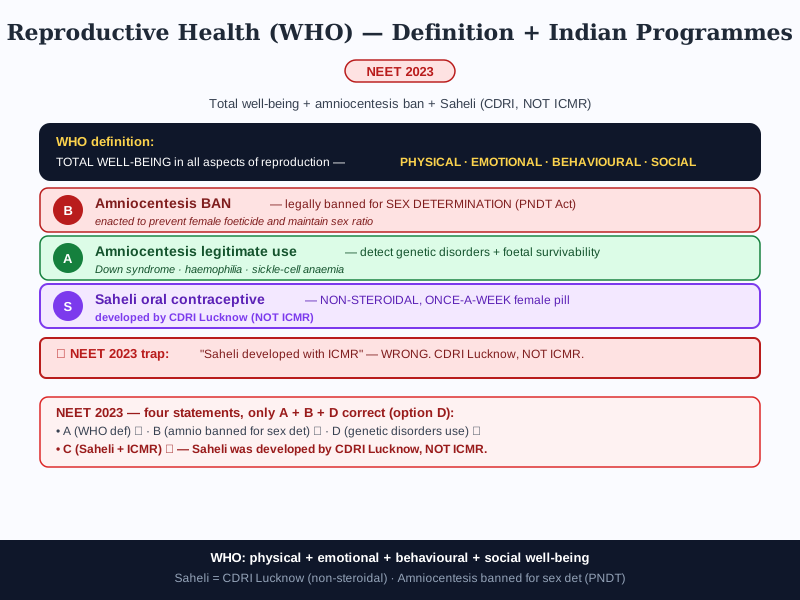
REPRODUCTIVE HEALTH simply refers to HEALTHY REPRODUCTIVE ORGANS with NORMAL FUNCTIONS, but the term has a BROADER PERSPECTIVE that includes EMOTIONAL and SOCIAL aspects of reproduction. According to the WORLD HEALTH ORGANISATION (WHO), reproductive health means TOTAL WELL-BEING in ALL ASPECTS of reproduction — PHYSICAL, EMOTIONAL, BEHAVIOURAL, and SOCIAL. A society is reproductively healthy when people have physically and functionally normal reproductive organs AND normal emotional/behavioural interactions in all sex-related aspects. Indian initiatives include amniocentesis BAN for sex determination (PNDT Act) to prevent female foeticide, and SAHELI — a NON-STEROIDAL oral contraceptive developed by CDRI Lucknow (NOT ICMR). Amniocentesis is used legitimately to detect genetic disorders and foetal survivability.
NEET 2023 tested four statements: A (WHO definition) ✓, B (amniocentesis banned for sex determination) ✓, C (Saheli developed with ICMR) ✗ — it was developed at CDRI Lucknow, NOT ICMR. D (amniocentesis used for genetic disorders + foetal survivability) ✓. Correct answer = A, B, D only. Memory: CDRI = Central Drug Research Institute (Lucknow). ICMR = Indian Council of Medical Research (different organisation). Don't confuse Saheli's origin. WHO four dimensions: physical + emotional + behavioural + social.
Saheli, the non-steroidal oral contraceptive for females, was developed by ICMR (New Delhi) in collaboration with CDRI.
Saheli was developed by CDRI Lucknow (Central Drug Research Institute) — NOT in collaboration with ICMR. Saheli = non-steroidal, once-a-week female pill.
Saheli = CDRI Lucknow (non-steroidal, once-weekly). WHO reproductive health = physical + emotional + behavioural + social well-being.
- WHO definition: total well-being in physical, emotional, behavioural and social aspects of reproduction.
- Amniocentesis is legally BANNED in India for sex determination (PNDT Act) — prevents female foeticide.
- Saheli = non-steroidal oral contraceptive developed by CDRI LUCKNOW (NOT ICMR).
- Amniocentesis legitimate use: detect genetic disorders (Down syndrome, haemophilia, sickle-cell anaemia) and foetal survivability.
What is Reproductive Health?
What did NEET 2023 ask on Reproductive Health?
What is the most common NEET trap on Reproductive Health?
How do you remember Reproductive Health for NEET?
What are the key components of Reproductive Health?
Through deep analysis of NEET and NTA, 176 of the 180 ReNEET 2026 (June 21) questions were already in the MedicNEET question bank before the exam.
176/180MedicNEET's Biology question bank is built from the same NCERT lines NTA picks repeatedly. Not random MCQs — questions crafted exactly like NTA crafts them.
You just learned this concept. The free app turns it into a daily goal built from your weak topics and brings it back just before you forget it — using active recall and spaced repetition — so it stays till exam day.