
Amniocentesis — Foetal Diagnosis Tool BANNED for Sex Determination in India
✅ Asked in NEET 2023Given below are two statements: one is labelled as Assertion A and the other is labelled as Reason R. (NEET 2023) Assertion A: Amniocentesis for sex determination is one of the strategies of Reproductive and Child Health Care Programme. Reason R: Ban on amniocentesis checks increasing menace of female foeticide. In the light of the above statements, choose the correct answer from the options given below:
Given below are two statements: one is labelled as Assertion A and the other is labelled as Reason R. (NEET 2023) Assertion A: Amniocentesis for sex determination is one of the strategies of Reproductive and Child Health Care Programme. Reason R: Ban on amniocentesis checks increasing menace of female foeticide. In the light of the above statements, choose the correct answer from the options given below:
In the context of amniocentesis, which of the following statements is incorrect?
Answer & NCERT explanation
Correct answer: D — A is false but R is true
Assertion A is false because amniocentesis for sex determination is NOT a strategy of RCH programme - it's actually banned in India. The RCH programme focuses on maternal health, family planning, and child survival, not sex determination. Reason R is true as the ban on amniocentesis for sex determination was implemented to prevent female foeticide and maintain gender balance.
Read more NCERT concept on the PYQ
Successful implementation of various action plans to attain reproductive health requires strong infrastructural facilities, professional expertise and material support. These are essential to provide medical assistance and care to people in reproduction-related problems like pregnancy, delivery, STDs, abortions, contraception, menstrual problems, infertility, etc. Implementation of better techniques and new strategies from time to time are also required to provide more efficient care and assistance to people. Statutory ban on amniocentesis for sex-determination to legally check increasing menace of female foeticides, massive child immunisation, etc., are some programmes that merit mention in this connection. In amniocentesis some of the amniotic fluid of the developing foetus is taken to analyse the fetal cells and dissolved substances. This procedure is used to test for the presence of certain genetic disorders such as, down syndrome, haemophilia, sickle-cell anemia, etc., determine the survivability of the foetus.
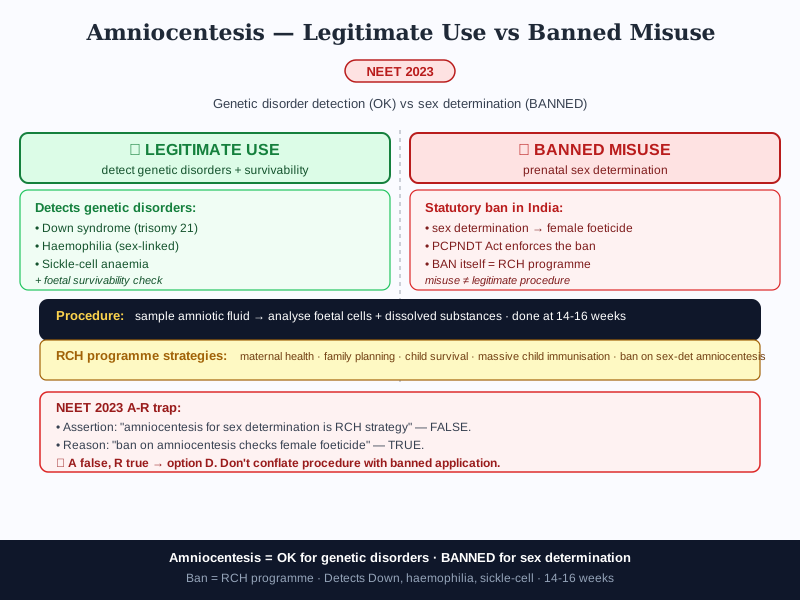
AMNIOCENTESIS is a foetal sex-and-disorder diagnostic test in which a small volume of AMNIOTIC FLUID is sampled from the pregnant uterus to analyse FOETAL CELLS and DISSOLVED SUBSTANCES. It can detect GENETIC DISORDERS such as DOWN SYNDROME, HAEMOPHILIA, SICKLE-CELL ANAEMIA, and can determine the survivability of the foetus. Because amniocentesis was being MISUSED for prenatal SEX DETERMINATION (and subsequent female foeticide), India placed a STATUTORY BAN on amniocentesis for sex determination — this ban is itself an RCH-related programme. The RCH programme focuses on maternal health, family planning, child survival and massive child immunisation — NOT on prenatal sex selection. Amniocentesis is usually done at 14-16 WEEKS of pregnancy.
Two NEET-tested distinctions: (1) Amniocentesis ITSELF is a legitimate diagnostic test for genetic disorders — what is BANNED is its misuse for SEX DETERMINATION. (2) The ban on amniocentesis is a programme of RCH; using amniocentesis for sex determination is NOT. NEET 2023 A-R: Assertion (amniocentesis for sex determination is RCH strategy) = FALSE; Reason (ban on amniocentesis checks female foeticide) = TRUE → option D. Cleft palate CANNOT be detected by amniocentesis (it's a structural defect needing ultrasound).
Amniocentesis for sex determination is one of the strategies of the RCH programme in India.
Amniocentesis for sex determination is BANNED in India. The BAN on amniocentesis is the RCH-related programme — not the procedure itself.
Amniocentesis = OK for detecting genetic disorders. BANNED for sex determination. Ban = RCH programme. 14-16 weeks pregnancy.
- Amniocentesis samples amniotic fluid to analyse foetal cells and dissolved substances (NCERT exact).
- Detects genetic disorders: Down syndrome, haemophilia, sickle-cell anaemia.
- Statutory BAN on amniocentesis for SEX DETERMINATION in India to check female foeticide.
- Usually done at 14-16 weeks of pregnancy. Cannot detect cleft palate (structural defect needing ultrasound).
Consider the following statements about amniocentesis and the RCH programme: S1: Amniocentesis involves sampling amniotic fluid to analyse foetal cells and dissolved substances. S2: Amniocentesis can detect Down syndrome, haemophilia and sickle-cell anaemia. S3: Amniocentesis for sex determination is one of the strategies of the RCH programme in India. S4: The statutory ban on amniocentesis for sex determination was implemented to check female foeticide. S5: Amniocentesis is usually performed when the woman is 14-16 weeks pregnant.
View bonus solution & explanation
Correct answer: B — S1, S2, S4 and S5
S1 CORRECT: NCERT exact — foetal cells + dissolved substances analysed. S2 CORRECT: Detects Down syndrome, haemophilia, sickle-cell anaemia (NCERT). S3 WRONG: NEET 2023 explicit — amniocentesis for sex determination is BANNED, NOT an RCH strategy. The BAN itself is the RCH-related programme. S4 CORRECT: The ban exists precisely to check female foeticide and maintain sex ratio. S5 CORRECT: Performed at 14-16 weeks of pregnancy. Trap: students confuse the legitimate procedure (detecting disorders) with its banned misuse (sex determination).
What is Amniocentesis?
What did NEET 2023 ask on Amniocentesis?
What is the most common NEET trap on Amniocentesis?
How do you remember Amniocentesis for NEET?
What are the key components of Amniocentesis?
Through deep analysis of NEET and NTA, 176 of the 180 ReNEET 2026 (June 21) questions were already in the MedicNEET question bank before the exam.
176/180MedicNEET's Biology question bank is built from the same NCERT lines NTA picks repeatedly. Not random MCQs — questions crafted exactly like NTA crafts them.
You just learned this concept. The free app turns it into a daily goal built from your weak topics and brings it back just before you forget it — using active recall and spaced repetition — so it stays till exam day.