
Entomophily — Insect Pollination: Large, Colourful, Fragrant Flowers with Nectar
✅ Asked in NEET 2023Large, colourful, fragrant flowers with nectar are seen in:
Large, colourful, fragrant flowers with nectar are seen in:
Attractants and rewards are required for (NEET 2017)
Answer & NCERT explanation
Correct answer: A — Insect pollinated plants
Large, colorful, fragrant flowers with nectar are adaptations for insect pollination (entomophily). These features attract insects like bees, butterflies, and moths. The bright colors provide visual signals, fragrances help insects locate flowers from distance, and nectar serves as a reward. Wind-pollinated flowers are small, inconspicuous, and lack nectar. Bird-pollinated flowers are typically red/orange, while bat-pollinated flowers are usually white and bloom at night.
Read more NCERT concept on the PYQ
Majority of insect-pollinated flowers are large, colourful, fragrant and rich in nectar. When the flowers are small, a number of flowers are clustered into an inflorescence to make them conspicuous. Animals are attracted to flowers by colour and/or fragrance. The flowers pollinated by flies and beetles secrete foul odours to attract these animals. To sustain animal visits, the flowers have to provide rewards to the animals. Nectar and pollen grains are the usual floral rewards. For harvesting the reward(s) from the flower the animal visitor comes in contact with the anthers and the stigma. The body of the animal gets a coating of pollen grains, which are generally sticky in animal pollinated flowers. When the animal carrying pollen on its body comes in contact with the stigma, it brings about pollination.
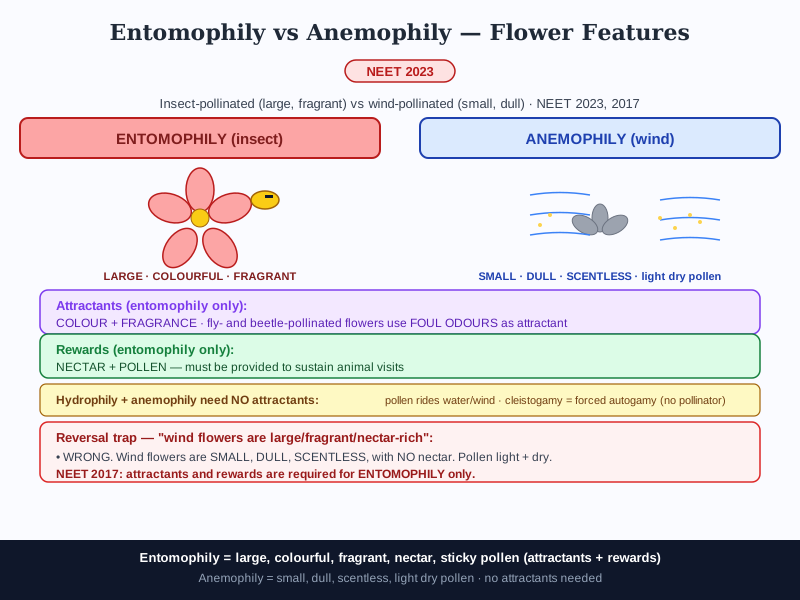
MAJORITY of INSECT-POLLINATED (entomophilous) flowers are LARGE, COLOURFUL, FRAGRANT and RICH IN NECTAR. When flowers are small, they cluster into an INFLORESCENCE to make them conspicuous. Animals are attracted by COLOUR and/or FRAGRANCE. Fly- and beetle-pollinated flowers secrete FOUL ODOURS to attract these animals. To sustain animal visits, flowers must provide REWARDS — usually NECTAR and POLLEN GRAINS. While harvesting rewards, the animal contacts the anthers and the stigma; its body becomes coated with STICKY POLLEN GRAINS (sticky is a feature of animal-pollinated flowers). When the pollen-carrying animal contacts the stigma of another flower, pollination occurs. Contrast: WIND-pollinated (anemophilous) flowers are small, dull, scentless, and produce LIGHT, NON-STICKY, DRY POLLEN in huge quantities.
NEET 2023 direct: 'Large, colourful, fragrant flowers with nectar' = INSECT-pollinated. NEET 2017: 'attractants and rewards are required for' = ENTOMOPHILY (NOT hydrophily, anemophily, or cleistogamy). Attractants = colour + fragrance; rewards = nectar + pollen. Hydrophily and anemophily don't need attractants — pollen rides water/wind. Cleistogamy is self-pollination in closed flowers — no pollinator needed. Bat-pollinated flowers (chiropterophily) are large, dull-coloured, open at night, strong-smelling.
Large, colourful, fragrant flowers with nectar are characteristic of wind-pollinated plants.
Large, colourful, fragrant flowers with nectar are characteristic of INSECT-POLLINATED plants (entomophily). Wind-pollinated flowers are SMALL, dull, scentless.
Insect pollination = LARGE, COLOURFUL, FRAGRANT, NECTAR, STICKY pollen. Wind = small, dull, scentless, light dry pollen in huge amounts.
- Insect-pollinated (entomophilous) flowers: large, colourful, fragrant, rich in nectar, sticky pollen.
- Small entomophilous flowers cluster into INFLORESCENCES to be conspicuous.
- Fly- and beetle-pollinated flowers secrete FOUL ODOURS as attractant.
- Attractants (colour, fragrance) + rewards (nectar, pollen) → required for ENTOMOPHILY (NEET 2017).
Consider the following statements about insect-pollinated (entomophilous) flowers: S1: They are typically large, colourful, fragrant and rich in nectar. S2: When small, the flowers cluster into an inflorescence to be conspicuous. S3: Fly- and beetle-pollinated flowers secrete foul odours as attractant. S4: Wind-pollinated flowers also produce copious nectar and emit strong fragrance. S5: Attractants and rewards are required for entomophily but not for anemophily or hydrophily.
View bonus solution & explanation
Correct answer: B — S1, S2, S3 and S5
S1 CORRECT: NEET 2023 — large, colourful, fragrant, nectar-rich = insect-pollinated. S2 CORRECT: Small entomophilous flowers cluster (NCERT exact). S3 CORRECT: Foul odours for fly/beetle pollinators (NCERT exact). S4 WRONG: Wind-pollinated flowers are SMALL, dull, SCENTLESS, and DO NOT produce nectar (NCERT). This is the reversal trap. S5 CORRECT: NEET 2017 — attractants and rewards required for entomophily; wind/water pollination don't need them.
What is Entomophily?
What did NEET 2023 ask on Entomophily?
What is the most common NEET trap on Entomophily?
How do you remember Entomophily for NEET?
What are the key components of Entomophily?
Through deep analysis of NEET and NTA, 176 of the 180 ReNEET 2026 (June 21) questions were already in the MedicNEET question bank before the exam.
176/180MedicNEET's Biology question bank is built from the same NCERT lines NTA picks repeatedly. Not random MCQs — questions crafted exactly like NTA crafts them.
You just learned this concept. The free app turns it into a daily goal built from your weak topics and brings it back just before you forget it — using active recall and spaced repetition — so it stays till exam day.