
Biotic Pollination — Bees are the Most Dominant Pollinating Agent
✅ Asked in NEET 2022Identify the incorrect statement related to Pollination: (NEET 2022)
Identify the incorrect statement related to Pollination: (NEET 2022)
Which of the following statements is not correct? (NEET 2016)
Answer & NCERT explanation
Correct answer: B — Moths and butterflies are the most dominant pollinating agents among insects.
Statement b is incorrect. Bees are the most dominant pollinating agents among insects, not moths and butterflies. Bees visit more flowers, carry more pollen, and are more efficient pollinators. Other statements are correct - flowers do produce foul odors for flies, water pollination is rare, wind pollination is common among abiotic types.
Read more NCERT concept on the PYQ
Majority of flowering plants use a range of animals as pollinating agents. Bees, butterflies, flies, beetles, wasps, ants, moths, birds (sunbirds and humming birds) and bats are the common pollinating agents.. Among the animals, insects, particularly bees are the dominant biotic pollinating agents. Even larger animals such as some primates (lemurs), arboreal (tree-dwelling) rodents, or even reptiles (gecko lizard and garden lizard) have also been reported as pollinators in some species.
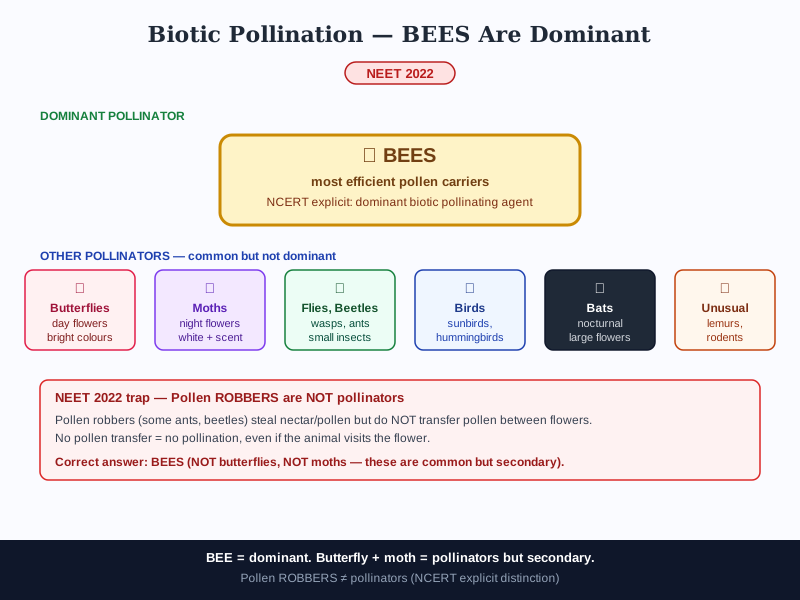
Most flowering plants use a range of animals as pollinating agents. Bees, butterflies, flies, beetles, wasps, ants, moths, birds (sunbirds and hummingbirds), and bats are common pollinators. Among all insects, bees are the dominant biotic pollinating agents — they are the most efficient pollen carriers. Even unexpected animals serve as pollinators in some species: primates (lemurs), arboreal rodents, and reptiles (gecko lizard, garden lizard). Flowers adapted for specific pollinators evolve characteristic features — colour, scent, reward type — matching the sensory abilities of their pollinator.
NEET 2022 tested a commonly reversed fact: students assume moths and butterflies are dominant pollinators because they are visually prominent. NCERT clearly states bees are dominant. The NEET 2016 question introduced 'pollen robbers' — organisms that consume pollen or nectar WITHOUT transferring it between flowers. These are NOT pollinators. True pollination requires pollen transfer. Pollen tube growth regulation involves chemical interactions between pollen proteins and pistil proteins — species-specific recognition prevents cross-species fertilisation.
Moths and butterflies are the most dominant pollinating agents among insects.
BEES are the most dominant biotic pollinating agents among insects — NCERT explicit statement. Moths and butterflies are pollinators but not dominant.
BEE = dominant. Butterfly and moth = pollinators but secondary. Pollen ROBBERS ≠ pollinators.
- Bees are the most dominant biotic pollinating agents — NCERT explicit (NEET 2022 wrong answer reversed this).
- Reptiles reported as pollinators in some species: gecko lizard and garden lizard (NEET 2016).
- Pollen robbers: organisms consuming pollen/nectar without pollinating — NOT called pollinators.
- Water pollination (hydrophily) is rare — only ~30 genera. Wind pollination is the most common ABIOTIC form.
Which of the following statements about pollination are INCORRECT? S1: Bees are the most dominant biotic pollinating agent among insects. S2: Moths and butterflies are the most dominant pollinating agents among all insects. S3: Insects that consume pollen or nectar without transferring it between flowers are called pollinators. S4: Some reptiles including gecko lizard have been reported as pollinators in some plant species. S5: Wind pollination is more common than water pollination among abiotic pollination types.
View bonus solution & explanation
Correct answer: B — S2 and S3
S1 CORRECT: Bees = most dominant biotic pollinating agents (NCERT exact). S2 WRONG: Bees are dominant, not moths/butterflies — this is the NEET 2022 wrong answer. S3 WRONG: Organisms consuming pollen/nectar without pollinating are called 'pollen robbers', NOT pollinators (NEET 2016). S4 CORRECT: Gecko lizard and garden lizard reported as pollinators in some species. S5 CORRECT: Wind (anemophily) is the most common abiotic mode; water (hydrophily) is rare.
What is Biotic Pollination?
What did NEET 2022 ask on Biotic Pollination?
What is the most common NEET trap on Biotic Pollination?
How do you remember Biotic Pollination for NEET?
What are the key components of Biotic Pollination?
Through deep analysis of NEET and NTA, 176 of the 180 ReNEET 2026 (June 21) questions were already in the MedicNEET question bank before the exam.
176/180MedicNEET's Biology question bank is built from the same NCERT lines NTA picks repeatedly. Not random MCQs — questions crafted exactly like NTA crafts them.
You just learned this concept. The free app turns it into a daily goal built from your weak topics and brings it back just before you forget it — using active recall and spaced repetition — so it stays till exam day.