
Hydrophily — Water Pollination in Vallisneria and Seagrasses
✅ Asked in NEET 2024Identify the set of correct statements: A. The flowers of Vallisneria are colourful and produce nectar. B. The flowers of water lily are not pollinated by water. C. In most of water-pollinated species, the pollen grains are protected from wetting. D. Pollen grains of some hydrophytes are long and ribbon like. E. In some hydrophytes, the pollen grains are carried passively inside water. Choose the correct answer:
Identify the set of correct statements: A. The flowers of Vallisneria are colourful and produce nectar. B. The flowers of water lily are not pollinated by water. C. In most of water-pollinated species, the pollen grains are protected from wetting. D. Pollen grains of some hydrophytes are long and ribbon like. E. In some hydrophytes, the pollen grains are carried passively inside water. Choose the correct answer:
Pollination in water hyacinth and water lily is brought about by the agency of (NEET 2016 Phase 2)
Answer & NCERT explanation
Correct answer: D — B, C, D and E only
Statement A is wrong - Vallisneria flowers are small and inconspicuous, not colorful. B is correct - water lily is insect pollinated. C is correct - pollen is protected from wetting by waxy coating. D is correct - some hydrophytes have ribbon-like pollen. E is correct - pollen can be carried passively underwater.
Read more NCERT concept on the PYQ
Pollination by water is quite rare in flowering plants and is limited to about 30 genera, mostly monocotyledons. As against this, you would recall that water is a regular mode of transport for the male gametes among the lower plant groups such as algae, bryophytes and pteridophytes. It is believed, particularly for some bryophytes and pteridophytes, that their distribution is limited because of the need for water for the transport of male gametes and fertilisation. Some examples of water pollinated plants are Vallisneria and Hydrilla which grow in fresh water and several marine sea-grasses such as Zostera. Not all aquatic plants use water for pollination. In a majority of aquatic plants such as water hyacinth and water lily, the flowers emerge above the level of water and are pollinated by insects or wind as in most of the land plants. In Vallisneria, the female flower reach the surface of water by the long stalk and the male flowers or pollen grains are released on to the surface of water. They are carried passively by water currents; some of them eventually reach the female flowers and the stigma. In another group of water pollinated plants such as seagrasses, female flowers remain submerged in water and the pollen grains are released inside the water. Pollen grains in many such species are long, ribbon like and they are carried passively inside the water; some of them reach the stigma and achieve pollination. In most of the water-pollinated species, pollen grains are protected from wetting by a mucilaginous covering.
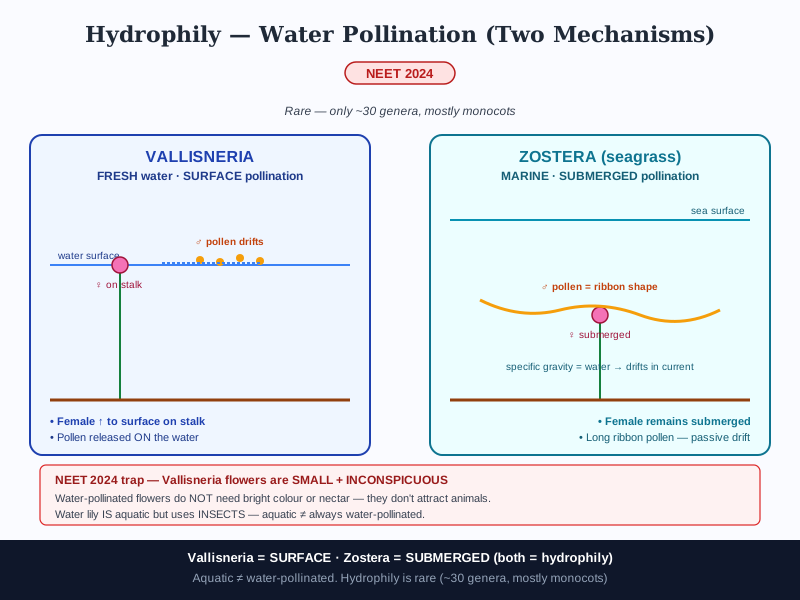
Water pollination (hydrophily) is rare, limited to about 30 genera, mostly monocotyledons. Two distinct mechanisms exist. In Vallisneria (fresh water): female flowers reach the water surface on a long stalk; male flowers/pollen grains are released onto the surface and carried passively by water currents to reach female flowers. In seagrasses like Zostera (marine): female flowers remain completely submerged; pollen grains are long and ribbon-like, released inside water and carried passively to submerged stigmas. Importantly, water hyacinth and water lily — though aquatic — are NOT water-pollinated. Their flowers emerge above water and are pollinated by insects or wind.
NEET 2024 tested five statements about hydrophily — understanding which aquatic plants use water vs insect/wind pollination is critical. Vallisneria flowers are small and inconspicuous (NOT colourful) — a key trap. Water lily flowers are colourful and emerge above water, attracting insects. The mucilaginous coating on pollen grains of hydrophilous plants (e.g., seagrasses) protects pollen from wetting/dissolution — this adaptation allows successful pollination in aquatic environments.
The flowers of Vallisneria are colourful and produce nectar to attract pollinators.
Vallisneria flowers are small and inconspicuous — they use water (not animals) for pollination and do not need attractive features.
Vallisneria = small + water pollination. Water lily = colourful + insect/wind. Aquatic ≠ always water-pollinated.
- Hydrophily limited to ~30 genera, mostly monocots — rare compared to insect/wind pollination.
- Zostera (seagrass): pollen long and ribbon-like, female flowers submerged, pollen protected by mucilage.
- Vallisneria: female flower reaches surface on long stalk; male pollen floats on surface then reaches female.
- Water hyacinth and water lily: flowers emerge above water — pollinated by insects or wind (NOT water).
What is Hydrophily?
What did NEET 2024 ask on Hydrophily?
What is the most common NEET trap on Hydrophily?
How do you remember Hydrophily for NEET?
What are the key components of Hydrophily?
Through deep analysis of NEET and NTA, 176 of the 180 ReNEET 2026 (June 21) questions were already in the MedicNEET question bank before the exam.
176/180MedicNEET's Biology question bank is built from the same NCERT lines NTA picks repeatedly. Not random MCQs — questions crafted exactly like NTA crafts them.
You just learned this concept. The free app turns it into a daily goal built from your weak topics and brings it back just before you forget it — using active recall and spaced repetition — so it stays till exam day.