
Monocot Seed — Scutellum, Coleoptile, Coleorhiza, Endosperm Food Storage
📚 Practice ConceptThe portion of the embryonal axis above the level of attachment of scutellum is the epicotyl. Epicotyl has a shoot apex and a few leaf primordia enclosed in a hollow foliar structure, the coleoptile. Soak a few seeds in water (say of wheat, maize, peas, chickpeas, ground nut) overnight. Then split the seeds and observe the various parts of the embryo and the seed.
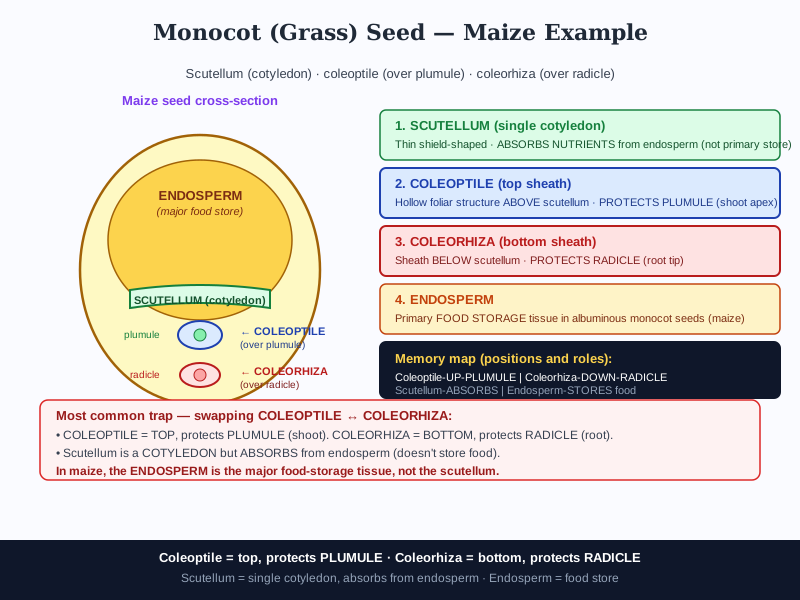
In monocot seeds, the coleoptile protects the radicle and the scutellum stores the seed's food reserves.
COLEOPTILE protects the PLUMULE (shoot tip). COLEORHIZA protects the RADICLE (root tip). SCUTELLUM = single cotyledon, ABSORBS nutrients from endosperm (doesn't store food). Food is stored in the ENDOSPERM.
Coleoptile = top, protects plumule. Coleorhiza = bottom, protects radicle. Scutellum = shield, absorbs from endosperm. Endosperm = food store (maize).
- Scutellum = single cotyledon in grasses; thin and shield-shaped; ABSORBS NUTRIENTS from endosperm (not primary food storage).
- Coleoptile = hollow foliar structure protecting the PLUMULE (shoot apex + leaf primordia) above the scutellum.
- Coleorhiza = sheath protecting the RADICLE (root tip) below the scutellum.
- In maize (albuminous monocot seed), the ENDOSPERM is the major food-storage tissue; scutellum mediates nutrient transfer.
Which of the following statements about protective structures in monocot seeds are NOT correct? S1: The scutellum is the single cotyledon, which typically stores a large amount of food reserves. S2: The coleoptile is an undifferentiated sheath that protects the radicle and root cap. S3: The epicotyl, along with the shoot apex and leaf primordia, is enclosed within the coleoptile. S4: The coleorhiza protects the plumule during germination. S5: In maize, the primary site for nutrient absorption from the endosperm is the coleoptile.
View bonus solution & explanation
Correct answer: C — S1, S2, S4 and S5 only
S1 WRONG: Scutellum IS the single cotyledon, but in albuminous monocot seeds (like maize) the ENDOSPERM is the major food store — scutellum is thin and primarily absorbs nutrients. S2 WRONG: Coleoptile protects the PLUMULE (shoot apex), NOT the radicle. Coleorhiza protects the radicle. S3 CORRECT: Epicotyl + shoot apex + leaf primordia are enclosed in coleoptile (NCERT). S4 WRONG: Coleorhiza protects the RADICLE, not plumule. S5 WRONG: In maize, the SCUTELLUM (not coleoptile) absorbs nutrients from endosperm. Incorrect statements: S1, S2, S4, S5 → answer C.
What is Monocot Seed?
What did NEET previous years ask on Monocot Seed?
What is the most common NEET trap on Monocot Seed?
How do you remember Monocot Seed for NEET?
What are the key components of Monocot Seed?
Through deep analysis of NEET and NTA, 176 of the 180 ReNEET 2026 (June 21) questions were already in the MedicNEET question bank before the exam.
176/180MedicNEET's Biology question bank is built from the same NCERT lines NTA picks repeatedly. Not random MCQs — questions crafted exactly like NTA crafts them.
You just learned this concept. The free app turns it into a daily goal built from your weak topics and brings it back just before you forget it — using active recall and spaced repetition — so it stays till exam day.