
Frog Sense Organs — Simple Eyes (One Unit), Tympanum, No External Ear
📚 Practice ConceptFrog has different types of sense organs, namely organs of touch (sensory papillae), taste (taste buds), smell (nasal epithelium), vision (eyes) and hearing (tympanum with internal ears). Out of these, eyes and internal ears are well-organised structures and the rest are cellular aggregations around nerve endings. Eyes in a frog are a pair of spherical structures situated in the orbit in skull. These are simple eyes (possessing only one unit). External ear is absent in frogs and only tympanum can be seen externally. The ear is an organ of hearing as well as balancing (equilibrium).
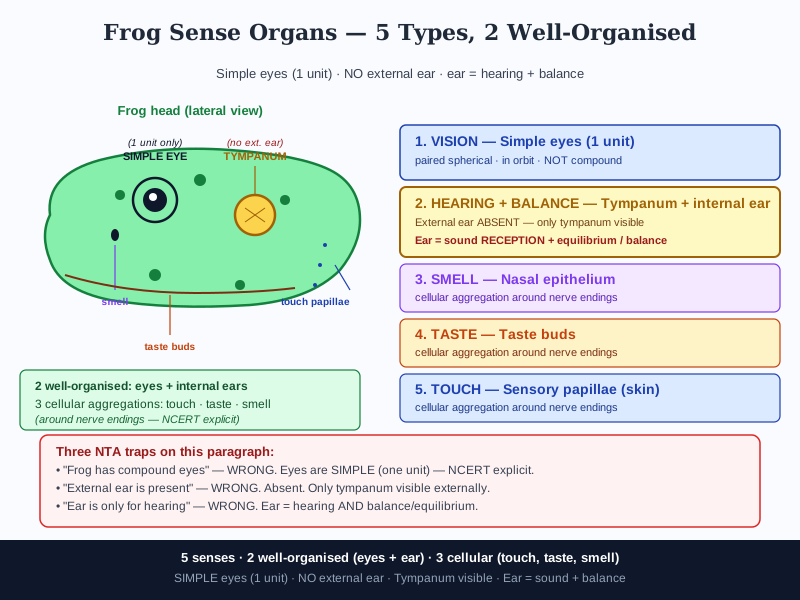
Frog eyes are compound (multiple units). External ear is present. Ear functions only for hearing.
Frog eyes are SIMPLE (one unit each). External ear is ABSENT — only tympanum visible. Ear = hearing + balance/equilibrium.
5 senses · 2 well-organised (eyes + ear) · 3 cellular (touch, taste, smell) · 1-unit simple eyes · NO ext ear · ear = sound+balance.
- Sense organ types: touch (sensory papillae), taste (taste buds), smell (nasal epithelium), vision (eyes), hearing (tympanum + internal ear) — 5 total.
- Eyes + internal ears = well-organised structures. Touch + taste + smell = simple cellular aggregations around nerve endings (NCERT explicit).
- Frog eyes are SIMPLE (one unit each) — housed in orbits in skull. Nictitating membrane covers eyes during swimming.
- External ear is ABSENT — only tympanum (eardrum) visible externally. Ear serves DUAL function: hearing + balance (equilibrium).
Which of the following statements about frog sense organs is/are CORRECT? S1: Frog eyes are compound eyes with multiple visual units. S2: The tympanum is the only externally visible part of the frog's ear — frogs lack an external ear flap. S3: Taste buds, sensory papillae, and nasal epithelium are simple cellular aggregations around nerve endings, not well-organised structures. S4: The frog ear functions exclusively for hearing and plays no role in balance. S5: Of the five sense organ types in frogs, only eyes and internal ears are well-organised structures.
View bonus solution & explanation
Correct answer: A — S2, S3 and S5
S1 WRONG: Frog eyes are SIMPLE eyes (one unit each), not compound. S2 CORRECT: External ear absent — only tympanum visible externally. S3 CORRECT: Touch, taste, smell are cellular aggregations around nerve endings (NCERT explicit). S4 WRONG: Ear serves BOTH hearing AND balance (equilibrium). S5 CORRECT: Among 5 sense types, only eyes + internal ears are well-organised. ⇒ Correct combination = S2, S3, S5.
What is Frog Sense Organs?
What did NEET previous years ask on Frog Sense Organs?
What is the most common NEET trap on Frog Sense Organs?
How do you remember Frog Sense Organs for NEET?
What are the key components of Frog Sense Organs?
Through deep analysis of NEET and NTA, 176 of the 180 ReNEET 2026 (June 21) questions were already in the MedicNEET question bank before the exam.
176/180MedicNEET's Biology question bank is built from the same NCERT lines NTA picks repeatedly. Not random MCQs — questions crafted exactly like NTA crafts them.
You just learned this concept. The free app turns it into a daily goal built from your weak topics and brings it back just before you forget it — using active recall and spaced repetition — so it stays till exam day.