
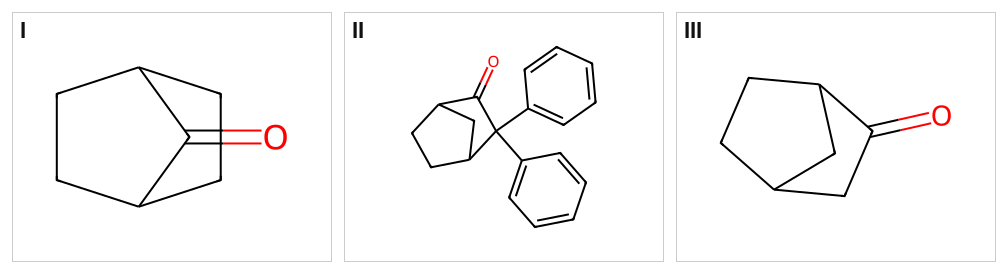
Which among the given bicyclic ketone molecules (I), (II) and (III) can exhibit tautomerism?
Answer: (A) III only. \textbf{Answer:} (a) III only \textbf{Solution:} Keto-enol tautomerism requires an alpha-hydrogen AND that the resulting enol does not place a double bond at a bridgehead (Bredt's rule).
- A.III only✓
- B.Both I and III
- C.Both I and II
- D.Both II and III
Correct Answer
(A) III only
Solution & Explanation
\textbf{Answer:} (a) III only \textbf{Solution:} Keto-enol tautomerism requires an alpha-hydrogen AND that the resulting enol does not place a double bond at a bridgehead (Bredt's rule). In (I) the enol would put a at the bridgehead (an anti-Bredt, unstable bridgehead alkene), so no tautomerism. In (II) the alpha-carbon next to the bears two phenyl groups and has no alpha-H to enolise. Only (III) has a normal alpha- that can enolise without violating Bredt's rule. Hence only III shows tautomerism. Hence (a).