
Predict the major product in the following sequence of reactions. The starting material is 1-methylcyclopent-1-ene: (i) , benzoyl peroxide; (ii) ; (iii) / (major). The structures of the options (A)-(D) are shown in the image below:
Answer: (C) (C). \textbf{Answer:} (C) A 1,2-disubstituted cyclopentane bearing and on adjacent carbons.
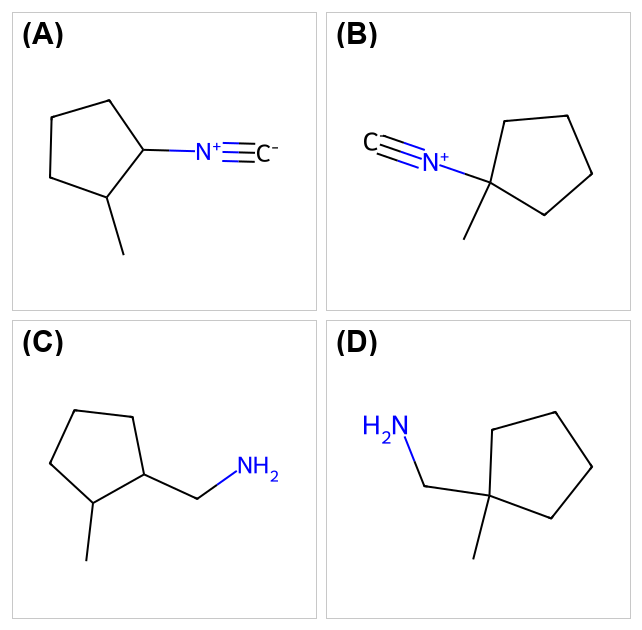
- A.(A)
- B.(B)
- C.(C)✓
- D.(D)
Correct Answer
(C) (C)
Solution & Explanation
\textbf{Answer:} (C) A 1,2-disubstituted cyclopentane bearing and on adjacent carbons. \textbf{Solution:} Step (i): with benzoyl peroxide adds by the anti-Markovnikov (radical) route. For 1-methylcyclopent-1-ene the double bond is between the -bearing carbon (more substituted) and the adjacent ; adds to the less-substituted carbon, generating the more stable 3 radical at the methyl carbon. This gives 2-bromo-1-methylcyclopentane ( on the carbon adjacent to the carbon). Step (ii): effects substitution of by (cyanide is a C-nucleophile, giving a nitrile, not the isocyanide), yielding 2-methylcyclopentane-1-carbonitrile. Step (iii): / reduces the nitrile to a primary amine . The product is (2-methylcyclopentyl)methanamine: and on adjacent ring carbons (option C). Options A and B retain an isocyanide (, which would need , and would not be reduced), and option D has the wrong (geminal) regiochemistry.