
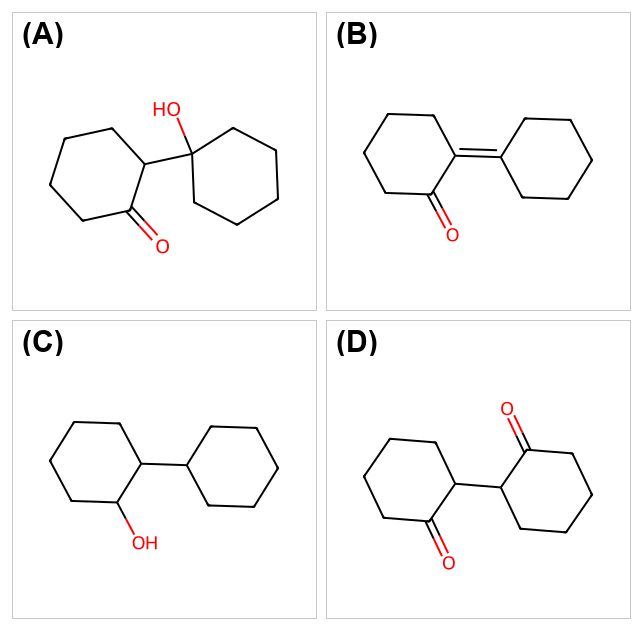
Which of the following is the product formed when cyclohexanone undergoes aldol condensation followed by heating?
Answer: (B) (B). \textbf{Answer:} (B) 2-(cyclohexylidene)cyclohexan-1-one \textbf{Solution:} Two molecules of cyclohexanone undergo base-catalysed aldol addition: the alpha-carbon enolate of one molecule attacks the carbonyl carbon of the second, giving the beta-hydroxy ketone 2-(1-hydroxycyclohexyl)cyclohexan-1-one.
- A.(A)
- B.(B)✓
- C.(C)
- D.(D)
Correct Answer
(B) (B)
Solution & Explanation
\textbf{Answer:} (B) 2-(cyclohexylidene)cyclohexan-1-one \textbf{Solution:} Two molecules of cyclohexanone undergo base-catalysed aldol addition: the alpha-carbon enolate of one molecule attacks the carbonyl carbon of the second, giving the beta-hydroxy ketone 2-(1-hydroxycyclohexyl)cyclohexan-1-one. On heating, dehydration gives the conjugated alpha,beta-unsaturated ketone 2-(cyclohexylidene)cyclohexan-1-one, in which an exocyclic is conjugated with the ring carbonyl. Aldol condensation = addition followed by dehydration.