
NEET 2016 Phase 2 · ChemistrySelf-aldolPrevious Year Question
Which among the following molecules (I, II, III) can exhibit tautomerism?
Answer: (A) (A) III only. \textbf{Answer:} (A) III only.
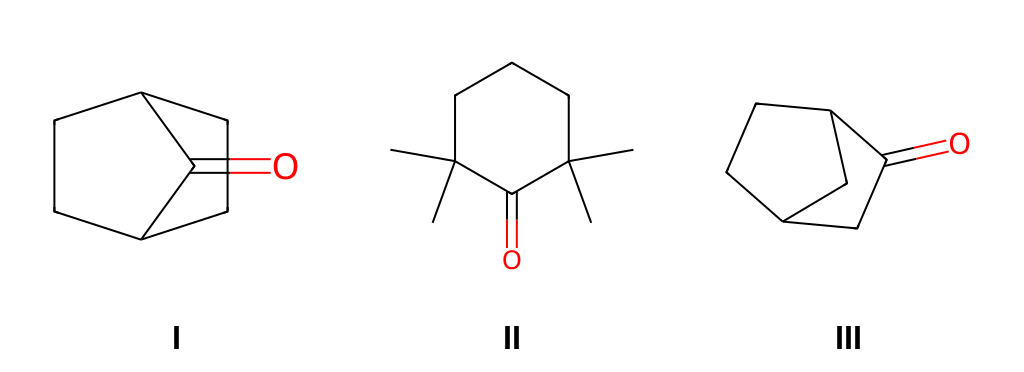
- A.(A) III only✓
- B.(B) Both I and III
- C.(C) Both I and II
- D.(D) Both II and III
Correct Answer
(A) (A) III only
Solution & Explanation
\textbf{Answer:} (A) III only. \textbf{Solution:} Keto-enol tautomerism requires an -hydrogen that can shift to give an enol . In I, enolisation would create a double bond at a bridgehead carbon, an anti-Bredt alkene forbidden by Bredt's rule, so I cannot tautomerise. In II the -carbon bears two phenyl groups and has no -hydrogen, so no enol can form. Only III (norbornanone-type) has a removable -hydrogen on a non-bridgehead carbon, so only III tautomerises.
🎯
43,000+ questions in हिंदी & English · one-tap toggle
Open →📚Practice all NEET Chemistry PYQs chapter-wise →💡Don't get it? Learn the Aldehydes, Ketones And Carboxylic Acid concepts →Practice NEET 2016 Phase 2 Chemistry — free, with instant solutions
The app builds a daily goal from your weak topics and brings each question back just before you forget it — so what you solve today turns into marks on exam day.
More NEET PYQ solutions
ChemConsider the reaction: CH3COCH3 ->[dil. Ba(OH)2] X The functional groups present in compound X areChemWhich one of the following is not formed when acetone (CH3COCH3) reacts with 2-pentanone (CH3COCH2CH2CH3) in the presence of dilute NaOH followed by heating?ChemThe reaction between benzaldehyde and acetophenone in the presence of dilute NaOH is known as:ChemWhich of the following is the product formed when cyclohexanone undergoes aldol condensation followed by heating?ChemThe correct statement regarding a carbonyl compound with a hydrogen atom on its -carbon is:ChemThe correct order of decreasing acidity of the following aliphatic acids is:ChemWhich one of the following reactions does NOT belong to Lassaigne's test?ChemHow many products (including stereoisomers) are expected from the monochlorination of 2-methylbutane, (CH3)2CH-CH2-CH3?