
For a reaction , the enthalpy of reaction is and the enthalpy of activation is . The correct potential energy profile for the reaction is shown in which option?
Answer: (D) PE profile: A at higher energy, curve rises over a small barrier, B settles at a level lower than A (exothermic, negative).. \textbf{Answer:} (D) \textbf{Solution:} The enthalpy of reaction is negative, so the reaction is exothermic and the products (B) lie at lower potential energy than the reactants (A).
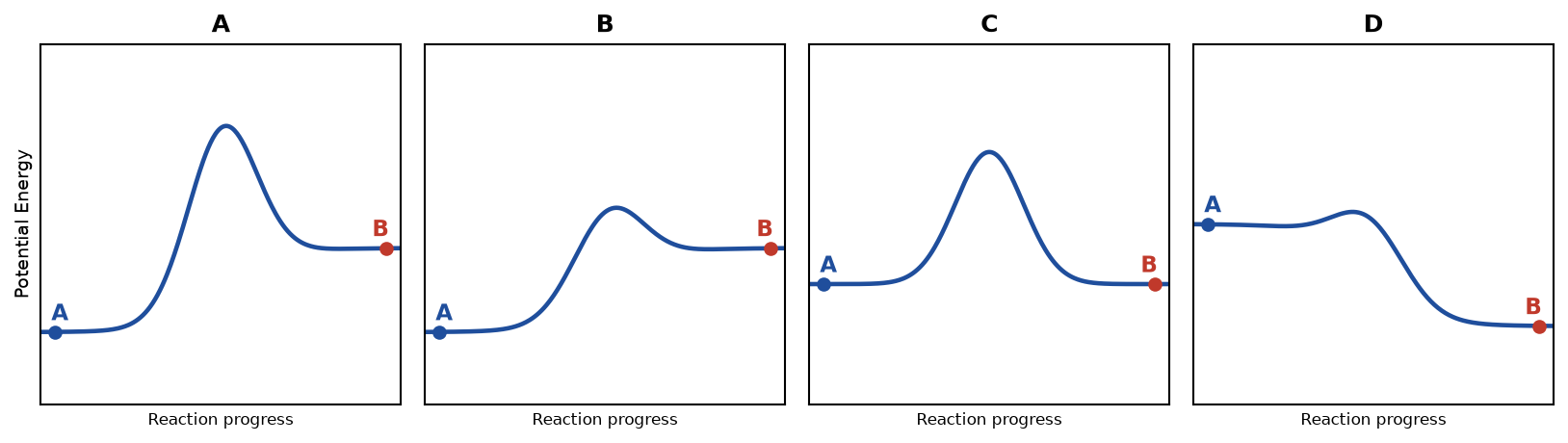
- A.PE profile: A at low energy, curve rises to a high peak, B comes down to a level higher than A (endothermic, large barrier).
- B.PE profile: A at low energy, curve rises over a barrier, B settles at a level higher than A (endothermic).
- C.PE profile: A and B at roughly the same energy level with a barrier in between (approximately thermoneutral).
- D.PE profile: A at higher energy, curve rises over a small barrier, B settles at a level lower than A (exothermic, negative).✓
Correct Answer
(D) PE profile: A at higher energy, curve rises over a small barrier, B settles at a level lower than A (exothermic, negative).
Solution & Explanation
\textbf{Answer:} (D) \textbf{Solution:} The enthalpy of reaction is negative, so the reaction is exothermic and the products (B) lie at lower potential energy than the reactants (A). The curve rises by the activation enthalpy () to a barrier, then drops to B below A. Only profile (D) shows B below A. Mapped: source lowercase answer 'd' → option D.