
One of the products formed in the following reaction is: cyclohexyl–MgBr + cyclohexyl–NH₂→
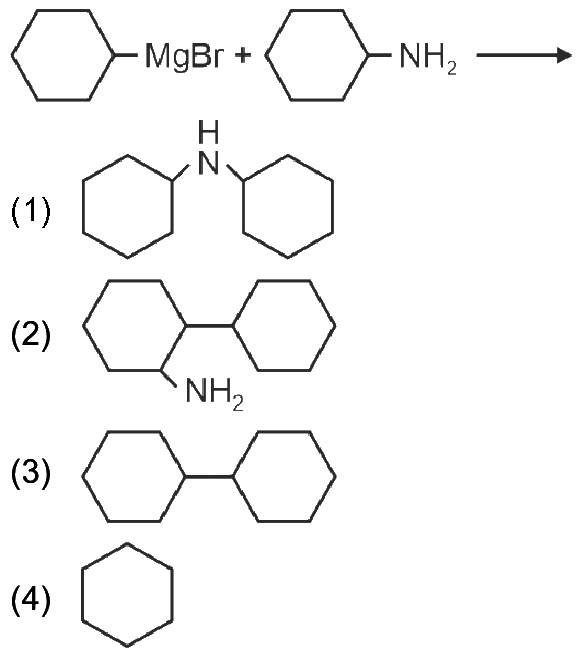
- A.a dicyclohexylamine ((C₆H₁₁)₂NH)
- B.a substituted amine bearing NH₂
- C.bicyclohexyl (C₆H₁₁-C₆H₁₁)
- D.cyclohexane (C₆H₁₂)✓
Correct Answer
(D) cyclohexane (C₆H₁₂)
Solution & Explanation
A Grignard reagent (R–MgBr) carries a strongly nucleophilic, strongly BASIC carbanion-like carbon, R⁻. Before it can add to anything, it reacts with any acidic proton present. Cyclohexylamine, C₆H₁₁–NH₂, has acidic N–H protons. The cyclohexyl carbanion of the Grignard simply abstracts an N–H proton (acid–base reaction), so it is protonated and converted to the hydrocarbon: C₆H₁₁–MgBr + C₆H₁₁–NH₂ → C₆H₁₂ (cyclohexane) + C₆H₁₁–NH–MgBr (magnesium amide salt). No C–C or C–N bond forms; the reaction stops at simple protonation because the N–H proton is consumed first. Trap: do not expect coupling (bicyclohexyl) or amine substitution — the basic destruction of the reagent dominates. Answer: cyclohexane (option D).
✅ We had this exact concept in our bank before the exam — Strong match, 90% match.
That's the Predicted Batch — it trains you on the exact high-probability concepts NEET repeats every year. 98% of the 2026 paper (176/180) was in our bank before the exam.
Master these concepts + 50,000+ NEET PYQs in the app — free, built for NEET 2027.
Start the Predicted Batch — Free →