
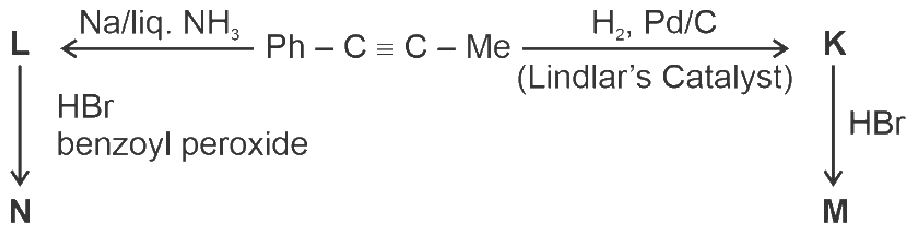
Consider the reaction sequences and choose the correct option. Ph-C C-Me with Na/liq. NH₃→ L; with H₂, Pd/C (Lindlar's catalyst) → K. Then L, benzoyl peroxideN and K.
- A.K and L are geometrical isomers✓
- B.K and L are enantiomers
- C.M and N are geometrical isomers
- D.M and N are stereoisomers
Correct Answer
(A) K and L are geometrical isomers
Solution & Explanation
Concept: the two partial-reduction methods of an internal alkyne give opposite alkene geometries. Starting alkyne: Ph–C≡C–Me. - Na/liq. NH₃ (dissolving-metal reduction) proceeds through a trans-vinyl radical/anion and gives the trans (E) alkene → L = (E)-PhCH=CHMe. - H₂ over Lindlar's catalyst (Pd/C poisoned, syn addition) gives the cis (Z) alkene → K = (Z)-PhCH=CHMe. K and L have the same constitution but differ only in the arrangement about the C=C double bond (cis vs trans) → they are geometrical (cis–trans) isomers. So option A is correct. Why the others fail: geometrical isomers are NOT enantiomers (B wrong, they are not mirror images). M and N come from radical HBr addition (benzoyl peroxide, anti-Markovnikov) on L and from K respectively; they are constitutionally/configurationally related but the question's correct, cleanest statement is about K and L, so C and D are not the chosen answer. Hence the answer is A — K and L are geometrical isomers.
✅ We had this exact concept in our bank before the exam — Strong match, 84% match.
That's the Predicted Batch — it trains you on the exact high-probability concepts NEET repeats every year. 98% of the 2026 paper (176/180) was in our bank before the exam.
Master these concepts + 50,000+ NEET PYQs in the app — free, built for NEET 2027.
Start the Predicted Batch — Free →