
Lipid Macromolecule Anomaly — Low Molecular Weight But Acid-Insoluble Fraction
📚 Practice ConceptThe molecules in the insoluble fraction with the exception of lipids are polymeric substances. Then why do lipids, whose molecular weights do not exceed 800 Da, come under acid insoluble fraction, i.e., macromolecular fraction? Lipids are indeed small molecular weight
Lipids appear in the acid-insoluble fraction because individual lipid molecules have molecular weights above 10,000 daltons.
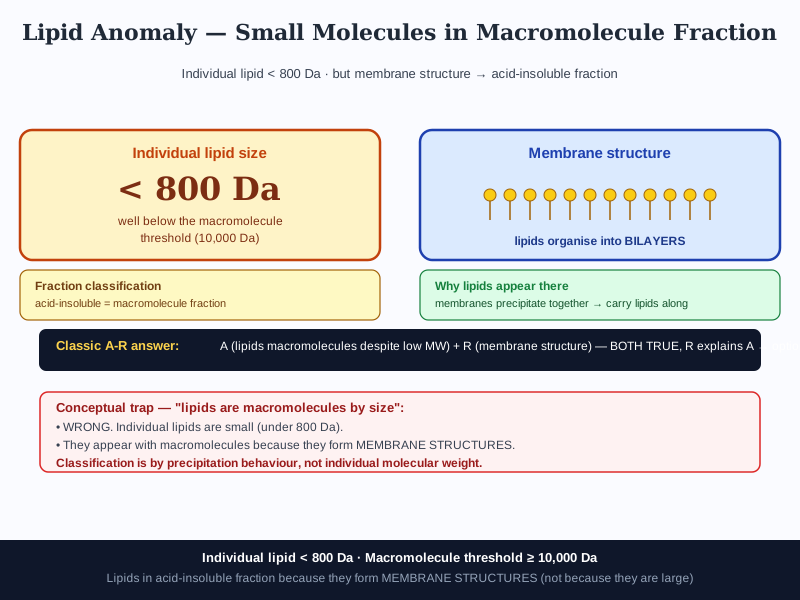
Lipid molecules are SMALL (under 800 Da) but exist as PART OF MEMBRANE STRUCTURES — the membranes precipitate together in the acid-insoluble fraction.
Lipid molecule weight = under 800 Da (NOT macromolecule by size). But lipids form MEMBRANES → acid-insoluble fraction by structure.
- Proteins, nucleic acids, polysaccharides = true polymeric substances (≥ 10,000 daltons).
- Individual lipid molecules = molecular weight does NOT exceed 800 daltons — SMALL molecules.
- Lipids appear in acid-insoluble (macromolecular) fraction because they form MEMBRANE STRUCTURES.
- Fractionation classification is based on precipitation behaviour, not individual molecular size.
Assertion (A): Lipids are classified as macromolecules despite their relatively low molecular weight. Reason (R): Lipids form membrane structures that make them appear in the acid-insoluble fraction.
View bonus solution & explanation
Correct answer: A — Both A and R are True and R is the correct explanation of A.
Assertion TRUE: NCERT poses exactly this question — 'why do lipids, whose molecular weights do not exceed 800 Da, come under the acid-insoluble (macromolecular) fraction?'. Reason TRUE: NCERT explains lipids appear in the acid-insoluble fraction because they exist as PART OF MEMBRANE STRUCTURES — the membranes precipitate together with other macromolecules. R correctly EXPLAINS A: the membrane-structural arrangement is precisely WHY individually small lipids cluster with true macromolecules during fractionation. Answer A.
What is Lipid Macromolecule Anomaly?
What did NEET previous years ask on Lipid Macromolecule Anomaly?
What is the most common NEET trap on Lipid Macromolecule Anomaly?
How do you remember Lipid Macromolecule Anomaly for NEET?
What are the key components of Lipid Macromolecule Anomaly?
Through deep analysis of NEET and NTA, 176 of the 180 ReNEET 2026 (June 21) questions were already in the MedicNEET question bank before the exam.
176/180MedicNEET's Biology question bank is built from the same NCERT lines NTA picks repeatedly. Not random MCQs — questions crafted exactly like NTA crafts them.
You just learned this concept. The free app turns it into a daily goal built from your weak topics and brings it back just before you forget it — using active recall and spaced repetition — so it stays till exam day.