
Reductionist Biology — Physico-Chemical Approach to Study Living Organisms
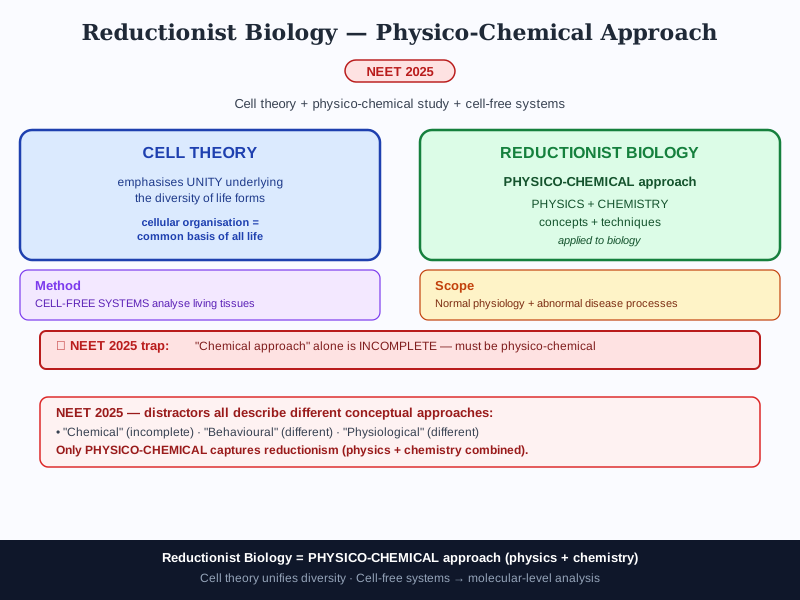
📚 Practice ConceptBiology is the study of living organisms. The detailed description of their form and appearance only brought out their diversity. It is the cell theory that emphasised the unity that underlies this diversity of forms, i.e., the cellular organisation of all life forms. A description of cell structure and cell growth by division is given in the chapters comprising this unit. Cell theory also created a sense of mystery around living phenomena, i.e., physiological and behavioural processes. This mystery was the requirement of integrity of cellular organisation for living phenomena to be demonstrated or observed. In studying and understanding the physiological and behavioural processes, one can take a physico-chemical approach and use cell-free systems to investigate. This approach enables us to describe the various processes in molecular terms. The approach is established by analysis of living tissues for elements and compounds. It will tell us what types of organic compounds are present in living organisms. In the next stage, one can ask the question: What are these compounds doing inside a cell? And, in what way they carry out gross physiological processes like digestion, excretion, memory, defense, recognition, etc. In other words we answer the question, what is the molecular basis of all physiological processes? It can also explain the abnormal processes that occur during any diseased condition. This physico-chemical approach to study and understand living organisms is called 'Reductionist Biology'. The concepts and techniques of physics and chemistry are applied to understand biology. In Chapter 9 of this unit, a brief description of biomolecules is provided.
Reductionist Biology refers to a purely chemical approach to study and understand living organisms.
Reductionist Biology = PHYSICO-CHEMICAL approach (physics + chemistry combined) to study living organisms. Not chemistry alone.
Reductionist = PHYSICO-CHEMICAL (physics + chemistry). Cell theory = unity in diversity. Cell-free systems analyse processes molecularly.
- Cell theory emphasised the UNITY underlying diversity of life — cellular organisation as the common basis.
- Reductionist Biology = PHYSICO-CHEMICAL approach (physics + chemistry techniques applied to biology).
- Uses cell-free systems to investigate biochemical processes in molecular terms.
- Can explain abnormal processes during diseased conditions, in addition to normal physiology.
Which one of the following statements refers to Reductionist Biology?
View bonus solution & explanation
Correct answer: D — Physico-chemical approach to study and understand living organisms
D CORRECT (NEET 2025): NCERT exact — Reductionist Biology is the PHYSICO-CHEMICAL approach to study and understand living organisms. It applies BOTH physics AND chemistry concepts and techniques to biology, breaking down complex systems into molecular components. A WRONG: 'Chemical approach' alone is incomplete — physics is also involved. B WRONG: Behavioural approach is about organism behaviour, not molecular reduction. C WRONG: Physiological approach studies system-level functions, not molecular reduction. Answer D. Memory: PHYSICO-CHEMICAL (P + C), not just C.
What is Reductionist Biology?
What did NEET previous years ask on Reductionist Biology?
What is the most common NEET trap on Reductionist Biology?
How do you remember Reductionist Biology for NEET?
What are the key components of Reductionist Biology?
Through deep analysis of NEET and NTA, 176 of the 180 ReNEET 2026 (June 21) questions were already in the MedicNEET question bank before the exam.
176/180MedicNEET's Biology question bank is built from the same NCERT lines NTA picks repeatedly. Not random MCQs — questions crafted exactly like NTA crafts them.
You just learned this concept. The free app turns it into a daily goal built from your weak topics and brings it back just before you forget it — using active recall and spaced repetition — so it stays till exam day.