
Eukaryote vs Prokaryote — Membrane-Bound Nucleus, Cytoplasm as Activity Arena
📚 Practice ConceptYou have earlier observed cells in an onion peel and/or human cheek cells under the microscope. Let us recollect their structure. The onion cell which is a typical plant cell, has a distinct cell wall as its outer boundary and just within it is the cell membrane. The cells of the human cheek have an outer membrane as the delimiting structure of the cell. Inside each cell is a dense membrane bound structure called nucleus. This nucleus contains the chromosomes which in turn contain the genetic material, DNA. Cells that have membrane bound nuclei are called eukaryotic whereas cells that lack a membrane bound nucleus are prokaryotic. In both prokaryotic and eukaryotic cells, a semi-fluid matrix called cytoplasm occupies the volume of the cell. The cytoplasm is the main arena of cellular activities in both the plant and animal cells. Various chemical reactions occur in it to keep the cell in the 'living state'.
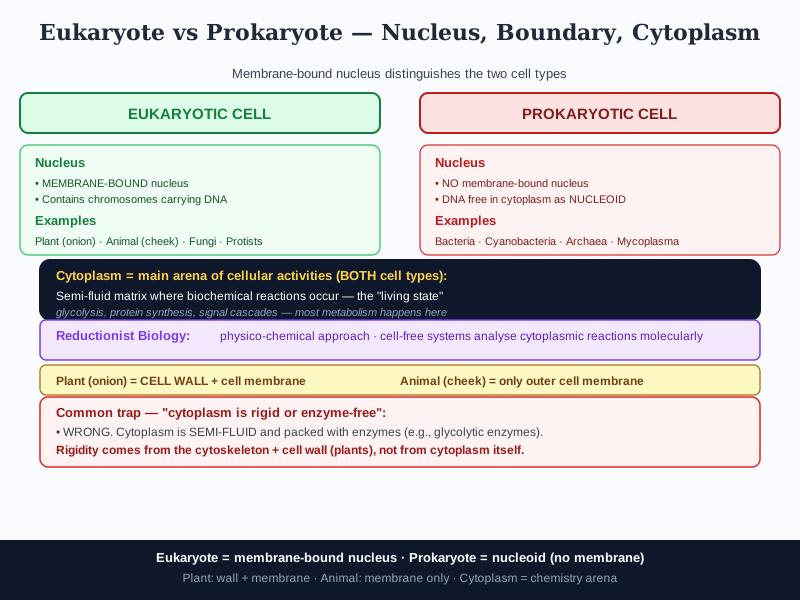
Cytoplasm serves as a rigid mechanical support that gives the cell its shape and holds enzymes inactive.
Cytoplasm is the SEMI-FLUID MATRIX where biochemical reactions occur — the 'living state'. Reductionist biology studies these molecular reactions.
Eukaryote = membrane-bound nucleus. Prokaryote = nucleoid (no membrane). Plant cell = wall + membrane. Animal cell = membrane only. Cytoplasm = chemistry arena.
- EUKARYOTIC cells have a MEMBRANE-BOUND nucleus; PROKARYOTIC cells lack one (nucleoid instead).
- Plant cell (onion) = cell wall + cell membrane. Animal cell (cheek) = only outer cell membrane.
- Cytoplasm = semi-fluid matrix; main arena of cellular activities in BOTH cell types.
- Reductionist Biology = physico-chemical approach to studying living organisms (cell-free systems for molecular analysis).
Why does cytoplasm serve as the 'arena of cellular activities' in both prokaryotic and eukaryotic cells, and how does this connect to the reductionist approach of biology?
View bonus solution & explanation
Correct answer: D — Because cytoplasm enables biochemical reactions explained physico-chemically
D CORRECT: Cytoplasm is where most metabolic processes occur — chemical reactions that keep the cell in the living state. REDUCTIONIST BIOLOGY studies these processes by applying physics and chemistry techniques, often using cell-free systems to investigate biochemical pathways molecularly. A WRONG: Cytoplasm is NOT primarily a waste store. B WRONG: Cytoplasm is SEMI-FLUID, not rigid — rigidity comes from the cytoskeleton/cell wall. C WRONG: Cytoplasm is FULL of enzymes (e.g., glycolytic enzymes); it is not enzyme-free. Answer D.
What is Eukaryote vs Prokaryote?
What did NEET previous years ask on Eukaryote vs Prokaryote?
What is the most common NEET trap on Eukaryote vs Prokaryote?
How do you remember Eukaryote vs Prokaryote for NEET?
What are the key components of Eukaryote vs Prokaryote?
Through deep analysis of NEET and NTA, 176 of the 180 ReNEET 2026 (June 21) questions were already in the MedicNEET question bank before the exam.
176/180MedicNEET's Biology question bank is built from the same NCERT lines NTA picks repeatedly. Not random MCQs — questions crafted exactly like NTA crafts them.
You just learned this concept. The free app turns it into a daily goal built from your weak topics and brings it back just before you forget it — using active recall and spaced repetition — so it stays till exam day.