
Bacterial Cell Envelope — Three Layers: Glycocalyx, Cell Wall, Plasma Membrane
📚 Practice ConceptMost prokaryotic cells, particularly the bacterial cells, have a chemically complex cell envelope. The cell envelope consists of a tightly bound three layered structure i.e., the outermost glycocalyx followed by the cell wall and then the plasma membrane. Although each layer of the envelope performs distinct function, they act together as a single protective unit. Bacteria can be classified into two groups on the basis of the differences in the cell envelopes and the manner in which they respond to the staining procedure developed by Gram viz., those that take up the gram stain are Gram positive and the others that do not are called Gram negative bacteria.
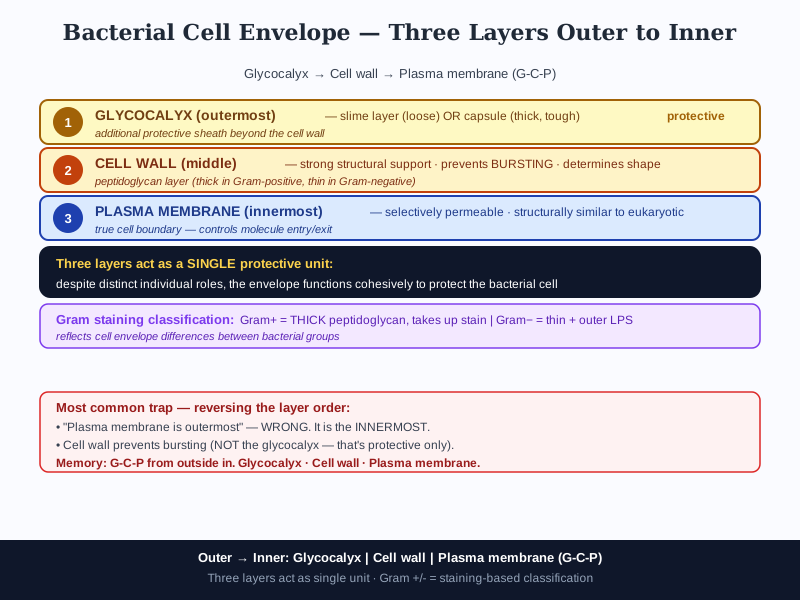
The plasma membrane is the outermost protective layer of the bacterial cell envelope, while the glycocalyx lies innermost.
From OUTSIDE to INSIDE: GLYCOCALYX (outermost, slime/capsule) → CELL WALL (structural support) → PLASMA MEMBRANE (innermost, selectively permeable).
G-C-P from outside in: Glycocalyx (slime/capsule) → Cell wall (no bursting) → Plasma membrane (selectively permeable).
- Glycocalyx = outermost protective layer; may be slime layer (loose) or capsule (thick, tough).
- Cell wall = strong structural support; prevents bursting; determines shape.
- Plasma membrane = innermost; selectively permeable; structurally similar to eukaryotic membranes.
- Three layers act as a SINGLE protective unit. Gram-positive vs Gram-negative distinguished by envelope and Gram stain uptake.
Match the bacterial cell components with their characteristic/function: Column I: A. Glycocalyx | B. Cell wall | C. Plasma membrane | D. Mesosome | E. Plasmid DNA | F. 70S Ribosomes Column II: i. Site for protein synthesis ii. Provides strong structural support; prevents bursting iii. Facilitates resistance to antibiotics iv. Involved in DNA replication and respiration v. Selectively permeable; structurally similar to eukaryotes vi. Outermost protective layer; may be slime layer or capsule
View bonus solution & explanation
Correct answer: D — A-vi, B-ii, C-v, D-iv, E-iii, F-i
A-vi: GLYCOCALYX is the outermost protective layer (slime layer or capsule). B-ii: CELL WALL provides structural support and prevents bursting. C-v: PLASMA MEMBRANE is selectively permeable and structurally similar to eukaryotic membranes. D-iv: MESOSOMES help in DNA replication and respiration. E-iii: PLASMID DNA carries antibiotic resistance genes. F-i: 70S RIBOSOMES are the sites of protein synthesis. Correct option D. Common trap: swapping glycocalyx (outermost) with plasma membrane (innermost), or confusing cell wall function with glycocalyx function.
What is Bacterial Cell Envelope?
What did NEET previous years ask on Bacterial Cell Envelope?
What is the most common NEET trap on Bacterial Cell Envelope?
How do you remember Bacterial Cell Envelope for NEET?
What are the key components of Bacterial Cell Envelope?
Through deep analysis of NEET and NTA, 176 of the 180 ReNEET 2026 (June 21) questions were already in the MedicNEET question bank before the exam.
176/180MedicNEET's Biology question bank is built from the same NCERT lines NTA picks repeatedly. Not random MCQs — questions crafted exactly like NTA crafts them.
You just learned this concept. The free app turns it into a daily goal built from your weak topics and brings it back just before you forget it — using active recall and spaced repetition — so it stays till exam day.