
Bacterial Flagellum — Filament, Hook, Basal Body Three-Part Architecture
📚 Practice ConceptBacterial cells may be motile or non-motile. If motile, they have thin filamentous extensions from their cell wall called flagella. Bacteria show a range in the number and arrangement of flagella. Bacterial flagellum is composed of three parts – filament, hook and basal body. The filament is the longest portion and extends from the cell surface to the outside.
Bacterial flagella have a 9+2 microtubule arrangement similar to eukaryotic flagella.
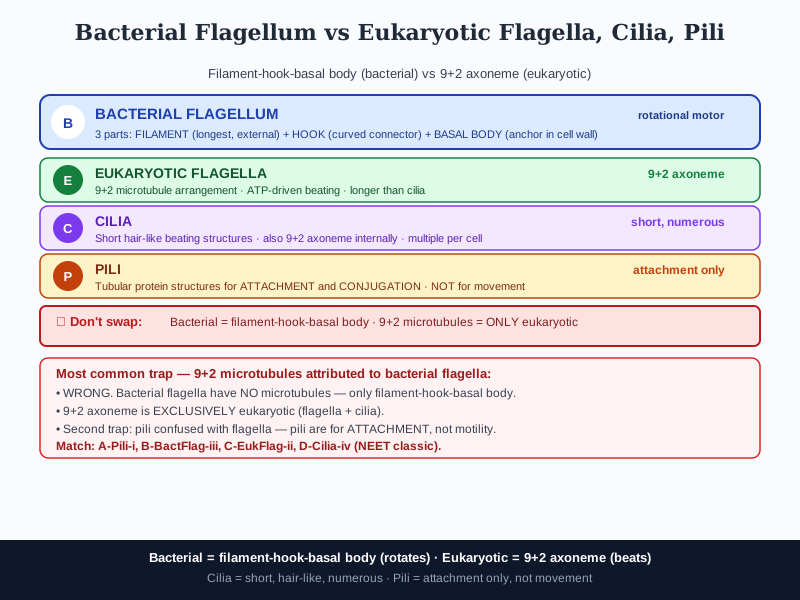
BACTERIAL flagella have a filament-hook-basal body structure (no microtubules). EUKARYOTIC flagella/cilia have the 9+2 microtubule axoneme.
Bacterial flagellum = 3-part (filament-hook-basal body), rotates. Eukaryotic flagella/cilia = 9+2 microtubules, beats. Pili = attachment, not movement.
- Bacterial flagellum has 3 parts: FILAMENT (longest, external), HOOK (curved connector), BASAL BODY (anchor in cell wall/membrane).
- Eukaryotic flagella and cilia: 9+2 microtubule axoneme arrangement; ATP-driven beating motion.
- Pili are TUBULAR PROTEIN structures used for attachment / conjugation (not for movement).
- Cilia = short hair-like beating structures (also 9+2); flagella = longer (in eukaryotes). In bacteria, flagella are structurally unrelated.
Match the structures with their descriptions: Column I: A. Pili B. Bacterial flagella C. Eukaryotic flagella D. Cilia Column II: i. Tubular protein structures for attachment ii. 9+2 microtubule arrangement iii. Filament-hook-basal body system iv. Short hair-like beating structures
View bonus solution & explanation
Correct answer: D — A-i, B-iii, C-ii, D-iv
A-i: Pili are tubular protein structures used for ATTACHMENT (and conjugation). B-iii: Bacterial flagella have the FILAMENT + HOOK + BASAL BODY architecture — NCERT exact. C-ii: Eukaryotic flagella have the 9+2 microtubule axoneme arrangement. D-iv: Cilia are short hair-like beating structures (also 9+2 internally, but the external appearance is short hair-like). The classic NEET trap is swapping ii and iii — assuming bacterial flagella have the 9+2 microtubule system. They do NOT — that arrangement is exclusively eukaryotic.
What is Bacterial Flagellum?
What did NEET previous years ask on Bacterial Flagellum?
What is the most common NEET trap on Bacterial Flagellum?
How do you remember Bacterial Flagellum for NEET?
What are the key components of Bacterial Flagellum?
Through deep analysis of NEET and NTA, 176 of the 180 ReNEET 2026 (June 21) questions were already in the MedicNEET question bank before the exam.
176/180MedicNEET's Biology question bank is built from the same NCERT lines NTA picks repeatedly. Not random MCQs — questions crafted exactly like NTA crafts them.
You just learned this concept. The free app turns it into a daily goal built from your weak topics and brings it back just before you forget it — using active recall and spaced repetition — so it stays till exam day.