
Centrioles and Cilia/Flagella — Triplet Fibrils, Hub, Spokes, Basal Body
📚 Practice ConceptEach of the peripheral fibril is a triplet.The adjacent triplets are also linked. The central part of the proximal region of the centriole is also proteinaceous and called the hub, which is connected with tubules of the peripheral triplets by radial spokes made of protein. The centrioles form the basal body of cilia or flagella, and spindle fibres that give rise to spindle apparatus during cell division in animal cells.
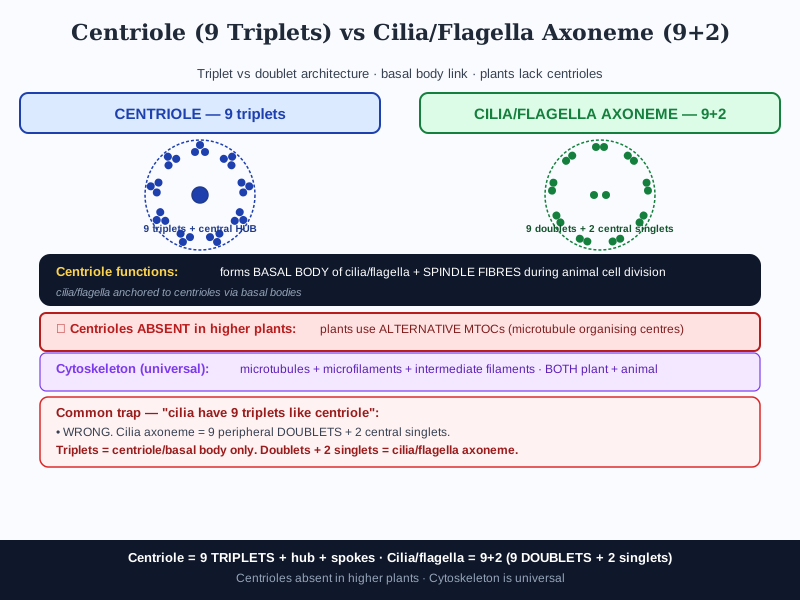
Cilia and flagella have a 9+2 array of peripheral triplets and a central pair, identical to the centriole structure.
Cilia/flagella axoneme = 9 peripheral DOUBLETS + 2 central SINGLETS (9+2 array). Centriole/basal body = 9 peripheral TRIPLETS, NO central pair.
Centriole = 9 TRIPLETS, hub + spokes. Cilia/flagella axoneme = 9+2 (9 DOUBLETS + 2 singlets). Centrioles absent in higher plants.
- Centriole = cylindrical structure with 9 peripheral TRIPLET fibrils; proteinaceous HUB connected by RADIAL SPOKES.
- Centrioles form the BASAL BODY of cilia and flagella + spindle fibres in animal cell division.
- Cilia/flagella have a 9+2 axoneme = 9 peripheral DOUBLETS + 2 central singlets (different from centriole's triplet pattern).
- Centrioles ABSENT in higher plants — plants use other MTOCs. Cytoskeleton is universal (plant + animal).
Which set of statements correctly integrates cytoskeleton, centrioles, and cilia/flagella with cell division? 1. Cytoskeleton provides mechanical support and motility in both plant and animal cells. 2. Centrioles are absent in higher plants but form basal bodies of cilia/flagella in animals. 3. Cilia/flagella possess a 9+2 axoneme structure, linked to centrioles. 4. Spindle apparatus in animal cell division originates from centrioles, while plants use other microtubule organising centres.
View bonus solution & explanation
Correct answer: A — 1, 2, 3 and 4
1 CORRECT: Cytoskeleton is universal — provides support and motility in BOTH plant and animal cells. 2 CORRECT: Centrioles are absent in higher plant cells; in animals, they form the basal body of cilia/flagella. 3 CORRECT: Cilia/flagella have the 9+2 axoneme arrangement, anchored to centrioles via basal bodies. 4 CORRECT: In animal cells, centrioles organise spindle fibres during division; plant cells use alternative microtubule organising centres (MTOCs). All four statements correct → answer A. Trap: confusing centriole triplets (9) with cilia doublets (9+2).
What is Centrioles and Cilia/Flagella?
What did NEET previous years ask on Centrioles and Cilia/Flagella?
What is the most common NEET trap on Centrioles and Cilia/Flagella?
How do you remember Centrioles and Cilia/Flagella for NEET?
What are the key components of Centrioles and Cilia/Flagella?
Through deep analysis of NEET and NTA, 176 of the 180 ReNEET 2026 (June 21) questions were already in the MedicNEET question bank before the exam.
176/180MedicNEET's Biology question bank is built from the same NCERT lines NTA picks repeatedly. Not random MCQs — questions crafted exactly like NTA crafts them.
You just learned this concept. The free app turns it into a daily goal built from your weak topics and brings it back just before you forget it — using active recall and spaced repetition — so it stays till exam day.