
Schwann (1839) — Plasma Membrane in Animals, Cell Wall Unique to Plants
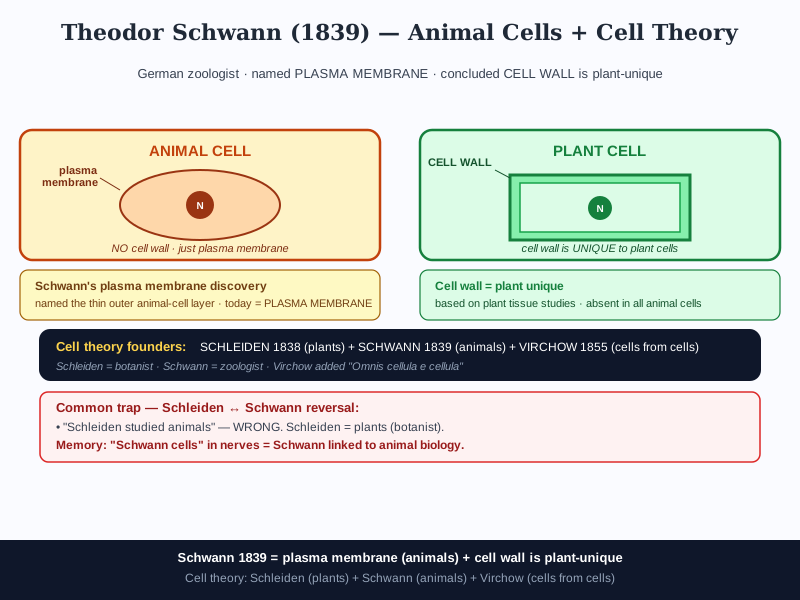
📚 Practice ConceptSchwann (1839), a German Zoologist, studied different types of animal cells and reported that cells had a thin outer layer which is today known as the 'plasma membrane'. He also concluded, based on his studies on plant tissues, that the presence of cell wall is a unique character of the plant cells. On the basis of this, Schwann proposed the hypothesis that the bodies of animals and plants are composed of cells and products of cells.
Schwann's key observation was that ribosomes or centrosomes are unique to plant cells, distinguishing them from animal cells.
Schwann identified the PLASMA MEMBRANE in animal cells and noted that the CELL WALL is unique to plant cells — distinguishing plant from animal cells.
Schwann (1839, zoologist) = animal cells + plasma membrane + 'cell wall = plant unique'. Schleiden (1838, botanist) = plants. Virchow (1855) = cells from cells.
- Theodor Schwann (1839) was a German ZOOLOGIST who studied animal cells.
- Schwann named the thin outer layer of animal cells — the PLASMA MEMBRANE.
- Schwann concluded that the CELL WALL is a unique character of PLANT CELLS (absent in animal cells).
- Cell theory founders: Schleiden (1838, plants) + Schwann (1839, animals) + Virchow (1855, cells from cells).
What differentiates plant cells from animal cells according to Schwann?
View bonus solution & explanation
Correct answer: C — Presence of cell wall
C CORRECT: Schwann (1839), a German zoologist studying animal cells, noted that the CELL WALL is a UNIQUE feature of PLANT CELLS — absent in animal cells. He concluded that bodies of animals and plants are composed of cells and products of cells, and the cell wall distinguishes plants from animals. A WRONG: Ribosomes are universal (present in both plant and animal cells). B WRONG: Mitochondria are present in both (except RBCs). D WRONG: Centrosome is actually unique to ANIMAL cells (absent in higher plants) — but this distinction was NOT Schwann's central observation.
What is Schwann (1839)?
What did NEET previous years ask on Schwann (1839)?
What is the most common NEET trap on Schwann (1839)?
How do you remember Schwann (1839) for NEET?
What are the key components of Schwann (1839)?
Through deep analysis of NEET and NTA, 176 of the 180 ReNEET 2026 (June 21) questions were already in the MedicNEET question bank before the exam.
176/180MedicNEET's Biology question bank is built from the same NCERT lines NTA picks repeatedly. Not random MCQs — questions crafted exactly like NTA crafts them.
You just learned this concept. The free app turns it into a daily goal built from your weak topics and brings it back just before you forget it — using active recall and spaced repetition — so it stays till exam day.