
Types of Placentation — Marginal, Axile, Parietal, Basal, Free Central
✅ Asked in NEET 2023Axile placentation is observed in:
Axile placentation is observed in:
Match the placental types (Column I) with their examples (Column II). Choose the correct answer from the following options: Column I (A) Basal (B) Axile (C) Parietal (D) Free central Column II (i) Mustard (ii) China rose (iii) Dianthus (iv) Sunflower
Match the placental types (Column-I) with examples (Column-II): A. Basal B. Axile C. Parietal D. Free central (i) Mustard (ii) China rose (iii) Dianthus (iv) Sunflower
Placentation, in which ovules develop on the inner wall of the ovary or in peripheral part, is:
Answer & NCERT explanation
Correct answer: C — China rose, Petunia and Lemon
Axile placentation occurs when ovules are attached to central axis in multilocular ovary. China rose (Hibiscus), Petunia (Solanaceae), and Lemon (Citrus) all show this pattern. The ovary is divided by septa and ovules attach to the central column where septa meet, as described in NCERT morphology chapter.
Read more NCERT concept on the PYQ
Placentation: The arrangement of ovules within the ovary is known as placentation. The placentation are of different types namely, marginal, axile, parietal, basal, central and free central. In marginal placentation the placenta forms a ridge along the ventral suture of the ovary and the ovules are borne on this ridge forming two rows, as in pea. When the placenta is axial and the ovules are attached to it in a multilocular ovary, the placentation is said to be axile, as in china rose, tomato and lemon. In parietal placentation, the ovules develop on the inner wall of the ovary or on peripheral part. Ovary is one-chambered but it becomes two-chambered due to the formation of the false septum, e.g., mustard and Argemone. When the ovules are borne on central axis and septa are absent, as in Dianthus and Primrose the placentation is called free central. In basal placentation, the placenta develops at the base of ovary and a single ovule is attached to it, as in sunflower, marigold.
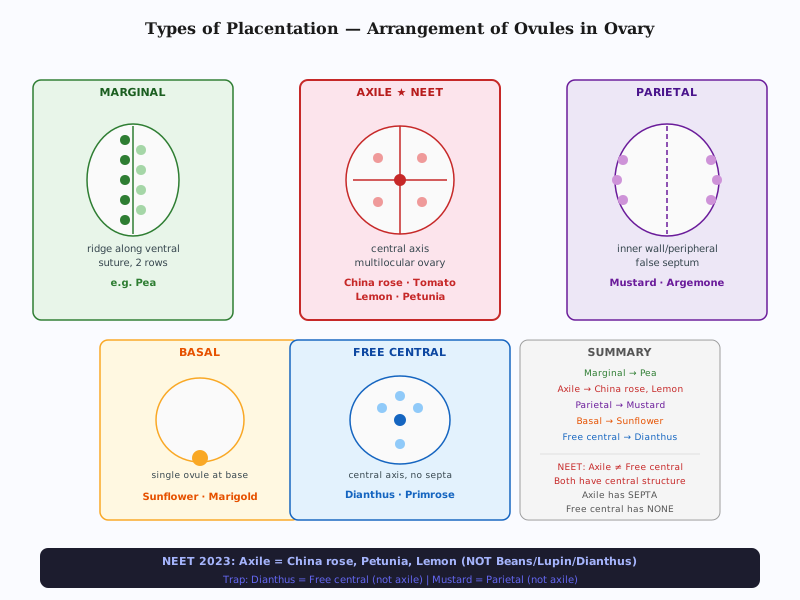
Placentation refers to the arrangement of ovules within the ovary and is a key taxonomic character. NCERT describes six types: Marginal (pea — ovules in two rows along ventral suture), Axile (china rose, tomato, lemon — ovules on central axis in multilocular ovary), Parietal (mustard, argemone — ovules on inner wall, unilocular with false septum), Basal (sunflower, marigold — single ovule at base of ovary), Free central (Dianthus, Primrose — ovules on central column with no septa), and Central. NTA most frequently tests Axile placentation — the correct examples are China rose, Petunia, and Lemon (not Dianthus, which is Free central).
The most tested distinction is Axile vs Free central — students confuse these because both involve a central structure. The key difference: Axile placentation occurs in a multilocular ovary (divided by septa into chambers), with ovules attached to the central axis where septa meet. Free central placentation occurs in a unilocular ovary with a central column but NO septa — the column is free-standing. Dianthus and Primrose are free central. China rose and Lemon are axile. This distinction has appeared in NEET 2019 and 2023.
Dianthus shows axile placentation because it has a central ovule-bearing structure.
Dianthus shows FREE CENTRAL placentation — the central axis has no septa. Axile REQUIRES septa creating multiple chambers.
AXILE = septa present → multilocular. FREE CENTRAL = no septa → unilocular. Both have central axis — septa is the difference.
- Axile examples in NCERT: China rose (Hibiscus), tomato, lemon — all multilocular ovaries.
- Parietal placentation: mustard and Argemone — false septum divides otherwise unilocular ovary.
- Basal placentation: single ovule at base — sunflower and marigold (Asteraceae family characteristic).
- Free central: Dianthus and Primrose — central axis with ovules but absolutely no septa between chambers.
A student observes a cross-section of an ovary showing: a central axis bearing ovules, multiple chambers separated by septa, and no free space between the septum and ovary wall. Which type of placentation is this, and what is the correct set of examples? Which of the following options is CORRECT?
View bonus solution & explanation
Correct answer: B — Axile placentation — China rose, Tomato, Lemon
The description — central axis bearing ovules, multiple chambers separated by septa — is the definition of AXILE placentation. The septa divide the ovary into locules (chambers), and ovules attach to the central axis where septa converge. Examples: China rose (Hibiscus), tomato, lemon. Free central (Dianthus) has no septa. Parietal (mustard) has ovules on the wall. Marginal (pea) has two rows along ventral suture.
What is Types of Placentation?
What did NEET 2023 ask on Types of Placentation?
What is the most common NEET trap on Types of Placentation?
How do you remember Types of Placentation for NEET?
What are the key components of Types of Placentation?
Through deep analysis of NEET and NTA, 176 of the 180 ReNEET 2026 (June 21) questions were already in the MedicNEET question bank before the exam.
176/180MedicNEET's Biology question bank is built from the same NCERT lines NTA picks repeatedly. Not random MCQs — questions crafted exactly like NTA crafts them.
You just learned this concept. The free app turns it into a daily goal built from your weak topics and brings it back just before you forget it — using active recall and spaced repetition — so it stays till exam day.