
Floral Primordium to Androecium and Gynoecium — Pre-Flower Development
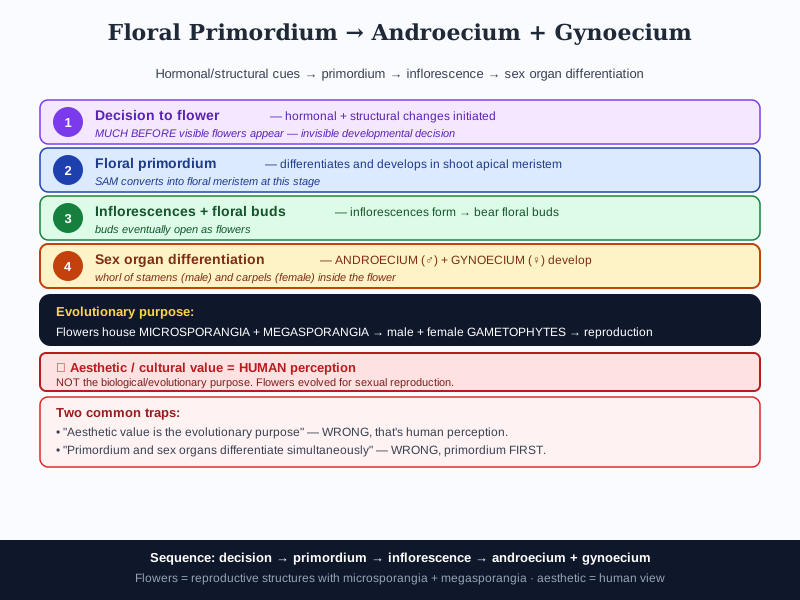
📚 Practice ConceptMuch before the actual flower is seen on a plant, the decision that the plant is going to flower has taken place. Several hormonal and structural changes are initiated which lead to the differentiation and further development of the floral primordium. Inflorescences are formed which bear the floral buds and then the flowers. In the flower the male and female reproductive structures, the androecium and the gynoecium differentiate and develop. You would recollect that the androecium consists of a whorl of stamens representing the male reproductive organ and the gynoecium represents the female reproductive organ.
The aesthetic, ornamental, social, religious and cultural values of flowers are their sole evolutionary purpose in nature.
The EVOLUTIONARY purpose of flowers is REPRODUCTION — they house microsporangia and megasporangia for male and female gametophyte production. Aesthetic value is HUMAN perception.
Floral decision FIRST → primordium → inflorescence → flower with androecium + gynoecium. Reproductive purpose = evolutionary; aesthetic = human.
- Decision to flower precedes visible flower formation — driven by HORMONAL + STRUCTURAL changes.
- Floral primordium → INFLORESCENCES → floral buds → flowers.
- Each flower differentiates ANDROECIUM (whorl of stamens, male) and GYNOECIUM (carpels, female).
- Flowers are reproductive structures housing microsporangia and megasporangia → male + female gametophytes.
Which of the following statements are correct? S1: All angiosperms invariably undergo sexual reproduction as a fundamental process for species continuation. S2: The aesthetic, ornamental, social, religious and cultural values of flowers are their sole evolutionary purpose in nature. S3: To a biologist, flowers are complex structures where microsporangia and megasporangia develop, producing male and female gametophytes. S4: The decision for a plant to flower (hormonal + structural changes) occurs simultaneously with the differentiation of the androecium and gynoecium. S5: Sexual reproduction in flowering plants is critical for creating new variants, enhancing survival advantage — a concept also applicable to human reproduction.
View bonus solution & explanation
Correct answer: A — S1, S3 and S5
S1 CORRECT: All flowering plants show sexual reproduction (NCERT). S2 WRONG: Aesthetic/cultural values are HUMAN PERCEPTIONS — not the biological/evolutionary purpose. The evolutionary purpose is REPRODUCTION. S3 CORRECT: Flowers house microsporangia + megasporangia → male and female gametophytes (NCERT biologist view). S4 WRONG: Floral primordium differentiation PRECEDES androecium/gynoecium differentiation — they don't happen simultaneously. S5 CORRECT: Sexual reproduction generates variants → survival advantage, applicable broadly. Answer A.
What is Floral Primordium to Androecium and Gynoecium?
What did NEET previous years ask on Floral Primordium to Androecium and Gynoecium?
What is the most common NEET trap on Floral Primordium to Androecium and Gynoecium?
How do you remember Floral Primordium to Androecium and Gynoecium for NEET?
What are the key components of Floral Primordium to Androecium and Gynoecium?
Through deep analysis of NEET and NTA, 176 of the 180 ReNEET 2026 (June 21) questions were already in the MedicNEET question bank before the exam.
176/180MedicNEET's Biology question bank is built from the same NCERT lines NTA picks repeatedly. Not random MCQs — questions crafted exactly like NTA crafts them.
You just learned this concept. The free app turns it into a daily goal built from your weak topics and brings it back just before you forget it — using active recall and spaced repetition — so it stays till exam day.